Betting history tracking is the systematic recording of every wager’s key details at the moment of placement, creating a personal performance database that reveals patterns invisible to memory alone. How betting history is tracked determines whether you make decisions based on real data or gut feeling. Tools like BetTracker, BetDiary, and custom spreadsheets each serve different needs, but the discipline behind logging every bet is what separates recreational gamblers from serious sports bettors. This guide breaks down the core data fields, tracking methods, key metrics, and organizational practices that turn raw bet logs into a genuine strategic edge.
What key data fields are essential when tracking betting history?
An effective betting history requires at least 10 key fields tracked consistently over 3–6 months before meaningful patterns emerge. Each field serves a specific analytical purpose, and missing even one creates blind spots in your performance review.
| Field | Analysis purpose |
|---|---|
| Date/time placed | Reveals time-of-day behavioral biases and impulsivity patterns |
| Sport/league | Identifies which markets you perform best in |
| Market type | Separates performance across Asian Handicap, Over/Under, moneyline |
| Selection | Tracks win rate by team, player, or outcome |
| Odds at placement | Baseline for calculating value and CLV |
| Stake | Enables bankroll and unit tracking |
| Sportsbook | Highlights which books offer you better lines |
| Closing odds | Required to calculate Closing Line Value |
| Outcome | Win, loss, push, or void |
| Profit/loss | Net result in currency and units |

The timestamp field deserves special attention. Logging placement time, not game time, uncovers behavioral biases tied to fatigue and impulsivity that game-time logging completely hides. A bet placed at 2 a.m. after a losing streak tells a very different story than one placed at noon after careful research.
Closing odds are equally critical. Without them, you cannot calculate Closing Line Value, which is the single most powerful metric for evaluating whether your bet selection process has a real edge.
How do sports bettors track their betting history?
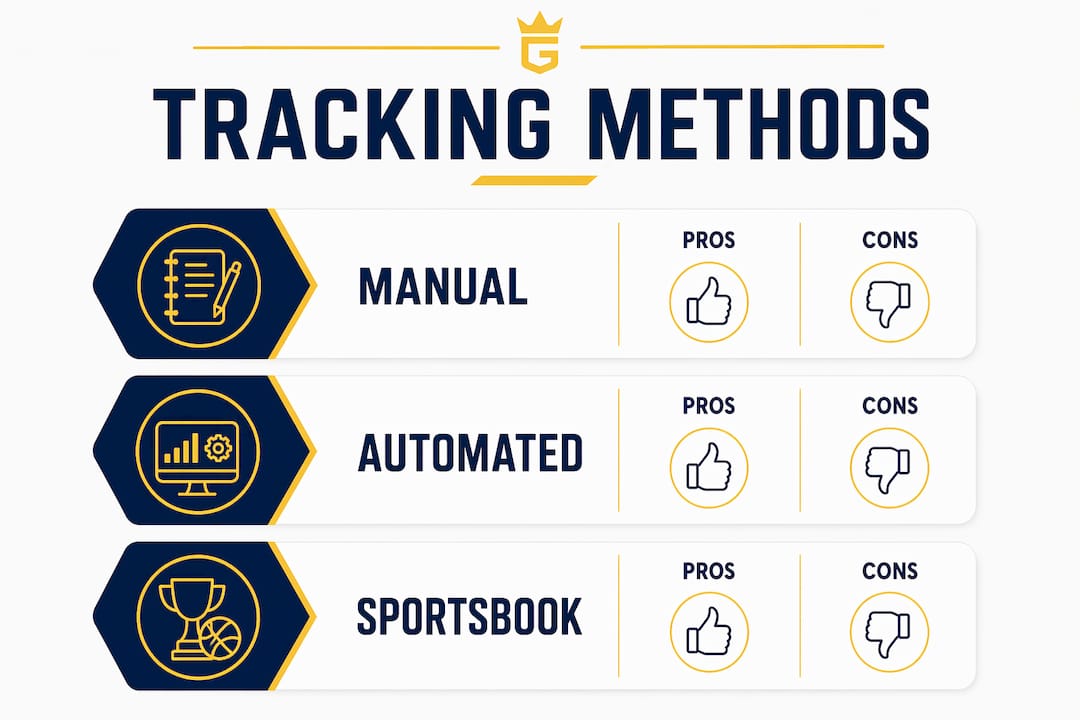
Three primary methods exist for monitoring wagering history: manual spreadsheets, automated apps, and sportsbook-provided history pages. Each has real trade-offs.
| Method | Strengths | Limitations |
|---|---|---|
| Manual spreadsheet | Full customization, free, exportable | Requires consistent manual entry |
| Apps (BetTracker, BetDiary) | Automate calculations, mobile-friendly | Often require paid subscriptions |
| Sportsbook history pages | Always available, no extra setup | Limited fields, no cross-book analysis |
Spreadsheets built in Google Sheets or Microsoft Excel give you complete control over fields, formulas, and visual dashboards. The downside is that every bet requires manual entry, which creates a temptation to skip logging after a bad session. Apps like BetTracker and BetDiary automate ROI calculations and generate performance charts, but their subscription fees add up over time. Sportsbook history pages are convenient but only show your activity on that one platform, making cross-book analysis impossible.
The right choice depends on how deep you want to go. Casual bettors get real value from a simple spreadsheet. Serious bettors who want behavioral analysis and CLV tracking benefit from a dedicated app or a custom database setup.
Pro Tip: Enter every bet immediately after placing it, not at the end of the day. Memory bias causes bettors to unconsciously skip logging losses, which corrupts your entire dataset.
Which metrics can you extract from recorded betting history?
Betting history is a behavioral dataset, not merely a financial record. Tracking loss chase ratio reveals emotional leaks that a simple win/loss record completely hides. Loss chase ratio measures how often you increase your stake after a loss compared to a win. A high ratio signals emotional decision-making, which is one of the most common causes of long-term losses.
The core metrics serious bettors calculate from their logs include:
- Closing Line Value (CLV): The gap between your odds at placement and the closing odds. Sustained positive CLV over 200+ bets is the strongest statistical indicator of a real edge.
- ROI: Net profit divided by total amount staked, expressed as a percentage. Even a 3–5% ROI over hundreds of bets is exceptional.
- Win rate: Percentage of bets that win. Win rate alone is meaningless without knowing your average odds.
- Units won/lost: Standardizes results across different stake sizes for fair comparison.
- Time-of-day analysis: Groups bets by hour to detect fatigue-driven wagering patterns.
CLV deserves its own explanation. The formula is: ((your odds implied probability minus closing odds implied probability) divided by closing odds implied probability) multiplied by 100. A consistently positive CLV means the market moved in your favor after you bet, which proves you are finding value before the sharp money closes the line.
Pro Tip: Do not evaluate your edge after 50 bets. CLV and ROI only become statistically meaningful after 200 or more recorded wagers. Patience with your dataset is part of the discipline.
What are best practices for organizing and managing betting history data?
Treating your bet ledger as a relational database is the most powerful organizational upgrade you can make. Relational database structures link separate tables for users, events, and bets, enabling complex queries that a flat spreadsheet cannot handle. For example, you can cross-reference your results by referee, rest schedule, or specific sportsbook to find edges invisible in a single-table view.
Here are the steps to organize your betting data properly:
- Create separate tables or sheets for bets, events, and bankroll transactions. Never mix them in one flat file.
- Use append-only event logs to record every deposit, withdrawal, and settlement. Append-only logs preserve your bankroll history at every point in time, making auditing accurate.
- Log placement time, not game time. This single change unlocks behavioral analysis that game-time logging cannot provide.
- Export your data regularly to CSV or JSON for backup and for use in analysis tools like Python or Tableau.
- Audit your records monthly by reconciling your logged profit/loss against your actual sportsbook balance. Discrepancies reveal logging errors before they compound.
A common mistake is recording the game’s kickoff time as the bet timestamp. This loses all information about when during the day or week you placed the bet, which is exactly the data you need for behavioral analysis. Fix this habit early, because retroactively correcting timestamps is nearly impossible.
How can you apply betting history insights to improve your strategy?
Your tracked data only creates value when you act on it. Monthly and quarterly performance reviews are the structured habit that turns raw logs into better decisions. Segment your results by sport, bet type, league, and sportsbook to find where your edge is strongest and where you are losing money without realizing it.
Practical ways to apply your data include:
- Identify emotional betting windows. If your ROI drops sharply on bets placed after 10 p.m. or immediately after a losing bet, set a personal rule to stop wagering in those conditions.
- Line shop with evidence. Your sportsbook performance data shows which books consistently offer you better closing odds. Prioritize those books for future wagers.
- Adjust stake sizing by market. If your CLV on Asian Handicap bets is consistently higher than on Over/Under bets, allocate more units to Asian Handicap.
- Recognize loss chasing early. Recording every bet immediately, including losses, creates a paper trail that makes emotional patterns impossible to deny.
The Singapore sports betting guide at Goldbet888 covers how to apply these principles across football markets, including Asian Handicap and Over/Under lines where CLV tracking is especially valuable.
Pro Tip: Set a rule that you will not place a new bet until the previous one is logged. This single habit eliminates memory bias and forces a brief pause that filters out impulsive wagers.
Key takeaways
Betting history tracking works because it converts subjective memory into objective data, and objective data is the only reliable foundation for long-term profitable wagering.
| Point | Details |
|---|---|
| Log 10 core fields | Record date/time placed, odds, stake, sportsbook, closing odds, and outcome for every bet. |
| Use placement timestamps | Log when you placed the bet, not game time, to detect behavioral biases. |
| Track CLV over 200+ bets | Sustained positive Closing Line Value is the strongest proof of a real betting edge. |
| Treat data as a database | Organize bets, events, and bankroll in linked tables for deeper cross-market analysis. |
| Review and act quarterly | Segment results by sport, bet type, and sportsbook to find where your edge is strongest. |
Why most bettors are sitting on a goldmine they never open
I have reviewed hundreds of bet logs over the years, and the pattern is always the same. The bettors who struggle most are not the ones making bad picks. They are the ones who have no idea which picks are bad because they never looked. They keep a rough mental tally of wins and losses, convince themselves they are “up overall,” and never confront the actual numbers.
The moment you start logging every bet, including the ones you are embarrassed about, something shifts. You stop seeing yourself as lucky or unlucky and start seeing yourself as a process. That process either has an edge or it does not, and the data tells you which one is true.
What surprised me most when I started tracking behavioral metrics was how much the time-of-day data revealed. My late-night bets had a dramatically worse ROI than my afternoon bets, even though the selections felt equally confident at the time. That single insight was worth more than any tipster subscription I had ever paid for.
The emotional control that comes from disciplined tracking is underrated. When you know your CLV is positive over 300 bets, a five-game losing streak does not shake your confidence. You know the math is working even when the short-term results are not. That kind of confidence is only possible when you have the data to back it up.
Treat your betting history as a personal performance database. Review it honestly. Act on what it tells you. The bettors who do this consistently are the ones who are still betting profitably two years from now.
— Jaye
Put your tracked insights to work with Goldbet888

You have the framework. Now you need a platform where those insights translate into real results. Goldbet888 offers live sports betting with competitive odds across football, Asian Handicap, and Over/Under markets, giving you the line quality your CLV tracking demands. With reported withdrawals processed in three minutes and a community of 5,000+ Telegram members sharing match previews, Goldbet888 is built for bettors who take their data seriously. Check the latest current promotions to maximize the value of every wager you log.
FAQ
What does betting history tracking mean?
Betting history tracking is the systematic recording of every wager’s key details, including odds, stake, sportsbook, and outcome, at the time of placement to enable performance analysis.
What is the most important metric in a betting log?
Closing Line Value (CLV) over a sample of 200 or more bets is the strongest indicator of a bettor’s true edge, outperforming simple win/loss records.
What is the best tool for tracking betting history?
Manual spreadsheets in Google Sheets or Microsoft Excel offer free, fully customizable tracking. Apps like BetTracker and BetDiary automate calculations but typically require paid subscriptions.
Why does placement time matter more than game time?
Logging placement time reveals behavioral biases like late-night impulsivity and post-loss chasing that game-time logging completely misses.
How long should I track bets before drawing conclusions?
Track at least 200 bets over 3–6 months before evaluating your edge. Smaller samples produce misleading results due to normal variance in sports betting outcomes.