A betting prediction is a calculated forecast about the likely result of a sports event, designed to inform wagering decisions. Bettors, tipsters, and prediction markets all produce these forecasts using data ranging from team form to injury reports. The industry term you will encounter most often is “sports betting forecast,” though “betting prediction” is the phrase most bettors search for and use daily. Understanding what separates a quality prediction from a casual guess is the single most important skill you can develop as a bettor. Goldbet888 breaks it down clearly so you can bet with confidence, not guesswork.
What is a betting prediction and how does it work?
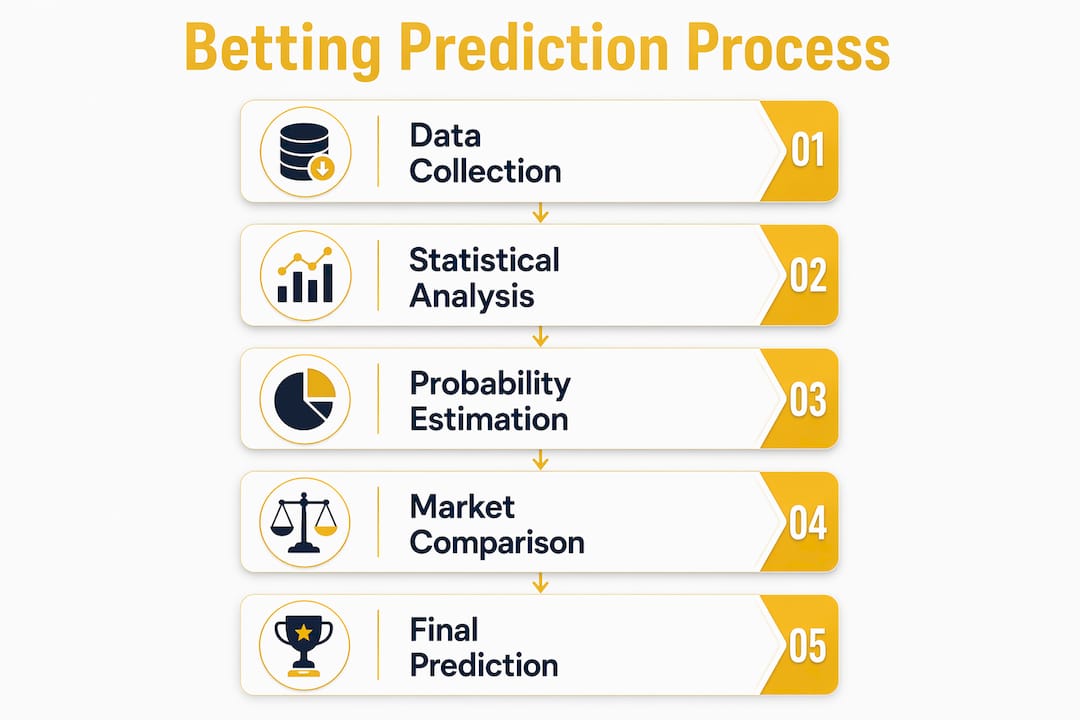
A betting prediction is a structured forecast of a sports event’s outcome, built on data rather than instinct. It differs from a random guess because it draws on measurable inputs: team form, head-to-head records, player availability, and statistical models. The goal is to estimate the probability of an outcome more accurately than the odds a sportsbook offers.

Predictions sit at the foundation of every informed wager. When you place a bet, you are essentially saying your probability estimate is better than the bookmaker’s implied probability. A betting prediction only creates value when your forecast is more accurate than the price on offer.
The concept of probability is central here. If you believe a team has a 60% chance of winning but the sportsbook’s odds imply only a 45% chance, you have identified a potential edge. That gap between your estimate and the bookmaker’s price is where profit lives over the long run.
How are betting predictions created?
Quality betting predictions rely on multiple data sets, including current team and player form, injury reports, historical trends, and advanced statistical modeling. Professional tipsters devote significant time to data aggregation and refining models to improve prediction accuracy. The difference between a casual guess and a professional forecast is the depth of that research process.
The core data inputs for a well-built prediction include:
- Team form: Recent results across the last five to ten matches, accounting for home and away splits
- Injury and suspension reports: Missing key players can shift win probability by a meaningful margin
- Head-to-head history: Some teams consistently underperform or overperform against specific opponents
- Statistical models: Expected goals (xG), possession metrics, and defensive pressure ratings add objectivity
- Situational factors: Fixture congestion, travel distance, and weather conditions all affect performance
Pro Tip: Never rely on a single data point. A team may have strong recent form but face a historically dominant opponent. Cross-referencing at least three independent data sources produces a more reliable forecast.
The process of using statistics in betting separates disciplined bettors from recreational ones. Recreational bettors often anchor on the most recent result. Professional forecasters weight a broader sample and adjust for context, such as whether a team was resting key players in a low-stakes fixture.
What distinguishes a betting tip from a betting prediction?
A betting prediction and a betting tip are related but not identical. A prediction is a probability estimate. A betting tip is a recommendation that adds a value assessment on top of that estimate. The tip tells you not just what is likely to happen, but whether the odds make it worth betting.
| Feature | Betting prediction | Betting tip |
|---|---|---|
| Core function | Forecasts an outcome | Recommends a wager |
| Value assessment | Not always included | Always included |
| Source | Models, analysts, markets | Tipsters, expert analysts |
| Actionability | Informational | Directly actionable |
| Risk signal | Probability estimate | Confidence-weighted pick |
Tipsters use a concept called the “NAP” to signal their highest-confidence pick of the day. NAP picks can carry win rates of 25–35% with varying return on investment depending on starting price. That range might sound low, but a 30% win rate at generous odds can still produce a positive return over a large sample.
The key distinction for you as a bettor is this: a prediction tells you what might happen. A tip tells you whether it is worth betting on. Both are useful, but a tip without reasoning behind it is no better than a prediction without value context. Always ask why a tipster recommends a selection, not just what they recommend.
A free betting tip, sometimes called a free bet tip, carries the same structure as a paid tip. The difference is access, not methodology. Free tips from credible sources still incorporate form analysis, injury data, and odds assessment.
How do prediction markets work?
Prediction markets function as peer-to-peer exchange-traded platforms with contracts priced between 1 cent and $1, reflecting real-time probability estimates determined by supply and demand. A market price of 33 cents signals a 33% consensus probability of event occurrence. That differs from bookmaker odds, which include a house margin built into the price.
| Feature | Prediction market | Traditional sportsbook |
|---|---|---|
| Price mechanism | Supply and demand | Bookmaker-set with margin |
| House edge | Minimal (exchange fee) | Built into every price |
| Probability signal | Direct (price = probability) | Implied (requires calculation) |
| Liquidity | Varies by market size | Generally high |
Prediction market efficiency arises from financial incentives that remove bias and force honest forecasting. Professor Eric Zitzewitz notes that anonymity and financial commitment push participants to reveal their true beliefs, which enhances market accuracy. The crowd’s collective judgment, weighted by money, often outperforms individual expert predictions.
That said, prediction markets are not perfect. Price movements sometimes reflect herd behavior or noise trading rather than genuine new information. Short-term distortions can appear when a large participant moves the market without a fundamental reason. Experienced bettors treat these distortions as potential opportunities rather than signals to follow.
Pro Tip: When a prediction market price moves sharply without obvious news, check injury reports and team announcements. Informed money often moves markets before public information catches up.
How can bettors use predictions to improve their strategy?
Betting predictions work best as research inputs, not as sole decision drivers. The most effective approach integrates predictions with your own analysis and a clear understanding of odds value. Here is a structured process that works:
Start with the prediction. Identify the most likely outcome using form data, statistical models, and expert forecasts. This gives you a probability baseline.
Assess the odds for value. Winning predictions alone do not guarantee profit. Success depends on odds offering positive expected value. A +200 odd means a $100 bet nets $200 profit plus the original stake if the prediction wins. Compare your estimated probability against the implied probability in the odds.
Check the tipster’s reasoning. Expert tipsters caution against blind reliance on tips. Use a NAP selection as a starting point, then validate it with your own research before committing your bankroll.
Apply bankroll discipline. Never stake more than a fixed percentage of your total bankroll on a single prediction, regardless of confidence level. A standard approach is 1–5% per wager.
Track your results. Record every prediction you act on, the odds, the stake, and the outcome. Reviewing this log over 50 or more bets reveals whether your prediction process is generating genuine edge or just variance.
The value identification checklist approach is particularly useful for football bettors. It forces you to confirm that each wager meets a minimum value threshold before you place it, which removes emotion from the decision.
Avoiding the trap of blind tip following is critical. Even the best tipsters have losing runs. If you follow tips without understanding the reasoning, you will abandon a sound strategy during a normal losing streak, which is the worst time to quit.
Key Takeaways
A betting prediction only creates real value when your probability estimate is more accurate than the odds a sportsbook or prediction market offers.
| Point | Details |
|---|---|
| Prediction vs. tip | A prediction forecasts an outcome; a tip adds a value assessment and recommends action. |
| Data drives accuracy | Form, injuries, head-to-head records, and statistical models all improve forecast quality. |
| Prediction markets | Prices reflect collective probability estimates and often outperform individual expert forecasts. |
| Value over winners | Winning predictions without positive expected value do not produce long-term profit. |
| Independent judgment | Always validate tips with your own analysis before committing your bankroll. |
Why I trust the process more than the pick
Jaye here. After years of watching bettors chase tips without understanding them, the pattern is always the same. A bettor finds a tipster with a strong recent run, follows every pick blindly, then abandons ship the moment a losing streak hits. The problem was never the tipster. The problem was the bettor never understood why the picks were made.
The most reliable bettors I have seen treat predictions like a weather forecast. A 70% chance of rain does not mean it will rain. It means the data supports rain more often than not. You still decide whether to carry an umbrella based on your own read of the situation.
What actually builds long-term results is reading match analysis before every wager, not just the final tip. When you understand the reasoning, you can judge whether the tip still holds if circumstances change, like a late team news update. That judgment is what separates bettors who last from those who burn out after one bad month.
— Jaye
Goldbet888 gives you the edge before kickoff
Goldbet888 is built for football bettors who want more than just odds. The platform combines live sports odds with expert match previews, Asian Handicap analysis, and Over/Under breakdowns across major tournaments including the FIFA World Cup 2026.

The Goldbet888 Telegram community of 5,000+ members shares real-time insights and match previews before every major fixture. Withdrawals are processed in as little as three minutes, so your winnings move fast. Whether you are placing your first prediction-based wager or refining a system you have used for years, Goldbet888 provides the analysis and markets to back your decisions with confidence.
FAQ
What is a betting prediction in simple terms?
A betting prediction is a forecast of a sports event’s likely outcome, based on data such as team form, injuries, and statistical models. It helps bettors estimate probability before placing a wager.
What is the difference between a betting tip and a prediction?
A prediction estimates what will happen. A tip recommends whether to bet on it, adding a value assessment based on whether the odds offer positive expected value.
What is a NAP in betting tips?
A NAP is a tipster’s highest-confidence pick of the day. NAP selections carry no guarantee of winning, so bettors should validate them with independent research before wagering.
How do prediction markets differ from sportsbooks?
Prediction markets price contracts between 1 cent and $1 based on supply and demand, making the price a direct probability estimate. Sportsbook odds include a house margin, so the implied probability is always slightly lower than the true estimate.
What is betting tip accuracy rate?
Betting tip accuracy rate measures the percentage of tips that result in a winning outcome. A rate of 25–35% can still be profitable if the average winning odds are high enough to generate positive expected value over a large sample.