Late team news is defined as any player injury, lineup change, or coaching decision confirmed within hours of kickoff that forces sportsbooks to reprice their betting markets. Understanding why late team news shifts odds is the single most valuable edge a football bettor can develop. Sportsbooks use automated real-time systems to recalibrate lines within seconds of a major announcement, and a single injury report can move a point spread by two or more points within minutes. That speed creates both risk and opportunity for bettors who know how to read the market.
Why late team news shifts odds so fast
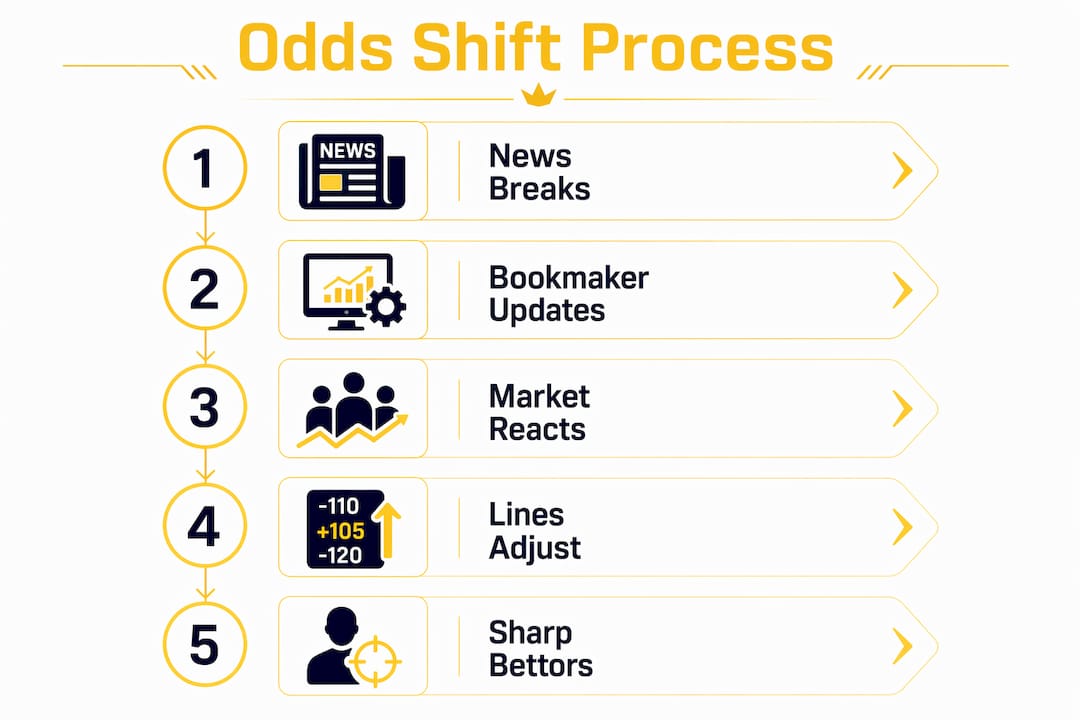
The mechanics behind odds movement are not mysterious. Sportsbooks run automated algorithms that scan credible real-time data streams continuously, recalibrating lines in under a minute to prevent exploitable gaps. The moment a confirmed injury or surprise lineup drops, those systems trigger immediate price changes across all related markets, from match result to Asian Handicap to Over/Under totals.
The scale of movement depends on the player’s role. Quarterback absences shift spreads by more than seven points in American football. In football (soccer), the absence of a first-choice goalkeeper or a team’s primary creative midfielder produces comparable volatility. The market is essentially repricing the team’s win probability from scratch.

Sportsbooks also move lines to limit exposure to sharp bettors who identify mispriced lines faster than the general public. This is not a passive process. Bookmakers actively balance their book by adjusting prices until incoming money on both sides reaches equilibrium. The result is that odds reflect dynamic market prices balancing bookmaker risk and public behavior, not absolute game predictions.
| Trigger type | Typical odds movement | Speed of adjustment |
|---|---|---|
| Star player ruled out | 2–7+ points on spread | Seconds to minutes |
| Key player listed as questionable | 0.5–2 points | Minutes to hours |
| Surprise tactical lineup change | 0.5–1.5 points | Minutes |
| Rotational player absence | Minimal or none | Slow or no move |
Pro Tip: Track odds movement on a match before any official announcement. A sudden line shift with no public news often signals that sharp bettors have already acted on insider information, which is a strong signal worth noting.
How market psychology causes odds to overcorrect
Public bettors react emotionally to headline injuries. That emotional response drives lines further than the actual performance reduction justifies. Emotional reactions exaggerate injury impact, and sportsbooks often price this in deliberately, anticipating a flood of recreational money on the “obvious” side.
The result is an overcorrected line. A team loses its second-best striker, and the market treats it like a catastrophic collapse. In reality, the backup may be a capable replacement, and the tactical system barely changes. The line moves three points when the true impact warrants one.
Savvy bettors exploit this gap by doing three things:
- Waiting for the initial panic to settle. The first 15–30 minutes after a major injury announcement are the most volatile and least reliable for finding value.
- Assessing backup quality independently. A “ruled out” designation means nothing without knowing who steps in and how the team’s depth holds up.
- Comparing the new line to pre-news implied probability. If the shift exceeds what the player’s actual statistical contribution justifies, the overcorrection is real.
- Watching for line reversal. When sharp money comes back the other way after an initial move, the market is self-correcting. That reversal is your signal.
“Experienced bettors distinguish meaningful tactical or structural team news from public noise and emotional market movements to find value. The bettor who waits 20 minutes and thinks clearly will almost always find a better number than the one who reacts in the first 60 seconds.”
This principle applies directly to football odds value. The bettor who understands market psychology holds a structural edge over the one who simply reacts to headlines.
How to read injury reports and team news for betting value
Not all late team news carries equal weight. The impact of late team news depends entirely on the player’s role, the quality of the replacement, and the accuracy of the source. Treating every injury update as equally significant is one of the most common and costly mistakes recreational bettors make.
Start with the designation itself:
- Ruled out means the player will not participate. This is confirmed and priced in quickly. The question becomes whether the market has overreacted or underreacted based on backup quality.
- Questionable means the player’s participation is uncertain. Misinterpreting this classification leads to market inefficiencies. A player listed as questionable who has a history of playing through similar issues is very different from one who has never done so.
- Probable means the player is expected to play. Markets rarely move significantly on a “probable” tag, but a late downgrade from probable to questionable can trigger sharp movement.
Positional value matters enormously. A goalkeeper absence in football reshapes the entire defensive structure and directly affects Over/Under markets. A rotational midfielder missing a match barely registers. Injury classification cadence in structured leagues like the NFL provides a weekly analytical framework, but football bettors must rely on press conferences, training ground reports, and official club announcements.
Pro Tip: Sharp bettors monitor press conference phrasing carefully. “Available but not fully ready” is very different from “will not feature.” That distinction often separates a mispriced line from a correctly priced one.
Source reliability is non-negotiable. A rumor on social media carries zero betting value. A confirmed club statement or a direct quote from the head coach carries maximum weight. Distinguishing rumor from confirmed news is a skill that separates disciplined bettors from reactive ones.
Strategies to capitalize on odds shifts from late team news
The biggest mistake recreational bettors make is rushing to bet immediately after news breaks. By the time you read the headline, the automated systems have already moved the line. Betting into a freshly adjusted price often means accepting the worst possible number.
The better approach follows a clear sequence:
- Monitor odds before news drops. Odds often move before official confirmation because sharp bettors act on rumors and insider information ahead of public media. A line moving without an obvious reason is worth investigating.
- Wait for line stabilization. After the initial adjustment, the market often overshoots and then corrects. The stabilized line, typically 20–40 minutes after the news cycle peaks, reflects a more accurate consensus.
- Use market movement as a signal. When sportsbooks overprice lines after marquee injuries to attract emotional bettors, the corrected odds shortly after represent genuine value.
- Focus on markets beyond match result. Late team news affects Over/Under totals and Asian Handicap lines differently than the match winner market. A key attacker ruled out may not change the winner odds dramatically but will shift the goals total significantly.
- Build a monitoring routine. Set alerts for official club channels, follow credible journalists who cover your target leagues, and check odds movement on multiple markets simultaneously.
The Over/Under betting strategy is particularly responsive to late team news. A defensive midfielder ruled out can open up a match; a prolific striker’s absence can close it down. These shifts in game dynamics show up in totals markets before they fully register in the match result price.
Pro Tip: Compare the Asian Handicap line before and after a major team news announcement. The handicap market is often slower to correct than the match result market, giving you a brief window to find value on the updated team context.
Key Takeaways
Late team news shifts betting odds because sportsbooks must reprice risk instantly, and bettors who understand timing, player value, and market psychology consistently find better numbers than those who react on instinct.
| Point | Details |
|---|---|
| Automated systems move fast | Odds recalibrate within seconds of confirmed news, so early reaction rarely beats the market. |
| Overcorrections create value | Emotional public betting pushes lines further than justified, creating opportunities for patient bettors. |
| Designation matters | “Ruled out,” “questionable,” and “probable” each carry different market implications and betting value. |
| Backup quality is underrated | The replacement player’s ability often determines whether the market’s reaction is accurate or excessive. |
| Timing is the real edge | Waiting for line stabilization after the initial panic consistently produces better entry points. |
What I’ve learned about betting on late news after years of watching markets move
The conventional wisdom says “act fast on breaking news.” I’ve found the opposite is almost always true. The bettors who consistently find value are the ones who slow down when everyone else speeds up.
The market’s first reaction to a major injury is almost never its most accurate one. Recreational money floods in on the obvious side, the line overshoots, and then sharp money quietly corrects it. The bettor who waits for that correction, who checks backup quality and reads the press conference transcript instead of the tweet, ends up with a meaningfully better number.
What I’ve also noticed is that late team news betting strategy is really about information quality, not information speed. You cannot outrun an automated algorithm. You can outthink the emotional crowd that feeds it bad signals. That means building a disciplined process: reliable sources, a clear framework for assessing player impact, and the patience to let the market settle before committing.
The bettors who treat odds as a reflection of market psychology rather than objective truth are the ones who find consistent edges. Understanding how team news affects betting tips is the foundation. Applying that understanding with patience and discipline is the actual skill.
— Jaye
Goldbet888 keeps you ahead of the market
Goldbet888 updates its football odds in real time, so when late team news drops before a World Cup 2026 match, you see the adjusted lines immediately. That speed matters when the window for value closes in minutes.

The platform’s 5,000+ member Telegram community shares match previews, lineup updates, and injury alerts before kickoff, giving you the context to act with confidence rather than guesswork. Goldbet888 also offers in-depth guides on Asian Handicap betting and Over/Under strategy, so you can apply the frameworks from this article directly to live markets. Check the live odds platform and see how fast the lines move when the team news hits.
FAQ
Why do betting odds change after a player injury?
Sportsbooks reprice odds after a player injury to reflect the team’s updated win probability and to rebalance their exposure. Automated systems trigger these adjustments within seconds of confirmed news.
How much can late team news move a betting line?
A single major injury can shift a point spread by two or more points within minutes, with star player absences causing moves exceeding seven points in some cases.
Should I bet immediately when injury news breaks?
Betting immediately after news breaks is rarely the best approach. Sportsbooks have already adjusted the line, and the initial market reaction often overshoots before correcting to a more accurate price.
What is the difference between “questionable” and “ruled out” in betting?
“Ruled out” means the player is confirmed absent and the market prices this in quickly. “Questionable” signals uncertainty, and misreading this tag is a common source of market inefficiency that disciplined bettors can exploit.
How do sharp bettors use late team news differently?
Sharp bettors monitor odds movement before official announcements, act on confirmed information rather than rumors, and wait for line stabilization to find value after the public’s emotional reaction has pushed prices too far.