Online sports betting is the act of wagering money through a licensed internet sportsbook on the outcome or events inside a sporting contest. Whether you’re picking a moneyline winner or building a multi-leg parlay, the core mechanic is always the same: you stake real money, the odds determine your payout, and the result of the event settles the bet. The single most important thing to know before you place your first wager: legality hinges entirely on your state’s licensing framework, and you must be physically located inside a legal jurisdiction when you bet. State gaming commissions, the Unlawful Internet Gambling Enforcement Act of 2006 (UIGEA), and the landmark Murphy v. NCAA Supreme Court ruling together form the legal backbone of U.S. sports betting. The beginner betting guide at Goldbet888 is one resource worth bookmarking as you get started.
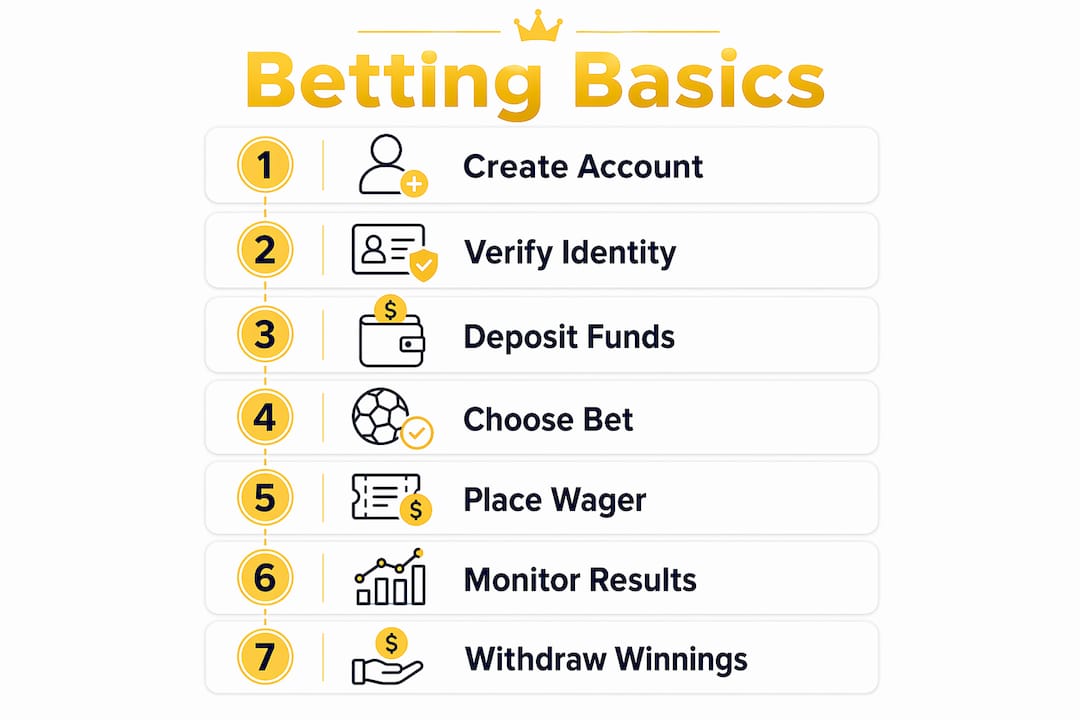
Table of Contents
- What is online sports betting, and how do sportsbook platforms work?
- Common bet types every beginner should know
- How to read American odds (and why the format matters)
- How sportsbooks make money: the vig explained
- How to place your first online sports bet in the U.S.
- Is online sports betting legal in the United States?
- Risks, bankroll basics, and responsible gambling
- Taxes and recordkeeping for U.S. bettors
- Key Takeaways
- The case for starting small and staying curious
- Goldbet888: live odds, expert guides, and a community built for bettors
- Useful sources and further reading
What is online sports betting, and how do sportsbook platforms work?
Online sports betting platforms act as regulated intermediaries between bettors and the markets. They set odds, accept wagers, manage accounts, and pay out winners. Here’s what happens under the hood.

Account creation and KYC
Before you can bet a single dollar, you need a verified account. Sportsbooks are legally required to confirm your identity, age, and location. KYC verification typically requires:
- A government-issued photo ID (driver’s license or passport)
- Your Social Security number (last four digits or full, depending on the platform)
- Proof of address in some cases (utility bill or bank statement)
- Confirmation that you are at least 21 years old in most U.S. jurisdictions
Most platforms complete KYC within minutes, though some take up to 24 hours if documents need manual review.
How odds and lines are set
Oddsmakers, sometimes called traders or lines managers, set the opening price for each event based on statistical models, injury reports, historical data, and market intelligence. Once a line goes live, it moves in response to betting volume and new information. If heavy money comes in on one side, the book adjusts the price to balance its exposure.

The bet slip: stake vs. payout
When you select a market, it drops into your bet slip. You enter your stake (the amount you’re risking), and the slip instantly calculates your potential payout based on the odds. Payout includes your original stake returned plus your profit. Confirm the slip and the bet is live.
In-play (live) betting
In-play betting lets you wager while the event is happening. Odds update in real time based on the score, time remaining, and momentum. It’s fast-moving and exciting, but it also demands quicker decisions. Many platforms also offer a Cash Out feature that lets you lock in a partial profit or cut losses before the final whistle.
The user journey on a sportsbook
- Browse available sports and events
- Select a market (e.g., moneyline, spread, total)
- Add it to your bet slip
- Enter your stake
- Review the potential payout
- Confirm the bet
Pro Tip: Enable location services on your device before you try to place a bet. Sportsbooks use geolocation software to verify you’re physically inside a licensed state. If your GPS is off or blocked, the platform will reject your wager entirely.
Common bet types every beginner should know
Knowing the bet types before you fund an account saves you from confusion at the worst moment. Here are the markets you’ll see on every U.S. sportsbook.
Moneyline
The simplest bet: pick who wins. Odds are expressed in American format.
- Example: Kansas City Chiefs -150 vs. Las Vegas Raiders +130. A $150 bet on the Chiefs wins $100 profit (plus your $150 back). A $100 bet on the Raiders wins $130 profit if they pull the upset.
Point spread
The spread levels the field between a favorite and an underdog by assigning a margin.
- Example: Chiefs -6.5 vs. Raiders +6.5. If you bet the Chiefs, they must win by 7 or more for your bet to win. If you bet the Raiders, they can lose by up to 6 and you still cash. A Chiefs win by exactly 6.5 is impossible (half-points prevent a tie), but if the spread were a whole number and the margin matched exactly, the bet would be a push and your stake is refunded.
Totals (over/under)
You’re not picking a winner. You’re betting on whether the combined score goes over or under a set number.
- Example: Total set at 47.5. Bet the over, and you need 48 or more combined points. Bet the under, and you need 47 or fewer.
Parlays
A parlay chains two or more bets together. All legs must win for the parlay to pay out. The upside: payouts multiply dramatically. The downside: one loss kills the whole ticket.
- Example: Three moneyline favorites each priced at -110. Individually, each pays roughly even money. Combined in a parlay, a $10 bet can return around $60 or more, depending on exact odds. Miss one leg and you lose the $10.
Props and futures
Prop bets focus on individual player or team statistics within a game (e.g., a quarterback throwing for over 275.5 yards). Futures are long-range bets on season-level outcomes, like which team wins the Super Bowl or which player wins MVP. Futures can offer big value early in a season, but your money is tied up until the market settles.
Pro Tip: Beginners are best served starting with moneyline and totals bets. They’re the easiest to evaluate and the easiest to track. Save parlays and props for when you have a feel for how lines move.
How to read American odds (and why the format matters)
American odds are the default format on every U.S. sportsbook. Once you understand the two-sign system, reading any line takes about two seconds.
Positive odds (+): the underdog price
A + number tells you how much profit you’d make on a $100 bet.
- +130 means a $100 wager returns $130 profit, so $230 total back.
- Implied probability: divide 100 by (100 + 130) = 100/230 = 43.5% chance of winning per the market.
Negative odds (−): the favorite price
A − number tells you how much you must risk to win $100 profit.
- -150 means you stake $150 to win $100 profit, so $250 total back.
- Implied probability: divide 150 by (150 + 100) = 150/250 = 60% chance of winning per the market.
Decimal and fractional formats
Some platforms let you toggle the display format.
| Format | Example | How to read it |
|---|---|---|
| American | +130 | Profit on $100 stake (underdog) |
| Decimal | — | Multiply stake × — for total return |
| Fractional | — | Win $13 for every $10 staked |
All three formats describe the same price. Decimal is common in Europe; fractional is standard in the UK. American is what you’ll see on U.S. sportsbooks by default.
Pro Tip: Before you place a bet, check the same line on two or three licensed books. Even a small difference, say +125 vs. +130 on the same side, adds up meaningfully over dozens of bets. Goldbet888’s odds comparison guide walks through exactly how to spot the better price.
How sportsbooks make money: the vig explained
Sportsbooks don’t need to predict game outcomes perfectly. They build a margin into every price, and that margin, called the vig, juice, or overround, is how they profit regardless of who wins.
A simple worked example
Imagine a coin-flip game. A fair price for each side would be +100 (even money). A sportsbook instead prices both sides at -110.
- Bettor A wagers $110 on Team X at -110.
- Bettor B wagers $110 on Team Y at -110.
- Total pool: $220. The winner collects $210 ($110 stake + $100 profit).
- The book keeps $10 regardless of the outcome.
That $10 on a $220 pool is roughly a 4.5% margin. Over thousands of bets, that margin compounds into significant revenue for the house.
Why line shopping matters
Small differences in odds across multiple licensed sportsbooks compound over time. A bettor who consistently finds +130 instead of +125 on the same side is capturing real value. Holding accounts at several books to secure the best available price is one of the simplest, highest-impact habits a bettor can build.
Pro Tip: Think of the vig the way you think of a currency exchange fee. You can’t avoid it entirely, but you can minimize it by finding the best rate. Comparing lines across licensed books before every bet is the closest thing to a free edge in sports betting.
How to place your first online sports bet in the U.S.
The betting process follows a clear sequence. Here’s the full walkthrough, including what to expect at each stage.
Step-by-step checklist
- Verify your state allows online betting. Check your state gaming commission’s website or the sportsbook’s licensing page. Not every state has legalized online wagering.
- Choose a licensed sportsbook. Look for a state gaming commission license number displayed on the site. Avoid any platform that doesn’t show licensing information.
- Create your account. Provide your name, address, date of birth, email, and Social Security number (partial or full, depending on the platform).
- Complete KYC. Upload a government-issued ID. Most platforms verify within minutes; some take up to 24 hours.
- Make a deposit. Common methods include debit card, credit card (where accepted), ACH bank transfer, PayPal, Venmo, or a sportsbook-branded prepaid card. Minimum deposits typically start at a low amount appropriate for most beginners.
- Place your bet. Browse markets, select your line, add it to the bet slip, enter your stake, and confirm.
- Track settlement. Bets settle within minutes of the event ending for most markets. Futures settle at season’s end.
- Request a withdrawal. Use the cashier section. Processing times vary by method.
Typical timelines and payment notes
| Step | Typical timeframe | Notes |
|---|---|---|
| KYC verification | Minutes to 24 hours | Manual review may delay approval |
| Debit card deposit | Instant | Most widely accepted method |
| ACH bank transfer | 1–3 business days | Lower fees, higher limits |
| E-wallet deposit (PayPal, Venmo) | Instant | Not available on all platforms |
| Withdrawal (e-wallet) | 24 hours or more | Fastest withdrawal route on most books |
| Withdrawal (bank transfer) | 3–5 business days | Standard for larger amounts |
Sign-up bonuses can look attractive, but read the fine print. Bonus funds typically carry playthrough or rollover requirements, meaning you must wager a multiple of the bonus amount before any of it converts to withdrawable cash. Bonuses often carry playthrough or rollover requirements that must be met before bonus funds convert to withdrawable cash.
Pro Tip: Open accounts at two or three licensed sportsbooks from the start, not just one. You’ll be able to line-shop every bet and take advantage of separate welcome offers. The extra five minutes of setup pays off quickly.
Is online sports betting legal in the United States?
The short answer: it depends on your state. Federal law no longer blocks it, but each state decides whether to allow it, and the rules vary widely.
The federal framework
The Murphy v. NCAA Supreme Court ruling in 2018 struck down the Professional and Amateur Sports Protection Act (PASPA), which had effectively banned state-authorized sports betting outside Nevada. After that decision, states gained the authority to legalize and regulate sports betting on their own terms. The Federal Wire Act of 1961 still applies to interstate wire communications for gambling purposes, but it does not create a blanket federal ban on state-licensed online betting within a state’s borders.
Where online betting is available
Online sports betting is available in 34 states as of recent summaries, though that number continues to shift as new states pass legislation. States with active, widely available online markets include New Jersey, Pennsylvania, Colorado, Michigan, Illinois, and New York, among others. In some states that have legalized sports betting, wagering is restricted to in-person retail sportsbooks only.
To confirm your state’s current status:
- Visit your state gaming commission’s official website
- Check the licensing section of any sportsbook you’re considering
- Review state-specific guides from sources like PlayUSA or CBS Sports
Warning: Do not attempt to bypass geolocation restrictions using a VPN or by falsifying your location. Sportsbooks use geolocation enforcement to verify you’re physically inside a licensed state. VPNs are typically detected, and any bet placed outside the licensed jurisdiction will be blocked or voided. Attempting to circumvent these controls can result in account suspension.
Pro Tip: If you travel frequently, check whether your destination state has legalized online betting before you try to place a wager. Your home-state account won’t work from a state where online betting isn’t legal, even if your account is in good standing.
Risks, bankroll basics, and responsible gambling
Sports betting is entertainment. Treating it as a reliable income source is one of the fastest paths to financial and emotional trouble. The research is clear on this, and every licensed sportsbook in the U.S. is required to offer responsible-gambling tools.
Bankroll basics
- Set a dedicated bankroll. Only bet money you can afford to lose entirely. A common starting point for beginners is $100–$200.
- Use flat unit sizing. Bet the same amount per wager, typically 1–5% of your total bankroll. On a $200 bankroll, that’s $2–$10 per bet.
- Never chase losses. Increasing your stake after a losing run to “get even” is one of the most common and damaging behavioral patterns in gambling.
- Set a win target and a loss limit per session. Decide in advance when you’ll stop, whether you’re up or down.
Beginners benefit most from treating early bets as an education, not a profit center. Small, flat-unit wagering reduces emotional decisions and keeps the experience sustainable.
Behavioral risk signals
Watch for these patterns in yourself:
- Betting more than you planned to recover losses
- Lying to others about how much you’re wagering
- Neglecting work, family, or finances because of betting activity
- Feeling anxious or irritable when you can’t bet
Where to get help
If any of those signals feel familiar, resources are available right now:
- National Problem Gambling Helpline: 1-800-522-4700 (call or text, 24/7)
- National Council on Problem Gambling (NCPG): ncpgambling.org
- Self-exclusion programs: every licensed U.S. sportsbook is required to offer self-exclusion, which blocks your account for a set period. Use it proactively if you need a break.
- Goldbet888’s responsible gaming page covers deposit limits, session controls, and self-exclusion options in detail.
Pro Tip: Set your deposit limit before you make your first deposit, not after a bad session. Every licensed sportsbook lets you cap how much you can deposit per day, week, or month. It’s the single most effective guardrail available to you.
Taxes and recordkeeping for U.S. bettors
Gambling winnings are taxable income under federal law. The IRS treats net gambling winnings as ordinary income, and you’re required to report them regardless of whether you receive a tax form from the sportsbook.
Records to keep
- Wager history: date, sport, bet type, stake, odds, and outcome for every bet
- Deposit and withdrawal receipts: screenshots or PDF exports from the sportsbook cashier
- Bet slip confirmations: save or screenshot each confirmed wager
- Settlement records: the final payout or loss confirmation for each bet
- Annual net totals: total winnings and total losses for the calendar year
Most sportsbooks provide a downloadable transaction history in your account settings. Export it at least monthly.
Federal tax basics
The IRS requires you to report all gambling winnings as income. You may deduct gambling losses, but only up to the amount of your winnings, and only if you itemize deductions. Sportsbooks are required to issue a W-2G form for certain large payouts. For jurisdiction-specific rules, consult the IRS guidance on gambling income and losses directly, or work with a qualified tax professional.
Pro Tip: Keep a simple spreadsheet updated after every session. Reconstructing a year’s worth of bets from memory at tax time is painful and inaccurate. Thirty seconds per bet now saves hours in April.
Key Takeaways
Online sports betting in the U.S. is legal only in states that have authorized it, and every bet requires a licensed sportsbook, verified identity, and physical presence inside the licensed jurisdiction.
| Point | Details |
|---|---|
| Verify state legality first | Check your state gaming commission’s site before signing up for any sportsbook. |
| Complete KYC with valid ID | Government-issued photo ID and SSN are required; most verifications complete within 24 hours. |
| Start with simple bet types | Moneyline and totals bets are easiest to learn; avoid parlays until you understand line movement. |
| Understand the vig | Both sides of a standard bet are priced close to even odds with a built-in margin for the house. |
| Goldbet888 for live odds and guides | Goldbet888 offers live odds, markets, and beginner-friendly guides for bettors ready to explore. |
The case for starting small and staying curious
There’s a tendency in beginner betting content to either oversell the excitement or bury the reader in disclaimers. Neither approach actually helps someone place their first bet confidently. What works is simpler: start with one sport you already watch, pick a moneyline bet on a game you’d watch anyway, and treat the stake as the cost of a very interactive viewing experience. The learning curve on reading odds and understanding the vig is genuinely short. Most people get it in an afternoon. What takes longer is developing the discipline to stick to flat unit sizing when a game goes sideways in the third quarter. That’s where the real skill gap is, not in understanding the mechanics, but in managing your reaction to variance. Responsible betting practices and a clear bankroll plan are what separate bettors who stay in the game from those who burn out after a bad week.
Goldbet888: live odds, expert guides, and a community built for bettors
If you’ve worked through this guide and you’re ready to go deeper, Goldbet888 is built for exactly this moment. Where most platforms hand you a bet slip and leave you to figure out the rest, Goldbet888 pairs live sports odds with a growing library of market-specific guides covering Asian Handicap, Over/Under strategy, and event previews. The platform’s 5,000+ Telegram community shares match insights and previews in real time, so you’re never making decisions in a vacuum.

Goldbet888 reports withdrawal processing in as little as three minutes, and the odds comparison tools on-site make line shopping straightforward rather than a chore. Whether you’re placing your first moneyline bet or researching a futures market for the FIFA World Cup 2026, the sports betting guide gives you the context to bet with confidence. Head to Goldbet888 now and check the live odds board before your next game.
Useful sources and further reading
The resources below let you verify legal status, dig into odds math, and find official guidance for your situation.
Official and regulatory sources
- Your state gaming commission: search “[your state] gaming commission” for the official licensing and legal-status page
- IRS: Gambling Winnings and Losses: irs.gov (search “gambling income” for the official guidance page)
- National Council on Problem Gambling: ncpgambling.org
Goldbet888 resources
- Sports Betting Guide — platform-specific beginner guide and market overview
- Compare Bookmaker Odds — line-shopping techniques and odds comparison tools
- Over/Under Betting Strategies — deeper reading on totals markets
- Responsible Gaming — deposit limits, self-exclusion, and safer-play tools
This article is general information, not legal, financial, or tax advice. Confirm current rules with your state gaming commission, the IRS, or a qualified professional before placing real-money wagers.