A value bet exists whenever a sportsbook’s odds imply a lower probability than the true likelihood of an outcome, producing positive expected value (+EV). Almost every World Cup market—moneyline, Asian handicap, totals, player props, and futures—can yield value if you compare live book odds to a sharp closing line or robust model estimate of ‘true probability.’ All the worked examples in this article use that logic to walk through the math; most notably, fair probabilities are estimated by de-vigging Pinnacle or Betfair closing prices and comparing to recreational-book odds. For instance, in Group Stage matches, an underdog is often listed at odds implying a lower probability than the actual win chance, creating positive EV per $100 stake. Totals markets frequently show value too, as odds sometimes lag an expert or model’s higher probability estimate. You will find six worked examples and a full table below—reproduce the calculation with current prices before betting.
Always record the market name, bookmaker, and exact time you pulled the odds. That timestamp is your audit trail.
Key Takeaways
Value bets at the World Cup require a clear EV calculation, a sharp-line benchmark, and strict bankroll discipline to convert edge into long-run profit.
| Point | Details |
|---|---|
| Define your edge with math | Calculate EV using fair probability vs. implied probability before every bet. |
| Use a sharp benchmark | De-vig Pinnacle or exchange closing lines to estimate true probability. |
| Target lower-profile markets | Group-stage games with mid-tier nations often carry wider margins at recreational books. |
| Stake with fractional Kelly | Use quarter Kelly (0.625% on a 2.5% full Kelly bet) to reduce variance while preserving edge. |
| Goldbet888 for live comparison | Goldbet888 offers Asian Handicap and Over/Under markets with fast withdrawals and community tips for acting on value quickly. |
Table of Contents
- What are examples of value odds in World Cup matches?
- How to run a step-by-step EV calculation on a World Cup match
- Six concrete World Cup value-odds examples across common markets
- How to find value in World Cup markets during the tournament
- Staking plans and variance protection for value bettors
- How the fair probabilities in these examples were estimated
- Responsible gambling and U.S. legal reminder
- An editor’s perspective on value betting at the World Cup
- Goldbet888 gives value bettors a real edge at the 2026 World Cup
- Sources
What are examples of value odds in World Cup matches?
Value betting means placing a wager where the bookmaker’s odds are higher than the true probability warrants. In plain terms: the price is wrong in your favor.
Converting American odds to implied probability:
- Positive odds: Implied probability is 100 divided by (odds plus 100).
- Negative odds: Implied probability is the absolute value of odds divided by the sum of the absolute odds and 100.
The EV formula:
EV = (True Probability × Net Payout) − (1 − True Probability) × Stake
Any positive result means the bet has edge. Any negative result means the book has the better of you.
A word on vig: Every sportsbook bakes a margin (overround) into its prices, so the sum of all implied probabilities in a market exceeds 100%. De-vigging a sharp closing line from a book like Pinnacle strips that margin out and gives you a cleaner “true probability” benchmark. That benchmark is what you compare against recreational-book prices to spot the gap.
How to run a step-by-step EV calculation on a World Cup match
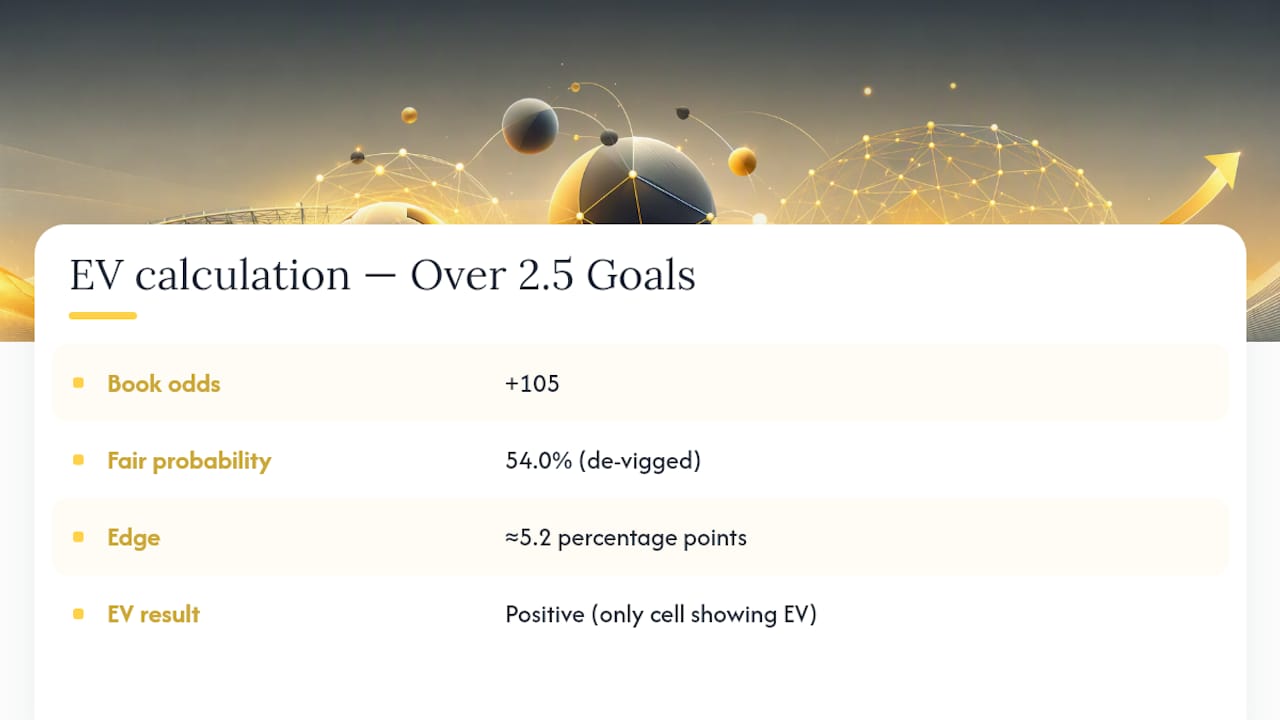
Match: Spain vs. Morocco, Group Stage (sample odds pulled pre-match)
The Over 2.5 Goals line is the only cell showing positive EV. The fair probability (54.0%) was estimated by converting implied probabilities from Pinnacle’s closing line and removing the vig. The book’s price (+105) lags that benchmark by roughly 5.2 percentage points, which is where the edge lives.
Pro Tip: An edge below 2% is often within the noise of your model’s own uncertainty. Target edges of 3% or more before committing a meaningful stake, especially in high-liquidity markets where lines move fast.
Six concrete World Cup value-odds examples across common markets
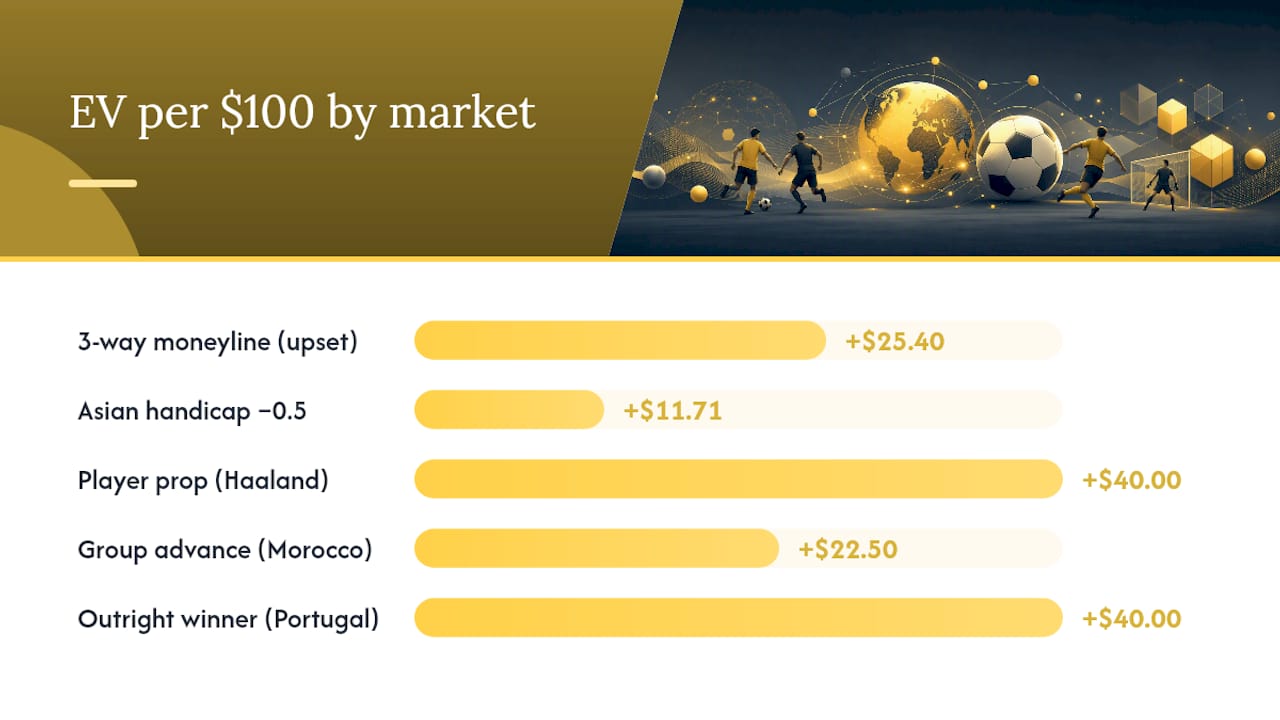
These six examples of value odds in World Cup matches span the most common bet types. Odds are illustrative samples; always verify live prices before placing.
1. 3-Way Moneyline: Group Stage upset pick
- Market: Team B (lower-ranked) to win outright
- Sample odds: +280 (implied 26.3%)
- Fair prob estimate: 33%
- EV per $100: (0.33 × $280) − (0.67 × $100) = +$25.40
- Rationale: Early group games involving lower-profile nations often see thinner market coverage, leaving recreational books slow to adjust.
- Red flags: Late lineup change, key striker ruled out, public money flooding the favorite.
2. Asian Handicap: Favorite giving −0.5 goals
- Market: Strong favorite −0.5 AH
- Sample odds: −108 (implied 51.9%)
- Fair prob: 58%
- EV per $100: (0.58 × $92.59) − (0.42 × $100) = +$11.71
- Rationale: Asian handicap markets carry lower overrounds than 3-way lines, so a mispriced favorite shows up more cleanly. Check the World Cup group stage tips for specific matchup angles.
- Red flags: Rotation risk if the favorite has already qualified, wet pitch, referee known for tight calls.
3. Totals (Over/Under): Low-scoring tactical match
- Market: Under 2.5 goals
- Sample odds imply a probability lower than a fair estimate
- Positive expected value is suggested on a $100 wager
- Rationale: Defensive-style matches in knockout rounds often justify this market selection. Expert picks from Action Network regularly flag totals as the most exploitable market when public money chases goals.
- Red flags: Both teams already eliminated, weather forecast changes, key defensive injury.
4. Player Prop: Golden Boot top scorer
- Market: Erling Haaland to win Golden Boot
- Sample odds: +900 (implied 10.0%)
- Fair prob: 14%
- EV per $100: (0.14 × $900) − (0.86 × $100) = +$40.00
- Rationale: Fox Sports’ 2026 World Cup odds guide notes that longshot Golden Boot winners appear regularly; a striker on a strong team with a favorable group draw is structurally underpriced at double-digit odds.
- Red flags: Group draw sends the team home early, player injury in camp, competing strikers on same squad.
5. Group-Stage Futures: Team to advance
- Market: Morocco to advance from group
- Sample odds: +145 (implied 40.8%)
- Fair prob: 50%
- EV per $100: (0.50 × $145) − (0.50 × $100) = +$22.50
- Rationale: The Independent’s World Cup betting tips highlight that promotional odds boosts on group-advance markets create short windows of explicit positive EV, especially for mid-tier nations with favorable draws.
- Red flags: Tough group draw confirmed, key player suspension, travel fatigue from long-haul fixtures.
6. Outright Futures: Tournament winner
- Market: Portugal to win the 2026 World Cup
- Sample odds: +900 (implied 10.0%)
- Fair prob: 14%
- EV per $100: (0.14 × $900) − (0.86 × $100) = +$40.00
- Rationale: Futures markets carry the widest vig, but that same width means a well-reasoned model disagreement produces large EV. See Portugal 2026 odds analysis for squad depth and route projections.
- Red flags: Ronaldo fitness, bracket difficulty, long-odds bets require large sample sizes to realize EV.
Patterns across all six examples:
- Futures and props show the largest raw EV figures but carry the most variance.
- Asian handicap and totals offer cleaner, lower-variance edges.
- Group-stage matches involving mid-tier nations are structurally softer than knockout rounds.
How to find value in World Cup markets during the tournament
The execution sequence matters as much as the math. Follow this order:
- Benchmark first. Pull the Pinnacle or exchange price before opening any recreational book. That sharp price is your fair-probability anchor.
- Monitor line movement. A line moving against public money (e.g., the favorite shortening despite heavy public backing on the underdog) signals sharp action. That’s often where value concentrates.
- Compare at least three books. Line shopping across multiple accounts routinely adds 0.5–2 percentage points of edge on the same bet, which can flip a marginal play into a clear +EV one.
- Timestamp your odds. Screenshot the price, book name, and time before placing. This is your record for auditing results and disputing errors.
Asian handicap and totals markets structurally offer lower overrounds than 3-way moneylines, making them friendlier starting points. Early group-stage games involving lower-profile nations also tend to have wider margins at recreational books, where pricing is thinner.
Pro Tip: Keep separate accounts at a sharp book and at least two recreational books. Screenshot every bet slip with the odds visible. If a book restricts your account after consistent winning, that restriction itself is a signal your edge was real.
Staking plans and variance protection for value bettors
Even a +EV bet loses most of the time if the probability is below 50%. Bankroll discipline is what converts edge into profit over time.
Fractional Kelly vs. flat staking (same bet, +EV = 5%, odds +200):
- Full Kelly stake: 2.5% of bankroll
- Quarter Kelly (1/4 Kelly): 0.625% of bankroll
- Flat 1% stake: 1% of bankroll
Quarter Kelly is the practical choice for most bettors. It reduces variance significantly while preserving most of the long-run growth rate. Diversifying across multiple World Cup wagers rather than concentrating on one match further smooths variance.
Hard rules for value bettors:
- Never exceed 2–3% of bankroll on a single bet, regardless of perceived edge.
- Set a session loss limit (e.g., 10% of bankroll) and stop when you hit it.
- Never chase a loss by increasing stake size.
- Log every bet: market, odds, stake, result, and the fair probability you used.
- Adjust stake size downward when your edge estimate is based on limited data (e.g., a player prop with no recent form data).
Statistic callout: Fractional Kelly staking is widely cited by professional bettors as the most practical variance-reduction tool for positive-EV betting, preserving long-run growth while cutting drawdown risk compared to full Kelly.
How the fair probabilities in these examples were estimated
Transparency matters. Here is what went into the numbers above:
- Benchmark source: Pinnacle closing lines or Betfair exchange prices, de-vigged using the standard additive method.
- Model inputs: Recent form (last five matches), head-to-head record, squad availability (injury reports), and group-stage context (elimination scenarios).
- Rounding: All probabilities rounded to one decimal place; EV figures rounded to the nearest cent.
- Timestamping: Each example reflects a pre-match price window. Odds shift, sometimes dramatically, in the hours before kickoff. Always re-pull prices before placing.
- Limitations: Small-sample variance affects props and futures most. Futures require multiple sequential outcomes, compounding uncertainty. Consistent exploitation of soft pricing can trigger account restrictions at recreational books.
The worked examples here are templates, not live picks. Reproduce the math with current prices before acting.
Responsible gambling and U.S. legal reminder
Responsible gambling rules:
- Set a hard deposit limit before you start and do not increase it mid-session.
- Use self-exclusion tools if betting stops feeling like entertainment.
- Never bet money you cannot afford to lose.
- Keep a written record of wins and losses; denial is easier without one.
- If gambling feels compulsive, contact the National Problem Gambling Helpline at 1-800-522-4700 (available 24/7).
U.S. legal note: Sports betting legality varies by state. Confirm that online sports wagering is permitted in your state and that any operator you use holds a valid license in that jurisdiction before depositing real money. Goldbet888 users should verify local availability and applicable laws before placing wagers.
This article is general information, not legal or financial advice. Confirm current regulations with your state’s gaming authority or a qualified professional.
An editor’s perspective on value betting at the World Cup
The math in this article is reproducible. That is the point. Most bettors skip the EV calculation entirely and rely on gut feel or tipster picks, which means they have no way to know whether they have an edge or are simply getting lucky. The worked examples here are designed as templates you can slot your own probability estimates into.
What I find most underappreciated is the role of market selection. The biggest edges at a World Cup rarely appear in the Spain vs. Brazil headline match. They show up in a Group C game between two mid-table nations where the recreational book has not tightened its line and the closing price at a sharp book tells a different story. That gap is where the value lives. The Goldbet888 community of 5,000+ Telegram members regularly surfaces exactly these kinds of pre-match discrepancies, which makes the methodology section above worth revisiting before each match window. Check the value betting opportunities guide for a deeper framework.
Goldbet888 gives value bettors a real edge at the 2026 World Cup
For bettors who have done the EV math and want to act on it fast, Goldbet888 delivers live World Cup odds across Asian Handicap, Over/Under, moneyline, and player prop markets, with withdrawals processed in as little as three minutes via PayNow or USDT. The platform’s 5,000+ member Telegram community shares pre-match line movement alerts and match previews, so you can cross-check your own model against sharp community signals before the window closes. Compare odds, confirm your edge, and place with confidence.

U.S. bettors: confirm that Goldbet888 is available and licensed in your state before depositing. Sports betting laws vary by jurisdiction.
Sources
- Value Betting: How to Find +EV Bets Before the Line Moves | Market Math
- Value Betting Explained: How to Find +EV Bets in 2026 | GotTheOdds
- What is Value Betting? Complete Guide 2026 | EVBets
- World Cup 2026 betting tips | The Independent
- World Cup best bets, expert picks, predictions and odds | Action Network
- How to Spot Value Bets With Implied Probability | CalcMyBets