Expected value betting is defined as placing wagers where your calculated long-term average return per bet is positive, based on comparing your true probability estimate against the odds a sportsbook offers. Professionals call this concept “EV betting,” and it is the foundation of every serious sports betting strategy. Sportsbooks like Pinnacle set sharp closing lines that serve as benchmarks for true probability estimation. The gap between your probability estimate and the posted price is your edge. When that edge is consistently positive, your bankroll grows over time regardless of short-term results.
What is expected value betting and how does it work?
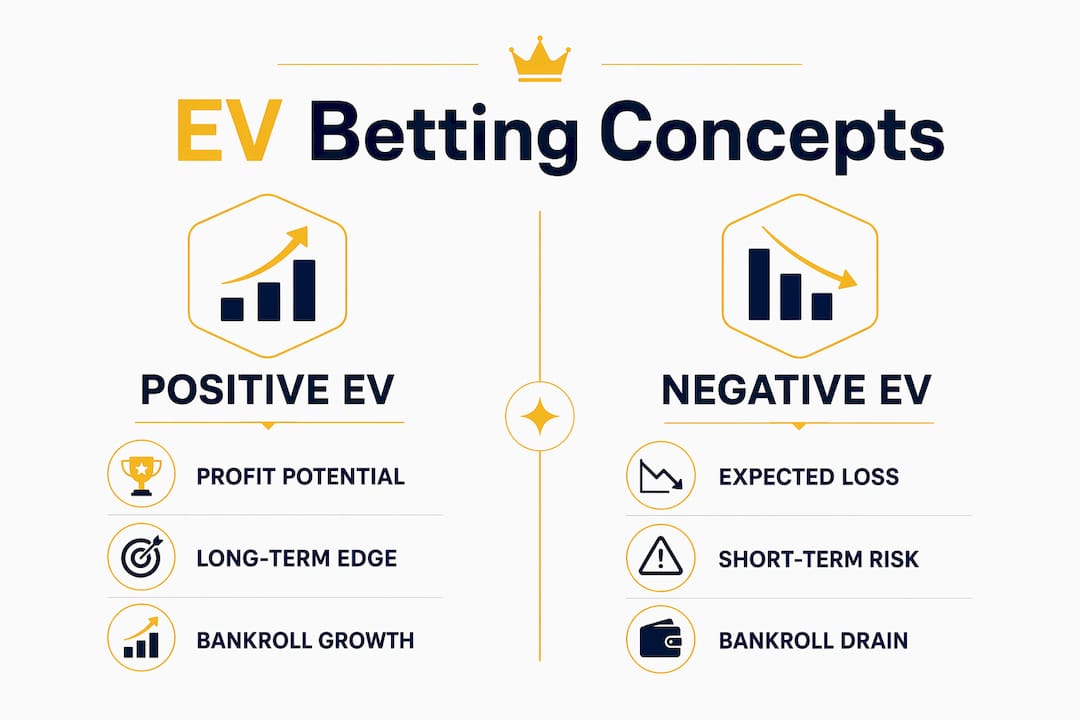
Expected value in gambling is the average projected return of a wager per unit staked, measured across many repetitions. A positive EV means the bet is profitable over time. A negative EV means the opposite. Professional bettors treat every wager as a probability question, not a prediction. The goal is not to pick winners. The goal is to find odds that are mispriced relative to the true probability of an outcome.
Sports betting profitability hinges on finding incorrect sportsbook pricing rather than accurately predicting game outcomes. This reframes the entire exercise. You are not trying to be right about the game. You are trying to be right about the price. When the sportsbook prices a team’s win probability at 45% but your model says 52%, that gap is where expected value lives.

Professional bettors typically flag a bet only when it offers at least 3% expected return per wager. That threshold filters out marginal edges that variance can easily erase. Below 1%, the edge is often negated by transaction costs and natural variance before it ever shows up in your results.
How to calculate expected value in sports betting
The core formula for EV is straightforward: EV = (Probability of Winning × Potential Profit) minus (Probability of Losing × Potential Loss). Sophisticated bettors target a 2–5% edge per bet, while retail bettors often operate at a negative 2% disadvantage due to the house edge baked into standard odds.
Step-by-step EV calculation example
Say a sportsbook offers you +110 American odds on Team A to win. That implies a 47.6% win probability after removing the vig. Your own model estimates Team A wins 54% of the time. Here is the math:
- Potential Profit: $110 on a $100 stake
- Probability of Winning: 54% (0.54)
- Probability of Losing: 46% (0.46)
- EV = (0.54 × $110) minus (0.46 × $100) = $59.40 minus $46.00 = +$13.40
A positive $13.40 EV per $100 wagered means this bet is worth taking. Repeat this process across hundreds of bets and the math compounds in your favor.
Odds formats and their impact on EV calculations
Understanding how different odds formats convert to implied probability is critical for accurate EV work.
| Odds Format | Example | Implied Probability | Notes |
|---|---|---|---|
| American | +110 | 47.6% | Positive = underdog; negative = favorite |
| Decimal | 2.10 | 47.6% | Divide 1 by decimal odds |
| Fractional | 11/10 | 47.6% | Common in UK markets |
| Asian Handicap | 0.5 | ~50% | Eliminates draw; popular in football |
All three formats represent the same price. The key step is always converting to implied probability, then comparing it to your true probability estimate.
Pro Tip: Use de-vigging calculators from tools like MarketMath or Oddible to strip the bookmaker’s margin before comparing implied probabilities. Failing to account for the vig means you are consistently overestimating your edge.
Why positive EV matters more than winning percentage
Positive EV is the only metric that predicts long-term profitability. Win percentage tells you almost nothing on its own. A bettor winning 55% of bets at poor odds can still lose money. A bettor winning 45% of bets at excellent odds can still profit. The math is what matters, not the scoreboard.
Even +EV bets lose short-term due to variance. This is the hardest psychological reality in EV betting. You can execute perfectly and still run at a loss for 50 or even 100 bets. That is not failure. That is variance doing what variance does.
Positive vs. negative EV: a practical comparison
| Bet Type | Odds | True Probability | EV per $100 | Long-Term Result |
|---|---|---|---|---|
| Standard -110 (50/50 market) | -110 | 50% | -$4.55 | Consistent loss |
| +EV bet at +105 | +105 | 52% | +$2.60 | Gradual profit |
| Strong +EV at +120 | +120 | 55% | +$11.00 | Meaningful growth |
| -EV favorite at -130 | -130 | 43% | -$12.70 | Accelerated loss |
A standard -110 bet in a 50/50 market loses about $4.55 per $100 wagered. That number illustrates exactly why casual bettors bleed money over time without realizing it. The vig is silent but constant.
Tracking results over at least 100 bets is the minimum sample size to separate skill from noise. Below that threshold, short-term variance can make a bad strategy look good and a good strategy look terrible. Patience is not optional in EV betting. It is the strategy.
Pro Tip: Track closing line value on every bet rather than just wins and losses. CLV measures how your odds compare to the final pre-game line, and it is the most reliable indicator of whether your process is actually generating positive expected value.
How to apply expected value betting strategies in practice
Knowing the formula is only the beginning. Applying EV betting consistently requires a system, not just a calculator. Here is how serious bettors build that system:
Build or use a probability model. Your EV calculation is only as good as your probability estimate. Statistical models using team form, injury reports, and historical matchup data produce more accurate estimates than gut feel. Tools like Oddible and MarketMath automate much of this work by aggregating market data and flagging mispriced lines.
Shop lines across multiple sportsbooks. A 2% edge at one book can become a 5% edge at another. Line shopping is one of the highest-return activities in sports betting. Check your sports betting options across platforms before placing any bet.
Apply the Kelly Criterion for bet sizing. The Kelly Criterion calculates the optimal percentage of your bankroll to stake based on your edge and the odds. Full Kelly is aggressive. Most professionals use half Kelly or quarter Kelly to reduce variance while still growing the bankroll efficiently.
Set a staking discipline and follow it. Emotional bet sizing destroys EV strategies faster than bad picks. Decide your unit size before the season starts. Stick to it regardless of recent results.
Log every bet with full details. Record the odds you got, the closing line, your estimated probability, and the result. This data tells you whether your edge is real or imagined.
Pro Tip: Consistent 2–5% EV per bet compounded over hundreds of wagers produces meaningful bankroll growth. Edges below 1% are often erased by variance and costs before they ever materialize in your account.
Common mistakes that undermine EV betting
Most bettors who understand EV theory still fail in practice. The reasons are predictable and avoidable.
- Ignoring the vig. Calculating EV using raw implied probabilities without de-vigging the sportsbook margin distorts every number. You will think you have an edge when you do not.
- Treating short-term results as signal. Winning five bets in a row does not validate your model. Losing ten in a row does not invalidate it. Sample size below 100 bets is statistical noise, not evidence.
- Betting on gut feeling or hot streaks. Discipline to bet only when EV favors you is what separates profitable bettors from the general public. Gut feelings are not probability estimates.
- Overestimating your edge. Most bettors overstate their true probability estimates by 3–5 percentage points. Calibrate your model against closing lines regularly to check for systematic bias.
- Mismanaging bankroll during losing runs. Chasing losses by increasing stake size is the fastest way to turn a temporary variance swing into a permanent bankroll wipeout. The Kelly Criterion exists precisely to prevent this.
- Skipping closing line value tracking. CLV is a better indicator of skill than win rate. If you consistently beat the closing line, your process is sound even when results are temporarily poor.
Key takeaways
Expected value betting generates long-term profit by identifying wagers where your true probability estimate exceeds the sportsbook’s implied probability, compounded consistently across hundreds of bets.
| Point | Details |
|---|---|
| Core EV formula | EV = (Win Probability × Profit) minus (Loss Probability × Stake); positive result means the bet has long-term value. |
| De-vig before calculating | Always strip the sportsbook margin from implied probabilities before comparing to your true estimate. |
| Sample size matters | Evaluate your EV strategy over at least 100 bets to separate skill from short-term variance. |
| Track closing line value | CLV is a more reliable performance metric than win percentage for measuring true betting edge. |
| Kelly Criterion for sizing | Use half or quarter Kelly to size bets based on your edge, protecting the bankroll during variance swings. |
Why discipline is the real edge in EV betting
I have spent years watching bettors who understand the math perfectly still blow up their bankrolls. The formula is not the hard part. The hard part is sitting on your hands when there is no edge and waiting for the right spot.
The biggest mistake I see is bettors abandoning their EV process after a 15-bet losing streak. Variance at that sample size is completely normal, even on a solid +3% edge strategy. The math has not failed. The bettor has failed the math by quitting too early or sizing up to recover losses.
Record keeping changed everything for me. When you log every bet with your estimated probability, the closing line, and the result, you stop reacting to outcomes and start evaluating process. A losing week with strong CLV is a good week. A winning week with poor CLV is a warning sign. That mental shift from outcome thinking to process thinking is where real improvement happens.
My advice: start with a small, defined bankroll you can afford to lose entirely. Apply the EV formula to every bet. Track CLV religiously. Do not touch the Kelly sizing rules. After 200 bets, your data will tell you whether your probability estimates are accurate. That feedback loop is worth more than any tipster service or hot streak.
— Jaye
Apply EV betting with live odds at Goldbet888
If you are ready to put EV principles into practice, you need access to sharp odds across a wide range of markets. Goldbet888 offers live sports betting odds across football, World Cup 2026 fixtures, and more, giving you the real-time pricing data you need to spot mispriced lines. The platform’s 5,000+ Telegram community shares match previews and odds insights that support your own probability modeling. Withdrawals process in as little as three minutes, so your bankroll stays liquid and ready for the next +EV opportunity.

Goldbet888 also covers FIFA World Cup 2026 betting markets with Asian Handicap and Over/Under options, two formats where line shopping and EV analysis produce the clearest edges. Start with the live odds page, build your probability estimates, and let the math do the work.
FAQ
What is expected value betting in simple terms?
Expected value betting means placing wagers where your calculated probability of winning exceeds what the sportsbook’s odds imply. Over many bets, positive EV translates to long-term profit.
How do i calculate expected value for a sports bet?
Use the formula: EV = (Probability of Winning × Potential Profit) minus (Probability of Losing × Stake). A positive result means the bet has long-term value worth taking.
Why do +EV bets sometimes lose?
Variance causes short-term results to deviate from expected outcomes even on mathematically sound bets. Tracking at least 100 bets is the minimum to evaluate whether your EV strategy is working.
What is closing line value and why does it matter?
Closing line value measures how your odds compare to the final pre-game line set by sharp sportsbooks like Pinnacle. CLV is a more reliable indicator of long-term edge than win percentage.
What is the biggest mistake in EV betting?
Ignoring the sportsbook vig when calculating implied probabilities is the most common error. Failing to de-vig the margin causes bettors to overestimate their edge and bet on negative EV wagers without realizing it.