A tipster confidence level is a probability-style percentage or graded label that tells you how likely the tipster believes a predicted outcome will occur — and it doubles as a stake-sizing guide. When a tip lands in your Telegram feed with “75% confidence,” that number is not a promise. It is a calibrated estimate, and your job is to compare it against the bookmaker’s implied probability before you commit a single dollar.
Here is what to keep in mind from the start:
- Confidence = probability estimate. A 70% confidence rating means the tipster believes the outcome has roughly a 70% chance of happening, not that it will definitely happen.
- Calibration tiers matter. Industry services commonly use three bands: 60–74% (slight lean), 75–89% (meaningful edge), and 90%+ (strong conviction). Even a 95% pick loses roughly 1 in 20 times, so bankroll discipline is non-negotiable.
- Compare before you bet. Convert the tipster’s confidence to implied decimal odds and check whether the bookmaker is offering better value. If the market already prices the outcome at 75%, a tipster’s 70% confidence offers no edge.
- Watch calibration metrics. Brier score and log loss are the two numbers that reveal whether a tipster’s confidence scores are honest over time, not just lucky.
Goldbet888 users following World Cup 2026 Telegram tips should treat every confidence rating as the start of a value check, not the end of one.
Table of Contents
- How tipsters calculate confidence levels: inputs and models
- How raw probability becomes a confidence grade and stake size
- How do you test whether a tipster’s confidence scores are calibrated?
- How to use confidence to find value against the market
- What are the red flags when reading tipster confidence ratings?
- A practical checklist for vetting Telegram tipsters
- Key Takeaways
- Why calibration beats confidence every time
- Goldbet888 gives you the tools to act on tipster confidence
- Useful sources
How tipsters calculate confidence levels: inputs and models
Every confidence score starts with raw data. Tipsters — whether human analysts or algorithm-driven services — feed a set of signals into a framework and produce a probability estimate. Understanding those signals helps you judge whether a tipster’s process is credible.
Common inputs:
- Recent form (last 5–10 matches, weighted toward the most recent)
- Head-to-head records at the specific venue
- Home/away splits and travel fatigue
- Confirmed lineups, injuries, and suspensions
- Referee tendencies and venue conditions
- Bookmaker market consensus (the “wisdom of the crowd” baked into opening lines)
- Fixture congestion and squad rotation risk
Football-specific models often layer in expected goals (xG) simulations, Poisson distribution models for scoreline probabilities, Elo-style team ratings, and ensemble methods that blend several approaches. The signal weighting shifts by sport: in soccer, xG and recent form dominate; in other sports, different variables take priority.
How a weighting formula works
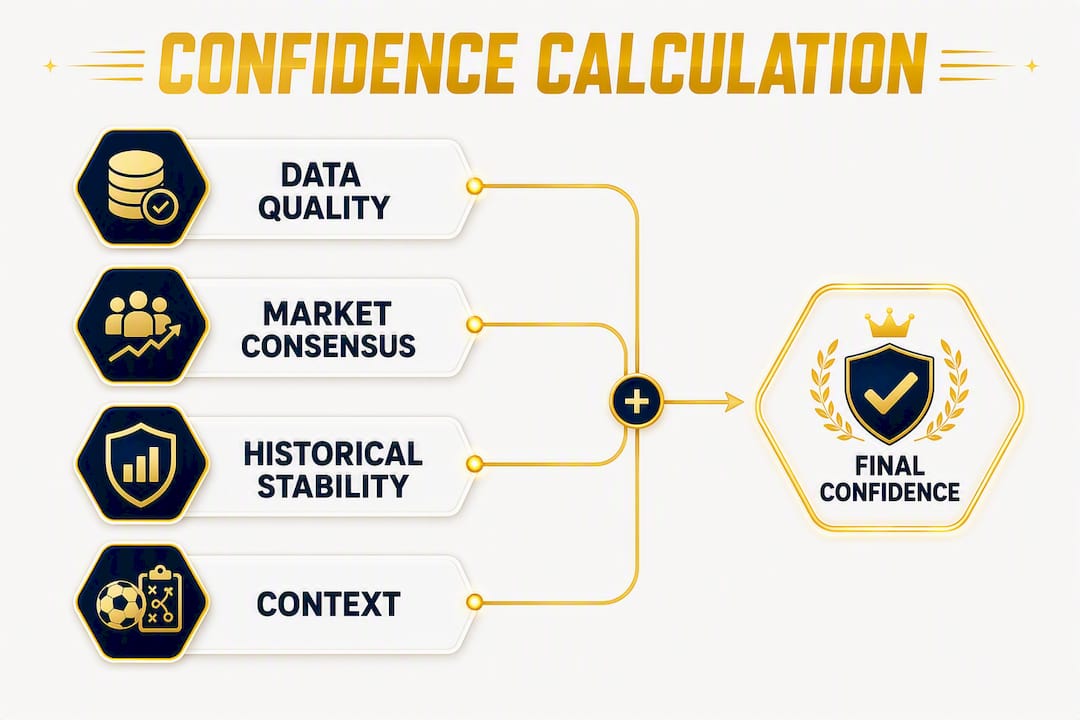
One published example formula combines four factors:
| Factor | Weight | What it captures |
|---|---|---|
| Data quality | 0.4 | Recency, completeness, and reliability of match data |
| Market consensus | 0.3 | Bookmaker-implied probability as a crowd-wisdom signal |
| Historical stability | 0.2 | Long-run head-to-head and venue patterns |
| Context | 0.1 | Situational factors: injuries, congestion, referee |

The formula: 0.4 × Data Quality + 0.3 × Market Consensus + 0.2 × Historical Stability + 0.1 × Context.
Most professional tipsters use a hybrid workflow: a model suggests a raw probability, then an experienced analyst applies context adjustments — a late injury, a surprise lineup — before publishing the final confidence score with a stated rationale.
How raw probability becomes a confidence grade and stake size
Once a model outputs a probability, tipsters convert it into a confidence bracket and a staking recommendation. The mapping is usually straightforward.
Probability to confidence tier:
- 60–74%: Slight lean — small stake, speculative
- 75–89%: Meaningful edge — standard or increased unit
- 90%+: Strong conviction — maximum planned unit (never chase beyond your pre-set ceiling)
Staking approaches tipsters use:
- Flat-unit staking. Every tip gets the same stake regardless of confidence. Simple, protects against overconfidence.
- Graded units. Stake scales with the confidence tier (1 unit at 65%, 2 units at 75%, 3 units at 90%+). Requires honest calibration to avoid inflating stakes on weak picks.
- Fractional Kelly criterion. Stake = (edge / odds) × fraction. Mathematically optimal but sensitive to probability errors; most bettors use quarter-Kelly or half-Kelly to limit variance.
A quick value math example. A tipster rates a match at 65% confidence. The implied fair decimal odds are 1/0.65 = 1.54. If a sportsbook offers 2.10 on the same outcome, the edge is real. If the sportsbook offers 1.45, you are paying for a worse price than the tipster’s own estimate — no value exists regardless of how confident the tip sounds.
One critical warning: market movement after a tip is published can erase the original edge entirely. Always check live odds at the moment you act, not when the tip was posted.
How do you test whether a tipster’s confidence scores are calibrated?
Calibration is the single most important quality check. A well-calibrated tipster’s 70% picks should win approximately 70% of the time across a large enough sample. Perfect calibration is rare and requires hundreds of predictions per band before the numbers stabilize.
Metrics to request or compute:
- Brier score: Measures mean squared error between predicted probability and actual outcome (0 = perfect, 1 = worst). Brier score and log loss both penalize overconfident predictions far more harshly than a simple win-rate calculation.
- Log loss: Penalizes confident wrong predictions exponentially — a tipster who posts 90% confidence on a loser takes a severe log-loss hit.
- Hit rate by confidence band: Group all 65–74% picks and check the actual win rate. Repeat for each band.
- Sample size: Fewer than 200–300 picks per band is statistically thin. Variance alone can mimic calibration.
- Closing price vs. advised price: A systematic gap between the odds the tipster advised and the odds you could actually get is a silent profit killer.
Proof-first tipsters provide independently tracked, timestamped records that cannot be edited after results are known. That immutability is what separates a credible track record from a curated highlight reel.
Pro Tip: Ask any Telegram tipster for a CSV export of their full history. Load it into a spreadsheet, group picks by confidence band, and compute the hit rate for each tier. If the 80% band is winning at 55%, the confidence scores are not calibrated — they are marketing.
A proper tipster audit requires: verified identity, timestamped entries, market and price source for each pick, a stated stake convention, settlement rules, and raw results benchmarked against market baselines.
How to use confidence to find value against the market
A strong probability does not automatically mean a good bet. A 90% confidence pick where the bookmaker implies 92% probability is a losing proposition over time. Value lives in the gap between the tipster’s probability and the market’s implied probability — adjusted for the bookmaker’s margin.
The value check process:
- Convert tipster confidence to implied decimal odds: 1 ÷ confidence %
- Convert bookmaker decimal odds to implied probability: 1 ÷ decimal odds
- Adjust for bookmaker margin (typically 4–8% on football markets) to find the true market probability
- If tipster probability > adjusted market probability, a positive expected value edge exists
Worked example:
- Tipster confidence: 65% → implied fair odds: 1.54
- Bookmaker decimal odds: 2.10 → implied probability: 47.6%
- After a 5% margin adjustment, true market probability: roughly 45%
- Tipster’s 65% vs. market’s 45% = a meaningful edge worth considering
Most value sits in moderate-confidence picks (65–80%) that diverge materially from market odds. Extreme-high confidence picks (90%+) rarely offer value because the market has already priced the favorite heavily.
Pro Tip: Always record the odds at the exact timestamp the tip was published. Use closing prices — the final odds before kick-off — as your benchmark. A tip that looked like value at 2.10 may have closed at 1.55, which tells you the market disagreed with the tipster’s edge.
What are the red flags when reading tipster confidence ratings?
Confidence numbers are easy to fabricate. Here is what to watch for:
- Screenshot-only records. No timestamps, no edit history, no third-party verification.
- Missing advised odds. A confidence score without a stated price is useless for value assessment.
- Edited or deleted posts. Telegram allows edits; a tipster who quietly revises a losing pick’s confidence after the result is manipulating their record.
- No staking rules. If unit sizes change after losing runs, the track record is meaningless.
- Tiny sample sizes. Fifty picks at 80% confidence tells you almost nothing statistically.
- High win-rate, negative yield. Winning 60% of bets at poor odds still loses money long-term. Win rate alone is not an edge.
- Ignoring closing prices. A tipster who never mentions closing line value is hiding the most honest performance signal available.
A practical checklist for vetting Telegram tipsters
Run through this before staking real money on any tip:
- Timestamp present? The post must show the exact time it was published, before kick-off.
- Advised odds listed? Confidence without a stated price cannot be verified for value.
- Staking units defined? Units must be consistent across the full history, not adjusted retroactively.
- Full history link provided? A link to a complete, unedited record — not a curated “best of” screenshot gallery.
- Third-party tracker linked? Services that independently log and timestamp picks remove the possibility of post-hoc editing.
- Edit history visible? On Telegram, check whether posts have been edited after results.
- Paper-trade first. Log the tip, record the advised odds, and track results for 50–100 picks before committing meaningful stakes.
Pro Tip: If a Telegram tipster cannot provide a timestamped, independently verifiable history, treat every confidence number as a marketing claim. Paper-trade their picks for a month and compute your own Brier score before risking real money.
Key Takeaways
A tipster’s confidence score is only as valuable as the calibration and transparency behind it — always verify the proof before you size a stake.
| Point | Details |
|---|---|
| Confidence is probability, not certainty | Even a 95% pick still loses roughly 1 in 20 times; size stakes to reflect that reality. |
| Calibration is the real test | Request hit rates by confidence band and compute Brier score across at least 200–300 picks. |
| Value requires a market comparison | Convert confidence to implied odds and compare to bookmaker price, adjusted for margin. |
| Proof-first records are non-negotiable | Timestamped, third-party-tracked histories prevent post-hoc editing and cherry-picking. |
| Goldbet888 community tips | Goldbet888’s 5,000+ Telegram community shares match previews with stated odds, giving you the raw material to run your own value checks. |
Why calibration beats confidence every time
Most bettors fixate on the confidence number itself. The smarter question is whether that number has ever been tested against reality. A tipster posting “85% confidence” on every pick is useless if their 85% band wins at 55%. The confidence score is just a claim — calibration data is the proof.
What I look for, and what Goldbet888 emphasizes in its community, is a combination of three things: a Brier score computed across a minimum sample of several hundred picks, a full advised-vs-taken odds comparison that shows whether the stated edge was actually achievable, and a third-party tracker link that makes editing impossible. Without all three, a confidence rating is an opinion dressed up as a statistic.
The bettors who consistently outperform over a season are not the ones chasing the highest confidence picks. They are the ones who found tipsters whose 70% band actually wins at 70% — and who used that calibration to size stakes with discipline rather than excitement.
For deeper reading on calibration methods and value identification, Goldbet888’s betting confidence rating guide and football odds value checklist are solid starting points.
Goldbet888 gives you the tools to act on tipster confidence
Knowing how tipsters calculate confidence levels is only half the equation. Acting on that knowledge requires live odds you can trust, markets that match the tips you are receiving, and a community that shares the reasoning behind each pick — not just the result.

Goldbet888’s live sports betting platform gives Singapore bettors real-time football odds across Asian Handicap, Over/Under, and match result markets, so you can run a value check the moment a Telegram tip arrives. The 5,000+ member Telegram community shares match previews with stated odds and reasoning, giving you the context to test calibration rather than just follow blindly. The Singapore betting guide walks through converting confidence scores into stake sizes step by step. Withdrawals process in three minutes via PayNow or USDT, so when value appears, you can move fast. Register at Goldbet888 and start comparing tipster confidence to live market odds today.
Betting involves financial risk. This article provides general information only and is not professional financial or gambling advice. Always verify current rules and odds with the relevant platform or a qualified professional before placing real-money wagers.
Useful sources
These references cover calibration methods, tipster auditing, and probability modeling in depth:
- Prediction Confidence vs. Betting Value — explains why high probability does not equal positive expected value; includes worked examples contrasting confidence and market odds.
- Sports Betting Confidence Ratings Explained — covers Brier score and log loss as calibration tools; explains why win rate alone misleads bettors.
| Source | Best for |
|---|---|
| The Spread (confidence vs. value) | Understanding when high confidence offers no edge |
| TipsterReviews (vetting checklist) | Step-by-step proof-first verification process |
| ATSwins (Brier/log loss) | Computing calibration metrics from a tipster’s history |
| PredictifySports (confidence tiers) | Mapping probability percentages to confidence bands |
| SupaTips (football methodology) | Understanding xG, Poisson, and Elo model inputs |
| SportsSignals (audit guide) | Full audit framework for tipster record verification |