A betting signal group (also called a betting syndicate or tips community) is an organized channel where market-driven alerts, line-movement data, or curated picks are shared with members so they can act on the same information before odds shift. The bottom line: some of these groups deliver genuine edge; most do not. Before you join or pay for anything, run this quick check.
Three trust signals to look for:
- Timestamped, publicly viewable bet records going back at least several months
- Reasoning behind every pick, not just “bet Team A on the spread”
- Independent verification or a third-party tracker you can audit yourself
Three red flags to walk away from:
- Guaranteed win-rate claims or promises of “100% profit”
- No verifiable history, or records that only show winners
- Pressure to upgrade fast, recruit others, or use a specific bookmaker
Immediate next steps: Ask for the group’s full, unedited log before paying. Request a trial period. Check whether any third-party site independently tracks their results. If they refuse all three, move on.
Table of Contents
- What exactly is a betting signal group or syndicate?
- How betting signal groups produce and deliver signals
- Why line movement and “sharp” money create usable betting signals
- How to spot a legitimate betting signal group
- Common scams and red flags to avoid
- Legal and ethical considerations for U.S. bettors
- How to join or start a betting signal group safely
- Key Takeaways
- The real problem with most signal groups isn’t the signals
- Goldbet888: a community-backed platform for serious football bettors
- Useful sources and further reading
What exactly is a betting signal group or syndicate?
The term covers a wide spectrum. At one end, you have a casual Telegram channel where a single tipster posts football picks. At the other, you have a professional sports betting syndicate that pools bankrolls, employs analysts, and deploys coordinated runners to capture price discrepancies across multiple sportsbooks simultaneously.
Common structures you’ll encounter:
- Tipster channel: One person (or a small team) publishes picks with or without analysis. Free or subscription-based. Quality varies enormously.
- Betting community: A forum or group chat where members share ideas, debate lines, and post their own picks. Think Discord servers or large Telegram groups with open discussion.
- Organized syndicate: A closed operation with defined roles, pooled capital, and a systematic process for identifying and placing bets. Access is usually restricted and vetted.
Inside a professional syndicate, roles tend to be clearly divided. An originator identifies the value and sets the bet parameters. Analysts research the market, injury reports, and line history. Runners are the people who physically (or digitally) place the bets across multiple accounts to avoid triggering bookmaker limits. This division of labor is what separates a syndicate from a casual tips group.
The pooled-bankroll model matters for one practical reason: it allows the group to cover more bets, split research tasks, and place wagers simultaneously at several books before the market corrects. That speed advantage is the core of what makes a well-run syndicate valuable. It also explains why most retail bettors can never fully replicate syndicate results even when they receive the same signal, since by the time the tip reaches your phone, the best price may already be gone.

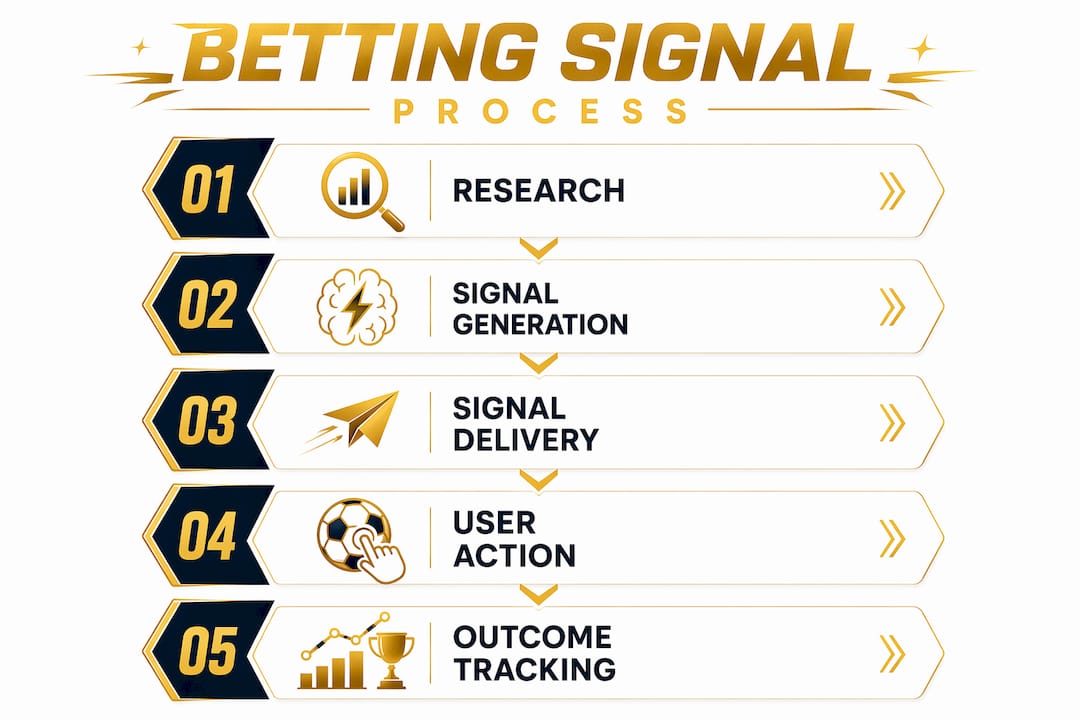
How betting signal groups produce and deliver signals
Signals start with money, not opinions. When a large-dollar professional wager hits a sportsbook, the book adjusts its line to limit exposure. That price movement is the signal itself. Signal groups either detect these moves directly (through data subscriptions or insider networks) or analyze patterns across books to infer where sharp money has landed.
Two primary signal types:
- Steam moves: A rapid, coordinated line shift across multiple sportsbooks in a short window. Usually triggered by a syndicate placing simultaneous bets. High urgency; value decays within minutes.
- Reverse line movement (RLM): The line moves against the majority of public bets. If 70% of tickets are on Team A but the line moves toward Team B, sharp money is almost certainly on Team B.
Delivery platforms and models:
- Telegram is the dominant platform for retail signal groups. Instant push notifications, large group capacity, and easy channel management make it the default choice. Platform alone tells you nothing about quality.
- Discord is common for community-style groups where discussion and analysis happen alongside picks.
- Encrypted apps (Signal, WhatsApp) and private dashboards appear in more professional or paid-tier services, often for speed and privacy rather than transparency.
Pricing models range from completely free (ad-supported or community-driven) to donation-based, one-off purchase, monthly subscription, or a managed-bankroll share where the group takes a percentage of profits. Free groups are not automatically worse than paid ones. The fee structure tells you about the business model, not the quality of picks.
Pro Tip: Latency kills value on steam moves. If you receive a signal more than a few minutes after it was generated, the line has likely already corrected. Always check the current line against the signal’s recommended price before placing the bet.
Why line movement and “sharp” money create usable betting signals
Sportsbooks set opening lines based on their own models, then adjust as money comes in. When a large, well-timed wager from a known sharp player or syndicate hits, the book moves the line quickly to protect its margin. That movement is a data point: someone with significant capital and presumably significant research just committed to a position.
The key distinction most bettors miss is the difference between ticket percentages and dollar percentages. A game might show 75% of tickets on one team while 65% of the dollars sit on the other side. The dollar split reflects where the large bets landed. Large-dollar wagers matter far more than ticket counts when you’re trying to identify sharp action. Raw public percentages are mostly noise.
Signal reliability also varies by type. Originator steam moves (the initial coordinated push from a professional syndicate) carry the highest short-term reliability in the market, with decay windows measured in minutes. Raw public percentages sit at the bottom of the reliability hierarchy. Confirmed reverse line movement falls somewhere in the middle, with a longer window before the value disappears.
Signal Reliability Snapshot: Originator steam moves rank highest for short-term reliability; raw public ticket percentages rank lowest. The gap between these tiers is significant enough that treating them as equivalent is one of the most common and costly mistakes retail bettors make.
A practical example: a syndicate places identical bets on the same side at five books within 90 seconds. Each book moves its line by half a point. A signal service detects the cross-book movement and alerts subscribers. A bettor who acts within two minutes can still find the pre-move price at a slower-adjusting book. A bettor who acts 20 minutes later is betting into a corrected market with no edge.
Signal confirmation strengthens the case. When multiple sportsbooks move in the same direction, that reflects broader sharp action rather than one book managing its own risk. A single-book move could be noise; a coordinated multi-book shift is a much stronger indicator.
Pro Tip: Before acting on any signal, check whether the same line has moved at two or more other books. Conflicting signals across books are a reliable reason to skip the play entirely, as noted by analysts at Action Network.
How to spot a legitimate betting signal group
Credibility comes down to verifiable evidence, not marketing copy. Here is a checklist you can apply to any group before committing money or time.
| Trust Signal | What to Check |
|---|---|
| Timestamped records | Full bet log with date, time, odds, and stake — not just a screenshot of wins |
| Reasoning behind picks | Written analysis explaining why the bet has value, not just the selection |
| Third-party verification | An independent tracker, public spreadsheet, or auditable bet slip history |
| Long-term track record | At least 6–12 months of results, including losing runs and drawdown periods |
| Clear fee and refund policy | Transparent pricing, a trial option, and a stated refund process |
What legitimate groups actually look like in practice:
- They publish full results, wins and losses, so you can calculate ROI yourself
- They explain the reasoning behind each pick, which lets you learn and evaluate their process rather than just follow blindly
- They welcome independent verification and do not discourage you from tracking results yourself
- Their long-term ROI is modest and realistic; legitimate groups never claim 80–90% win rates over a real sample size.
- Community engagement is genuine: members discuss picks, push back on analysis, and share their own tracking data
Credible groups prioritize education and transparent long-term proof over claims of guaranteed returns. That emphasis on education is itself a trust signal. A group that teaches you how to evaluate a bet is far more valuable than one that just tells you what to bet.
Understanding the difference between a signal and a prediction also matters here. A signal is a market-derived data point (line movement, dollar splits). A betting prediction is an analyst’s opinion on an outcome. Both can be useful; they are not the same thing, and conflating them is how bettors end up following opinion dressed up as market intelligence.
Common scams and red flags to avoid
The betting tips industry has a high concentration of fraudulent operators. Most scams follow predictable patterns, which makes them easier to spot once you know what to look for.
Red flags that should stop you immediately:
- Guaranteed wins or extreme win-rate claims. No legitimate service guarantees profits. Anyone claiming 80–90% accuracy over a meaningful sample is either lying or cherry-picking results.
- Pressure sales tactics. “Only 3 spots left,” countdown timers, urgent upgrade prompts, and referral pyramid structures are manipulation, not value.
- Opaque or edited records. Screenshots without timestamps, records that only show winners, or bet slips that cannot be independently verified are worthless as evidence.
- Missing variance disclosure. Every betting strategy has losing runs. A group that never shows a losing month has not been transparent about its history.
- Bookmaker requirements. If a group insists you must sign up through their affiliate link or use a specific bookmaker, their revenue model is affiliate commissions, not your betting success.
- Account or withdrawal problems. Reports of difficulty withdrawing funds or unexplained account restrictions are serious warning signs about the platform or the group’s relationship with it.
Cherry-picked results are the most common manipulation tactic. A scam service will show you its best 30-day run and present it as representative performance. Always ask for the full, unedited log. If they cannot or will not provide it, that is your answer.
Pro Tip: Search the group’s name plus “scam” or “review” before paying. Independent forums and betting communities often flag fraudulent services within weeks of launch. A quick search takes two minutes and can save you real money.
Legal and ethical considerations for U.S. bettors
Using market data, line movements, and publicly available information to inform your bets is standard industry practice and entirely legal in the United States. The illegal line is not analyzing odds or following sharp money. It is match-fixing and collusion.
Where the legal boundaries sit:
- Legal: Receiving tips, following line movement data, joining a signal community, pooling bankrolls with friends under a clear agreement, and acting on publicly available market information.
- Illegal: Coordinating with players, coaches, or officials to influence a game’s outcome; placing bets based on insider information obtained through corruption; participating in any scheme designed to manipulate the result of a sporting event.
Syndicates that use runners and coordinated simultaneous bets operate in a gray area not because of U.S. law but because of sportsbook terms of service. Bookmakers can and do limit or ban accounts they identify as syndicate-connected. That is a commercial risk, not a legal one, but it is a real operational constraint.
Practical cautions for U.S. bettors:
- Sports governing bodies (NFL, NBA, MLB, NCAA) have their own rules about betting by players, coaches, and staff. If you work in or around professional sports, know those rules before joining any signal group.
- State-level gambling regulations vary. Legal sports betting is available in most but not all U.S. states. Always confirm your state’s current status before placing real-money wagers.
- Transparency in your own process reduces ethical risk. Keeping your own records and betting through licensed, regulated sportsbooks keeps you on the right side of both the law and the terms of service.
How to join or start a betting signal group safely
Vetting a group before you pay
- Request the full bet log. Ask for every bet placed over the last 6–12 months, with dates, odds, and stakes. Not a highlights reel.
- Run a trial period. Most credible services offer a free trial or a short paid trial with a refund option. Use it. Track every pick independently during the trial.
- Verify independently. Set up your own spreadsheet or use a free tracking tool. Do not rely on the group’s own reported results.
- Check cross-book confirmation. For any signal you receive, verify whether the same line has moved at other sportsbooks before acting.
- Start with small stakes. Even if the trial looks promising, begin with one unit per bet and observe over at least 50–100 picks before scaling up.
Safe testing protocol
- Blind tracking: Record every pick the group sends, whether you bet it or not. This gives you a true sample of their output, not just the picks you chose to follow.
- Exposure cap: Never allocate more than a small percentage of your total bankroll to signals from any single source. Diversifying across your own research and signal inputs reduces variance.
- Win target and stop-loss: Set a clear profit target and a maximum loss threshold for your trial period. If the group hits the stop-loss before the trial ends, stop following and reassess.
Starting your own group
If you want to build a small, transparent syndicate with friends or fellow bettors, a few operating rules make the difference between a functional group and a dispute-prone mess:
- Bankroll contributions: Agree on equal or proportional contributions upfront, documented in writing.
- Stake sizing: Use a fixed unit system (e.g., 1–5 units per bet) so every member bets the same relative amount.
- Recordkeeping: Assign one person to maintain the master log, and make it accessible to all members at all times.
- Dispute resolution: Agree in advance on how disagreements about picks or payouts are handled.
For practical guidance on following tips safely, the best practices for following betting tips framework covers bankroll rules and stake-sizing in detail. And if you want to understand how late-breaking information affects the lines your signals are based on, why late team news shifts odds is worth reading before you act on any pre-game signal.
Key Takeaways
A betting signal group is only as valuable as the transparency and verifiability of its records — without both, you are betting on trust, not evidence.
| Point | Details |
|---|---|
| Definition | A betting signal group shares market-driven alerts or curated picks so members can act before odds shift. |
| Top trust signals | Look for timestamped full records, reasoning behind picks, and independent third-party verification. |
| Top red flags | Walk away from guaranteed win claims, opaque records, and pressure to use specific bookmakers. |
| Signal reliability tiers | Originator steam moves rank highest for short-term reliability; raw public ticket percentages rank lowest. |
| Goldbet888 community | Goldbet888’s 5,000+ member Telegram community shares match previews and betting insights with transparent, community-driven discussion. |
The real problem with most signal groups isn’t the signals
Most bettors who get burned by signal groups do not lose because the signals were wrong. They lose because they never verified the group’s track record before trusting it with real money. The marketing is designed to make you feel like you’re getting access to something exclusive and proven. The reality is that almost no retail signal service publishes independently audited results, and the ones that do rarely show the kind of sustained edge their marketing implies.
The sharper question to ask is not “does this group win?” but “can I verify that independently?” A group that welcomes scrutiny, publishes its full history including losing runs, and explains its reasoning is worth testing carefully. A group that deflects verification requests with urgency or social proof is not.
Short-term performance is almost meaningless. A 10-game winning streak tells you nothing about a group’s long-term edge. Fifty bets is a minimum sample; 200 is where patterns start to become statistically meaningful. Any group pushing you to commit before you have seen that kind of evidence is prioritizing their revenue over your results.
The checklist in this article is not complicated. It is just the due diligence that most people skip because the marketing is compelling and the promise of an edge is genuinely exciting. Use the checklist. Run the trial. Track independently. The groups worth following will not mind.
Goldbet888: a community-backed platform for serious football bettors

If you’ve read this far, you understand what separates a signal group worth following from one worth avoiding: transparency, community, and verified information. Goldbet888 is built around exactly that model. The platform’s 5,000+ member Telegram community shares real match previews, line analysis, and betting insights before kickoff, giving you the kind of community-driven context that retail bettors rarely get access to in one place.
Beyond the community, Goldbet888 offers live odds on World Cup 2026 football, specialized Asian Handicap and Over/Under markets, and withdrawal speeds that the platform reports at three minutes via PayNow and USDT. That combination of fast execution and community intelligence is what makes it a practical next step for bettors who want to put signal-following into practice on real markets.
Ready to bet with better information behind you? Check the live odds and markets at Goldbet888 and see what the community is tracking today.
Useful sources and further reading
- Bet Signals explained — Sports Insights: A clear breakdown of steam moves and reverse line movement, how they form, and how to read them.
- Betting signal reliability tiers — Sports Command: The five-tier hierarchy that ranks signal types from originator steam moves down to raw public percentages, with decay-speed estimates.
- Sharp money and professional picks — Action Network: Practical guidance on confirming signals across books and avoiding false positives.
- Sports betting syndicates explained — Boyd’s Bets: How professional syndicates operate, including runner networks, encrypted communications, and bankroll pooling.
- Market signals and legal use — Streak for the Cash: Explains the legal boundary between using market data and illegal match-fixing.
- What is a betting community? — Goldbet888: Broader context on betting communities, types, and how to evaluate trustworthiness.
- Football odds value identification checklist — Goldbet888: A technical checklist for assessing whether a signal represents genuine odds value before you act on it.