A live betting feature is defined as the ability to place wagers on a sporting event after it has started, with odds updating continuously to reflect the current game state. Known in the industry as in-play betting, this format has become one of the fastest-growing segments of modern sportsbook activity. Unlike pre-match betting, where you lock in your position before kickoff, in-play betting lets you react to what you actually see on the field. The odds shift with every goal, injury, and momentum swing, giving you a dynamic range of options that simply do not exist before the whistle blows.
What is a live betting feature and how does it differ from pre-match?
Live betting is defined as wagering after a sporting event has started, with odds updating in real time to reflect the current score and game state. That distinction matters more than it sounds. Pre-match odds are set hours or days in advance using historical data, team news, and market sentiment. In-play odds, by contrast, respond to events happening right now, second by second.
The practical difference is control. You can watch a match for 20 minutes, assess which team is dominating possession, and then place a bet with far more information than any pre-match bettor had. That informational edge is the core appeal of the live betting format. Regulatory bodies in major betting markets recognize in-play wagering as a distinct product category, which is why many jurisdictions apply separate rules around market suspension and bet confirmation.

How does a live betting feature work step by step?
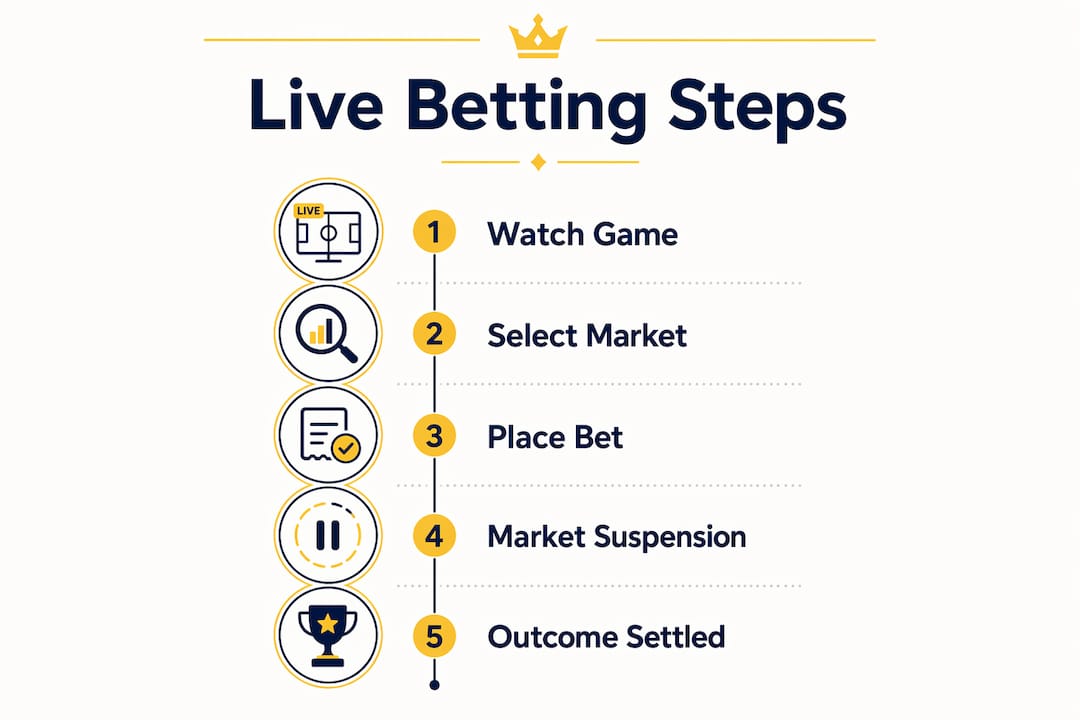
The process is straightforward once you understand the sequence. Here is how a typical in-play bet unfolds:
- Open the live section. Log into your sportsbook and navigate to the live or in-play tab. Events currently in progress appear here with real-time scores and available markets.
- Select your market. Markets like moneyline, spreads, totals, and micro-props are all available. Fast markets, such as “next team to score” or “next point in tennis,” resolve within minutes.
- Check the current odds. Odds refresh every few seconds. The number you see reflects the game state at that exact moment, not what it was two minutes ago.
- Enter your stake and submit. After you confirm your bet, the sportsbook processes it. If the odds shift between your click and the platform’s confirmation, you may receive a re-quote prompt asking you to accept the new price.
- Track your bet in real time. Most platforms show your active in-play bets alongside a live match tracker, so you can follow the action and your position simultaneously.
The re-quote step catches many new bettors off guard. Markets are suspended during high-impact moments like goals or red cards so odds can be recalculated. If you submit a bet just as a goal goes in, the platform pauses, recalculates, and presents you with a new price. You can accept or decline.
Pro Tip: Target fast markets early in a match when the game state is still relatively stable. Odds on “next scorer” or “next corner” tend to update slightly slower than the main match result market, giving you a brief window to find value.
What are the advantages of using a live betting feature?
In-play betting offers a set of advantages that pre-match wagering simply cannot replicate. The most significant ones are:
- Adaptability to real events. Live betting lets you adapt your wagers to injuries, tactical changes, and score shifts that were impossible to predict before kickoff. A key striker limping off in the 15th minute changes everything.
- Greater engagement and control. You are not locked into a decision made hours ago. You watch, assess, and act. That active involvement makes the experience far more engaging than waiting for a pre-match bet to settle.
- Momentum shift opportunities. A team down 1-0 at halftime but dominating possession often offers strong comeback odds. Those odds reflect the scoreline more than the actual game flow, creating genuine value windows.
- Diversified betting options throughout the match. You can place multiple bets across different markets as the game progresses, spreading your activity across the full 90 minutes rather than a single pre-match position.
- Hedging existing positions. If your pre-match bet looks shaky after 30 minutes, you can place an in-play bet on the opposing outcome to reduce your exposure.
“The real advantage of live betting is not just having more options. It is having better information than the market has fully priced in. When you spot a momentum shift before the odds catch up, that is where genuine edge lives.”
That edge is real, but it is also time-limited. Sportsbook algorithms update quickly, and the window between a game event and the odds reflecting it narrows every year.
How are live betting odds calculated and updated in real time?
Sportsbook algorithms integrate multiple real-time data streams to recalculate odds continuously. The primary inputs include current score, time remaining, possession statistics, shot counts, and injury reports. Odds can shift dramatically within a single half based on game flow, not just the scoreline.
| Data Input | Impact on Odds |
|---|---|
| Goal scored | Immediate, large shift in match result and next scorer markets |
| Red card | Significant shift toward the team with numerical advantage |
| Possession percentage | Gradual pressure on underdog odds when dominant team controls ball |
| Injury to key player | Rapid recalculation across all markets involving that team |
| Time remaining | Odds compress as the match approaches full time |
Human traders work alongside the algorithms to manage volatility during unusual events. If a situation falls outside the model’s training data, a human trader can suspend a market manually and set new parameters. This hybrid approach is standard across professional sportsbook operations.
One detail bettors often miss: bookmaker margins on live markets tend to be higher than pre-match, sometimes reaching 10–15% versus 5–8% for pre-match. That margin is the sportsbook’s premium for absorbing real-time risk. You are paying more for the privilege of betting with better information.
Pro Tip: Use a bookmaker odds comparison tool before placing live bets. Even a 0.5-point difference in odds on a live market can meaningfully affect your long-term returns.
What are effective strategies to use with a live betting feature?
Strategy in live betting separates profitable bettors from impulsive ones. The pace is fast, the margins are higher, and emotional decisions are expensive. These approaches consistently produce better outcomes:
- Decide before the match, not during it. Identify the scenarios where you plan to bet in-play before kickoff. For example: “If Team A goes down a goal before the 30th minute, I will back them at halftime.” Pre-planning removes emotion from the equation.
- Use real-time data tools. Professional bettors use odds aggregators and statistical platforms to spot pricing discrepancies rapidly. Watching a match on TV is not enough. You need possession data, expected goals, and shot maps to make informed calls.
- Account for broadcast delay. Broadcast delay runs 5–10 seconds, meaning the goal you just saw on TV was already processed by the sportsbook’s data feed seconds earlier. Professional bettors use direct match trackers to minimize this gap.
- Manage your bankroll aggressively. Higher margins mean you need to be more selective. Placing ten live bets per match at inflated margins is a fast way to drain your balance. Treat each in-play bet as a high-conviction position, not a reaction.
- Target momentum discrepancies. When a team is clearly dominating but the odds still reflect the scoreline rather than the game state, that gap is your opportunity. Learning to use statistics in high-stakes betting helps you identify these windows faster.
Pro Tip: Set a per-match live betting limit before the game starts. Decide your maximum exposure for in-play activity and treat it as a hard cap. The excitement of live action makes it easy to chase losses in ways you would never consider pre-match.
Key Takeaways
A live betting feature gives bettors a real informational edge, but higher margins and faster pace demand more discipline than pre-match wagering.
| Point | Details |
|---|---|
| Core definition | In-play betting lets you wager after an event starts, with odds updating in real time. |
| How odds update | Algorithms integrate score, possession, and injury data, with human oversight during volatile moments. |
| Margin awareness | Live markets carry margins of 10–15%, roughly double the 5–8% typical for pre-match bets. |
| Strategic discipline | Pre-plan your in-play scenarios before kickoff to avoid emotional, impulsive decisions. |
| Data tools matter | Odds aggregators and match trackers help you spot pricing gaps before the algorithm catches up. |
Live betting: what I’ve learned after years of watching the market
The single biggest mistake I see bettors make with in-play wagering is treating it like a faster version of pre-match betting. It is not. The mechanics are different, the margins are different, and the psychological demands are completely different.
Pre-match betting rewards research done in advance. Live betting rewards pattern recognition under pressure. Those are two distinct skills, and most bettors only develop one of them. The bettors who consistently find value in live markets are the ones who arrive with a plan, not the ones who react to every goal.
The margin issue also gets underestimated. Paying 10–15% to the house on every live bet means you need a significant edge just to break even. That is not a reason to avoid live betting. It is a reason to be highly selective. One well-timed in-play bet on a momentum shift you identified before the odds caught up is worth more than ten reactive bets placed out of excitement.
My honest advice: start by watching matches with live odds open, without placing any bets. Track the moments where you would have bet and whether those bets would have won. That practice builds pattern recognition without the financial risk. When you do start betting in-play, treat every position as a high-conviction call, not a casual wager. The platform that supports you with fast odds, clear market data, and reliable bet confirmation makes a real difference in how well you can execute that approach.
— Jaye
Goldbet888’s live betting platform for real-time football wagering
Goldbet888 offers a full range of live sports betting markets covering football, including Asian Handicap, Over/Under, and match result options with dynamic odds that update throughout the game.

The platform is built for football bettors in Singapore who want fast execution and competitive odds during live matches. Goldbet888 reports withdrawal processing in as little as three minutes, so your winnings move quickly. A community of 5,000+ Telegram members shares real-time match previews and in-play insights, giving you an additional layer of analysis when odds are shifting fast. For FIFA World Cup 2026 coverage, Goldbet888 provides dedicated World Cup betting markets with live odds across all group and knockout stage matches.
FAQ
What is in-play betting?
In-play betting, also called live betting, is wagering on a sporting event after it has started, with odds that update continuously to reflect the current game state.
Why do live betting odds change so fast?
Sportsbook algorithms process real-time data feeds including score, possession, and injury reports every few seconds, causing odds to shift rapidly as the game evolves.
Are live betting margins higher than pre-match?
Live betting margins typically reach 10–15%, compared to 5–8% for pre-match markets, reflecting the higher risk and volatility the sportsbook absorbs.
What is a market suspension in live betting?
A market suspension occurs when the sportsbook pauses betting during high-impact events like goals or red cards to recalculate odds before accepting new wagers.
How can I improve my live betting results?
Use real-time data tools and match tracking platforms to offset broadcast delays, pre-plan your in-play scenarios before kickoff, and limit your bets to high-conviction positions to manage the higher margins.