Betting terms and conditions are legally binding contracts. The moment you place a wager on a platform like BetMGM or Caesars Sportsbook, you’ve entered a formal agreement that governs every aspect of your bet, from payout rules to dispute resolution. These aren’t just fine print. They define what the operator owes you, what you owe them, and what happens when things go sideways. Under U.S. law, betting agreements are enforceable contracts subject to state-specific regulation, which means the terms you accept carry real legal weight.
Here’s what every bettor needs to know upfront:
- Betting T&Cs are contracts. Accepting them creates mutual obligations between you and the operator.
- State gaming commissions regulate these agreements and can intervene in disputes.
- Key clauses cover payouts, bet voids, bonuses, and data privacy.
- Ignoring the terms can cost you winnings, trigger account suspension, or eliminate your right to dispute.
- Regulatory bodies like state gaming commissions in New Jersey, Nevada, and Pennsylvania enforce operator compliance.
- Your rights as a bettor include formal complaint channels, dispute resolution processes, and consumer protections under state law.
Understanding these agreements isn’t optional if you’re serious about protecting your money.
Table of Contents
- 1. Why betting terms and conditions are legally binding contracts
- 2. Key terms and conditions you must understand before betting online
- 3. What legal rights and remedies do U.S. bettors actually have?
- 4. What happens when you don’t accept or violate betting terms?
- 5. Transparency and dispute resolution trends in U.S. sports betting
- Key Takeaways
- Goldbet888 puts transparent betting terms where you can find them
1. Why betting terms and conditions are legally binding contracts
Every bet you place is a contract under U.S. law. 31 U.S. Code § 5362 defines a “bet or wager” as the staking of something of value upon an outcome, under an agreement that the bettor will receive something of value if a certain result occurs. That definition alone signals that wagering is a contractual act, not a casual transaction.
State law governs the enforceability of these agreements. In New Jersey, Pennsylvania, Michigan, and other regulated markets, sportsbooks must file their house rules with state gaming authorities. Those rules, once approved, become the binding framework for every wager placed on the platform. You can’t opt out of them after placing a bet.
Pro Tip: Before depositing on any sportsbook, search for the platform’s “house rules” or “terms and conditions” page. Look specifically for sections on bet settlement, void conditions, and dispute resolution. These three clauses will affect you most directly.
The practical implication is straightforward: if a sportsbook’s terms say a bet is void when an event is abandoned before a certain elapsed time, that clause will hold up. Courts and regulators treat these agreements as standard commercial contracts. Operators have obligations too, and state gaming commissions can penalize them for breaching their own published terms.
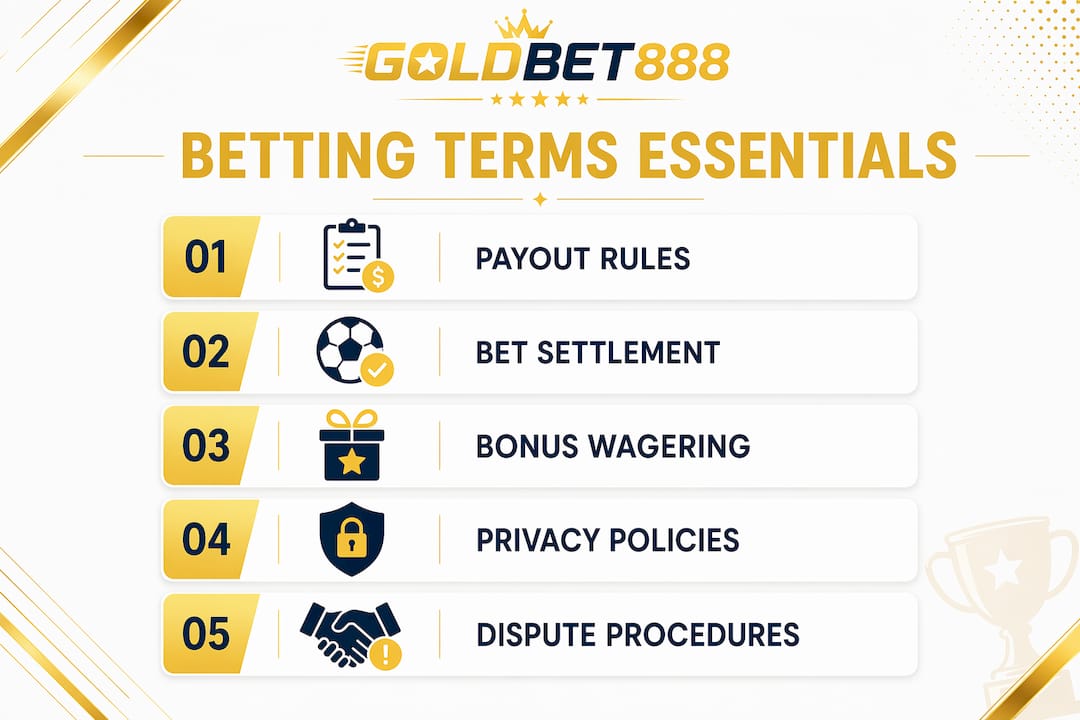
Offshore gambling sites operate entirely outside this framework. No U.S. legal recourse exists against offshore operators in a dispute, which is precisely why regulated platforms with state-approved terms offer bettors a fundamentally safer environment.
2. Key terms and conditions you must understand before betting online
Not all clauses carry equal weight. Some are routine; others can directly determine whether you get paid. Here are the categories that matter most.
Payout and withdrawal conditions
Withdrawal rules vary dramatically across platforms. Most sportsbooks specify minimum withdrawal amounts, processing windows, and verification requirements. Some require identity documents before releasing funds above a certain threshold. Read these before you deposit, not after you win.

Bet settlement and void rules
Bookmakers frequently use clauses allowing bet voiding for “palpable errors,” which are obvious pricing mistakes like reversed odds or wildly incorrect lines. If a line is posted at +5000 when it should be +500, the operator can void your bet even after you’ve won. This clause is legal, widely used, and almost never negotiated.

Event abandonment rules add another layer. Some sportsbooks require a minimum elapsed time for a bet to stand; others void all wagers if a game is postponed beyond a set window. When the NFL preseason game was canceled in August 2024, bettors discovered that different platforms applied completely different rules to the same event.
Bonus and wagering requirements
Promotional bonuses almost always come with wagering requirements, sometimes called “rollover” conditions. A $200 bonus with a 10x rollover means you must wager $2,000 before withdrawing any bonus-derived funds. Failing to meet these requirements before withdrawing can result in the bonus being stripped from your balance entirely.
Privacy and data protection clauses
Sportsbooks collect significant personal data: name, address, payment details, betting history, and in some states, Social Security numbers for tax reporting. Terms and conditions specify how this data is stored, shared with third parties, and used for marketing. Under state privacy laws and federal frameworks, operators must disclose these practices, but the specifics vary. Check whether the platform sells data to third-party advertisers and whether you can opt out.
Pro Tip: If a sportsbook’s privacy clause says it shares data with “affiliated partners” without defining who those partners are, treat that as a red flag. Regulated platforms in New Jersey and Pennsylvania must meet specific data security standards as a condition of their license.
Here’s a quick checklist of the critical clauses to locate in any betting agreement:
- Bet void and palpable error policy
- Event abandonment and postponement rules
- Withdrawal minimums, processing times, and verification requirements
- Bonus wagering requirements and expiration dates
- Account suspension and termination conditions
- Prohibited bet types and restricted markets
- System glitch and technical error policies
- Data collection, sharing, and retention practices
- Dispute resolution process and governing jurisdiction
- Responsible gambling tools and self-exclusion options
Operators may also embed prohibited bet type clauses that allow them to void entire stakes on bets placed due to system glitches, meaning you lose your original wager even when the error wasn’t yours.
3. What legal rights and remedies do U.S. bettors actually have?
U.S. bettors have more recourse than most realize, provided they’re using a state-licensed platform. The key is knowing the process before you need it.
- Document everything immediately. Screenshot your bet slip, the odds at time of placement, and any confirmation messages. If a dispute arises, this is your primary evidence.
- Submit a formal complaint to the sportsbook first. Most platforms require you to exhaust internal dispute channels before escalating. Keep records of all communications and note response times.
- File with your state gaming commission. In New Jersey, the Division of Gaming Enforcement handles bettor complaints. Pennsylvania has the Gaming Control Board. Nevada’s Gaming Control Board has the longest-established dispute process in the country, and several states have modeled their procedures after Nevada’s approach.
- Reference the operator’s approved house rules. Regulators will compare the operator’s conduct against their own filed terms. If the platform deviated from its approved rules, that’s a compliance violation.
- Escalate to consumer protection agencies if needed. The Federal Trade Commission handles deceptive trade practices. State attorneys general offices can pursue operators that systematically violate consumer protection statutes.
- Consult a gaming attorney for high-value disputes. For significant sums, legal counsel familiar with your state’s gaming law is worth the cost.
In New Jersey specifically, operators must provide evidence of system failure and obtain regulatory approval before canceling wagers. That’s a meaningful protection. The operator can’t simply decide a bet was an error and void it without accountability.
Pro Tip: Always bet on state-licensed platforms. Offshore sportsbooks have no obligation to honor your dispute, and no U.S. regulator can compel them to pay. The terms and conditions of an unlicensed site are essentially unenforceable from your side of the transaction.
Consumer protections under the Unlawful Internet Gambling Enforcement Act and state gaming statutes create a floor of rights for bettors on licensed platforms. Those rights don’t extend to offshore operators, which is why the choice of platform is itself a legal decision.
4. What happens when you don’t accept or violate betting terms?
The consequences are concrete and often immediate. Failure to comply with betting terms can lead to bet voids, denied payouts, and account suspensions per operator policies. Here’s how that plays out in practice:
- Bet voiding. If you place a wager that violates a prohibited bet type clause, the operator can void the stake entirely, returning nothing.
- Winnings withheld. Operators routinely freeze accounts pending review when they suspect terms violations, including bonus abuse or multi-accounting.
- Account suspension or permanent ban. Repeated violations, or a single serious breach like using a VPN to circumvent geo-restrictions, typically result in permanent account closure.
- Bonus forfeiture. Withdrawing before meeting wagering requirements strips the bonus and any winnings derived from it.
- Denied withdrawal. If your account hasn’t completed identity verification as required by the terms, the platform can hold your funds until you comply, or indefinitely if you can’t.
- Loss of dispute rights. Some terms specify that violations forfeit your right to formal dispute resolution, leaving you with no internal recourse.
The most common scenario is bonus abuse. Bettors who create multiple accounts to claim the same welcome offer, or who use promotional funds in ways the terms prohibit, almost always lose both the bonus and any associated winnings. Operators use pattern-detection software to flag these accounts, and the terms give them full authority to act.
Sportsbooks prioritize adherence to house rules over goodwill payouts, especially in edge cases involving event suspensions or cancellations. A “good faith” expectation of payment is not a guarantee. The published rules are the guarantee, which is exactly why reading them matters before you bet.
5. Transparency and dispute resolution trends in U.S. sports betting
The regulatory environment for U.S. sports betting is shifting toward greater bettor protection, and the pace is accelerating. There is a clear regulatory trend pushing for mandatory transparency and standardized dispute resolution across licensed states.
Nevada’s Gaming Control Board established the template: a formal, state-administered process where bettors can escalate disputes beyond the operator’s internal review. New Jersey, Pennsylvania, and Michigan have each built similar frameworks. The practical effect is that bettors in these states have a genuine legal path when an operator refuses to pay or voids a winning bet without adequate justification.
The debate over “palpable error” clauses is at the center of this regulatory conversation. Bookmakers use these clauses as insurance to void winning bets, and the fairness of that practice is under increasing scrutiny. Some state regulators are pushing for clearer definitions of what constitutes a palpable error, and for requirements that operators prove the error before voiding rather than after.
Regulatory watchpoint: In states where operators must obtain regulatory approval before canceling wagers, the burden of proof sits with the sportsbook, not the bettor. That’s a significant shift from the default position in less-regulated markets.
Pro Tip: Check your state gaming commission’s website for a published complaint form before you ever need it. Knowing the process in advance means you can act quickly if a dispute arises, and speed matters when accounts are frozen.
The broader trend is toward standardization. Industry groups and state regulators are in active discussions about creating uniform disclosure requirements for key terms, particularly around void conditions and withdrawal timelines. For bettors, this means the landscape is improving, but the current patchwork of state-by-state rules still demands that you read the specific terms of every platform you use.
BetMGM and Caesars Sportsbook both publish detailed house rules and maintain state-specific terms pages that reflect local regulatory requirements. Comparing how each platform handles event abandonment, palpable errors, and dispute escalation gives you a clear picture of where your protections are stronger before you commit your money.
Key Takeaways
Betting terms and conditions are enforceable contracts under U.S. state law, and understanding them is the single most effective way to protect your money and your rights as a bettor.
| Point | Details |
|---|---|
| T&Cs are binding contracts | Accepting a sportsbook’s terms creates legally enforceable obligations for both you and the operator. |
| Palpable error clauses carry real risk | Operators can void winning bets for pricing mistakes; state regulators in New Jersey require proof before cancellation is allowed. |
| State gaming commissions are your ally | Nevada, New Jersey, and Pennsylvania all offer formal bettor complaint processes that go beyond the operator’s internal review. |
| Violating terms costs you winnings | Bonus abuse, multi-accounting, or prohibited bet types can result in voided stakes and permanent account closure. |
| Goldbet888 prioritizes transparency | Goldbet888 publishes clear terms and conditions, giving bettors the upfront clarity that regulated, trustworthy platforms provide. |
Goldbet888 puts transparent betting terms where you can find them
If reading through dense sportsbook agreements has you second-guessing where to place your bets, the answer is a platform built around clarity from the start. Goldbet888 is a football-focused betting platform with transparent terms and conditions published openly, so you know exactly what governs your wagers before you deposit a dollar.

What sets Goldbet888 apart isn’t just the odds. Reported withdrawals are processed in as little as three minutes, which means your winnings move fast when you’re ready to cash out. The platform’s 5,000-plus Telegram community shares match previews and betting insights in real time, giving you context that most bettors never access. For the FIFA World Cup 2026, Goldbet888 offers specialized markets including Asian Handicap and Over/Under betting, with odds consistently positioned to deliver value.
You’ve just spent time understanding why betting agreements matter. The next step is betting on a platform where those agreements work in your favor. Check out live odds and football markets on Goldbet888 and place your first bet with full confidence in the rules behind it.