What does a football betting analyst actually do?

A football betting analyst is a specialist who uses statistical modeling, market timing, and tactical research to identify value bets before bookmakers fully adjust their lines. This is not a fan with strong opinions or a tipster posting gut feelings. The role sits closer to a quantitative trader than a pundit, with long-term ROI as the only scoreboard that matters.
The core job breaks into three pillars:
- Value identification: Finding odds where the bookmaker’s implied probability is lower than the analyst’s own estimate
- Market timing: Spotting lines that haven’t adjusted yet to new information like injuries or lineup changes
- Market selection: Choosing specific bet types, such as Over/Under or Asian Handicap, where the analyst holds a genuine edge
The industry term for this work is quantitative sports analysis, though “football betting analyst” is how most bettors search for it. The distinction from casual tipsters is simple: analysts build independent probability estimates before looking at the odds. Looking at the odds first anchors your thinking to the bookmaker’s number, which defeats the purpose entirely.
Key functions and techniques football betting analysts use
Analysts do not try to predict every match. They look for specific, repeatable situations where the market is mispriced.
- Pricing model construction: Analysts build spreadsheet or software-based models to estimate true odds, then compare those to live bookmaker lines to find positive expected value (+EV) bets
- Market timing: Chris Vasile, a betting analyst with over 13 years of experience breaking down soccer markets, focuses specifically on lines that are slow to adjust due to scheduling spots, player usage, or recent form
- Tactical and statistical match analysis: Form trends, expected goals (xG), head-to-head context, and lineup matchups all feed into a forecast
- Niche specialization: Focusing on one or two leagues builds depth that broad-coverage analysis cannot match
- Tracking market movement: Distinguishing sharp money from recreational volume tells an analyst whether a line shift reflects real information or just public hype
Pro Tip: Avoid analyzing every match superficially. Analysts who specialize in niche markets consistently outperform those who spread attention across dozens of leagues.
Why data beats narratives in football betting
The most common mistake recreational bettors make is betting on a story. The underdog with emotional momentum. The team “due” for a win. These narratives feel compelling, but they do not change the math.
- Successful analysts reject narratives in favor of numbers because popular storylines often ignore the actual odds determining profitability
- Bookmaker odds fluctuate due to market noise, meaning public betting volume unrelated to team quality; experienced analysts track these shifts to assess whether current odds still offer playable value
- Mathematical probability underpins every winning strategy; betting based on emotion jeopardizes long-term profit
Stat callout: A football betting strategy aims not to guarantee profit, but to reduce losses compared to bookmaker expectations through disciplined value betting before odds move.
The professional mindset shift is clear: once you start measuring every bet against your own probability model, narratives lose their pull. Numbers either support the bet or they don’t.
How analyst insights improve your betting strategy and ROI
Applying analyst thinking to your own betting does not require a mathematics degree. It requires structure and discipline.
- Market selection over match prediction: Choosing specific markets like Over/Under 2.5 goals or Asian Handicap offers clearer paths to profit than trying to call every match winner
- Bet timing: Placing bets before lines move, especially after late team news, captures the most value
- Bankroll discipline: Set a flat stake percentage per bet and track every result in a spreadsheet; a disciplined staking approach lets you assess genuine edge over a large sample
- Focused market depth: Analysts like Julian Keller combine predictive modeling with tactical breakdowns to strip away market noise and surface quantifiable value
Expert community and platforms that support football betting analysis
Credible analysts publish their process, not just their picks. That transparency is what separates professionals from noise.
- Chris Vasile (Covers.com) brings over 13 years of soccer market analysis, with work appearing on VSiN, BetMGM Network, and SportsGrid, focusing on timing-based value over volume
- Julian Keller (WeBetSmart) specializes in predictive modeling and tactical breakdowns of European football, weighing form, xG trends, and lineup matchups against market prices
- Goldbet888 supports bettors applying these insights with specialized football betting options, fast withdrawals, better odds, and a Telegram community of over 5,000 members sharing match previews and analysis
Goldbet888’s community model mirrors how professional analysts work: shared data, rapid information flow, and collective scrutiny of market movements before lines settle.
Understanding the full value of a football betting analyst
A football betting analyst brings a structured, data-first approach that casual bettors rarely apply consistently.
- Analysts focus on data, market timing, and value identification, not match predictions alone
- They differ from tipsters by building independent probability models before consulting bookmaker odds
- Their methods, applied with discipline, help bettors reduce losses and, for the sharpest, generate genuine long-term edge
What skills and qualifications does a football betting analyst need?
Strong analysts typically combine a quantitative background with deep football knowledge. A degree in mathematics, statistics, or economics provides the modeling foundation, but practical experience reading markets matters just as much. Luke Barber, a professional sports gambler and former bookmaker quantitative analyst, built his career by applying a First Class Master’s degree in Mathematics directly to football pricing models. Beyond credentials, analysts need spreadsheet proficiency, familiarity with expected goals metrics, and the discipline to track results honestly over hundreds of bets.
What tools do football betting analysts commonly use?
The core toolkit centers on data and probability. Analysts rely on:
- Spreadsheet software (Excel, Google Sheets) for building pricing models and tracking bet history
- Expected goals databases like Understat or FBref for match-level statistical research
- Odds comparison platforms to monitor line movement across bookmakers
- Statistical software (R or Python) for analysts running more advanced regression or simulation models
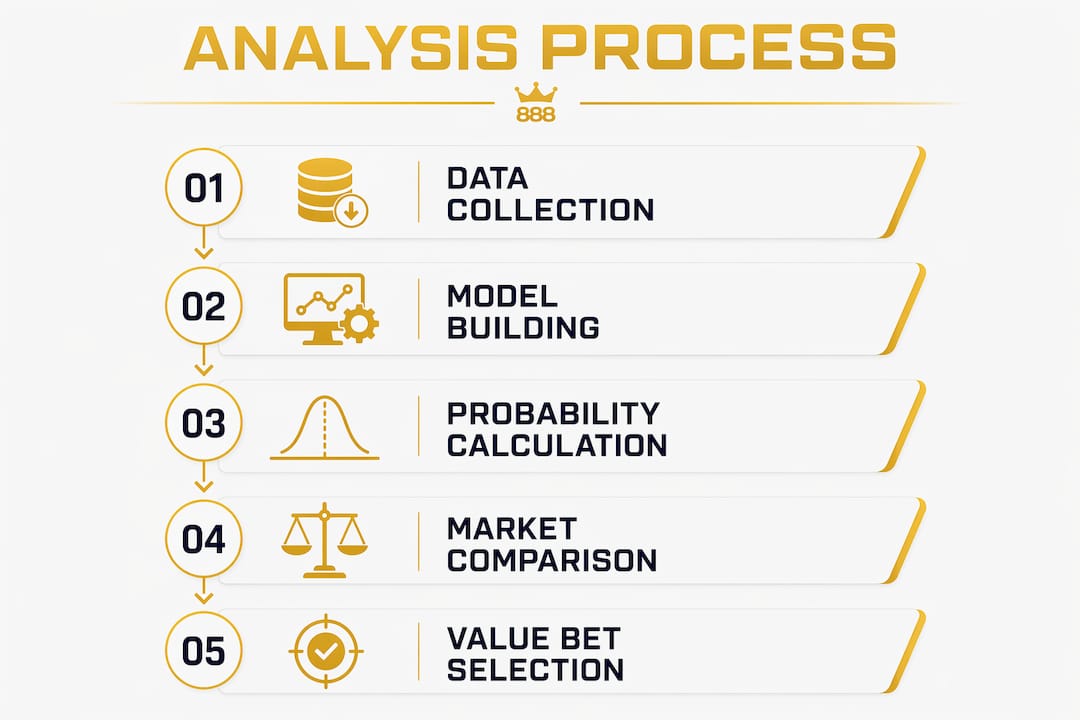
The goal of every tool is the same: compare your estimated true probability to the bookmaker’s implied probability and find the gap.
How do football betting analysts make predictions in practice?
A typical prediction process starts with the analyst’s own model, not the odds. Julian Keller’s approach illustrates this well: he weighs form trends, xG data, head-to-head context, and lineup matchups, then compares that picture to the current market price to identify genuine value. Chris Vasile looks for lines slow to adjust to scheduling spots or player usage changes, then explains why the number is worth playing. The common thread is that both analysts build their case independently before the bookmaker’s price enters the picture.
Limitations and risks of relying on football betting analysts
No analyst wins every bet, and following picks blindly carries real risk. Bookmakers restrict accounts that show consistent profitability, which limits even the sharpest analysts over time. Analysts also specialize, so their edge in one league or market may not transfer to another. Past performance in a small sample proves little; genuine edge only shows across hundreds of bets. Treat analyst insights as one input into your own structured process, not a guaranteed income stream.
How to find and evaluate credible football betting analysts
Credibility comes from transparency, not confidence. Look for analysts who publish their full record, including losses, with timestamps. Check whether they explain their reasoning in terms of probability and market pricing, not just who they think will win. Established analysts like Chris Vasile and Julian Keller document their methodology publicly. Avoid anyone promising guaranteed profits or refusing to show a verified track record. A betting community with open discussion and shared analysis, like Goldbet888’s Telegram group, also helps you pressure-test picks before acting on them.
Key Takeaways
A football betting analyst builds independent probability models to find value bets, focusing on market timing and disciplined market selection rather than match prediction alone.
| Point | Details |
|---|---|
| Core role | Analysts identify value bets by comparing their own probability estimates to bookmaker odds before lines move. |
| Market selection | Markets like Over/Under 2.5 goals and Asian Handicap offer clearer profit paths than standard match winner bets. |
| Data over narratives | Betting based on popular storylines jeopardizes long-term profit; mathematical probability drives winning strategies. |
| Niche specialization | Focusing on specific leagues or markets builds the depth needed to outperform broad-coverage analysis. |
| Credibility check | Trustworthy analysts publish full records with reasoning; avoid anyone promising guaranteed profits. |
Ready to apply analyst-level thinking to your bets? Goldbet888 offers live football odds across all major markets, plus a 5,000-member Telegram community delivering real-time match previews and analysis.