What is a betting confidence rating?
A betting confidence rating is a 0–100 score that measures how strongly a set of predictive models agrees on a wager’s likely outcome. It is a probability estimate, not a promise. When PropsBot AI assigns a player prop a confidence score of 80, it means multiple independent AI models are pointing in the same direction with similar magnitude. When those models disagree or the data is thin, the score drops toward 50 or below.
- What it measures: Model agreement across multiple independent algorithms
- What it is not: A guaranteed win, a betting odds equivalent, or a direct win probability
- Scale: 0 to 100, where 75+ signals strong agreement and under 50 signals weak or conflicting signals
- Key distinction: Confidence measures how aligned the models are; edge measures whether the sportsbook has mispriced the outcome
Understanding this distinction up front saves bettors from the most expensive mistake in data-driven wagering: treating a high confidence score as a lock.
How AI models calculate confidence scores
Confidence scores are derived by aggregating the outputs of multiple independent predictive models, then weighting those outputs by data quality factors. PropsBot AI, for example, runs each prop through 3–7 independent models depending on the sport and market type, using algorithms like XGBoost, LSTM networks, and gradient-boosted regressors.
The weighting factors that shape the final score include:
- Recency of data: More recent game results carry heavier weight than older ones
- Sample size: Matchups with limited historical data produce lower, less reliable scores
- Injury report freshness: Updated lineup news directly affects model confidence
- Model convergence: When all models predict the same outcome with similar magnitude, confidence climbs into the 80–90+ range; when models split, it drops to 50–60
TrueGameStats applies a comparable approach, cross-referencing player performance trends against opponent defensive tendencies before generating a consensus score. The core logic across platforms is the same: confidence quantifies collective model agreement, not the raw probability that a bet wins.
Pro Tip: Check when a platform last updated its injury data before trusting a high confidence score. A 90-rated pick built on stale lineup information can be far weaker than the number suggests.

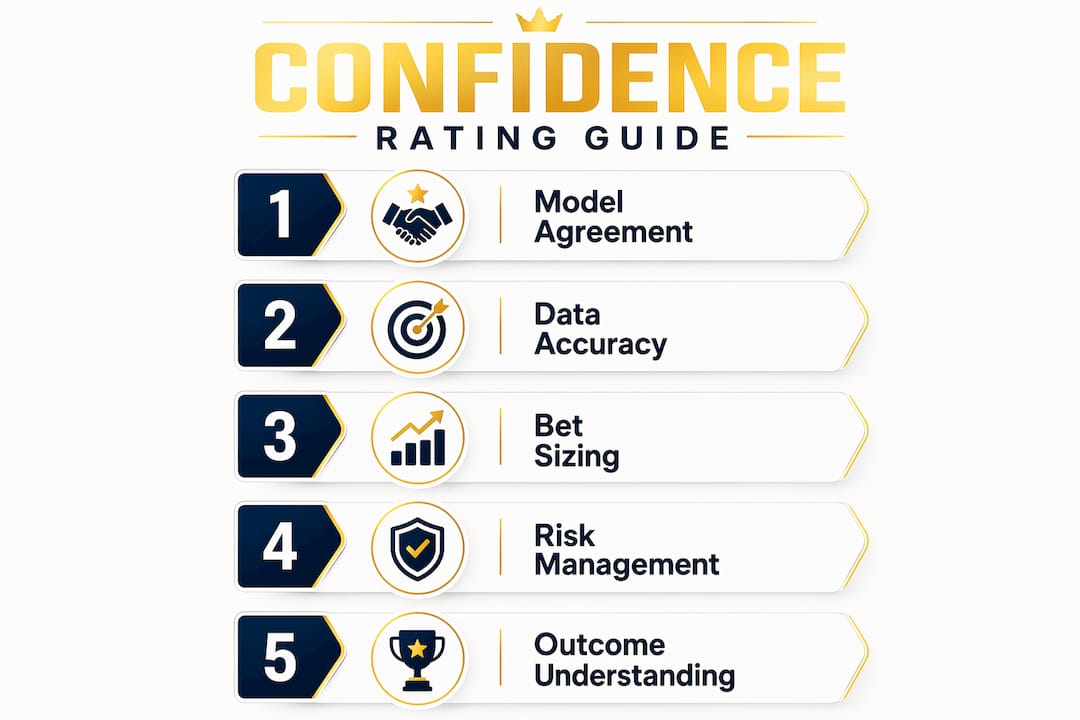
How to interpret confidence scores and use them in your betting
Calibrated confidence scores reflect expected win frequency across many similar situations, not certainty in any single game. A 70% confidence pick is expected to win roughly 70 times out of 100. It is also expected to lose 30 times. That is not a model failure; that is probability working exactly as described.
Here is how the standard confidence tiers translate into practical betting decisions:
- 75–89%: Strong favorites with meaningful edge. This tier is the most productive range for straight bets. The model sees a clear lean but acknowledges real competitive tension, which is exactly where value lives.
- 60–74%: Slight lean. The model detects an edge but the outcome is genuinely uncertain. These picks work better as parlay legs or lower-stakes plays rather than standalone high-confidence wagers.
- 55–59%: Essentially a coin flip. The model detects a marginal lean but cannot separate the teams meaningfully. Picks below 60% confidence are often treated as coin flips and discouraged for straightforward betting by expert guidelines.
Calibration is the real test of any confidence system. A well-calibrated model shows that 70% picks land roughly 70% of the time, 80% picks land roughly 80%, and so on. If a platform’s 85% picks only land 65% of the time, the model is overconfident and the scores cannot be trusted at face value.
Pro Tip: Before committing to any platform’s confidence scores, pull their historical accuracy data by tier. A provider whose 70% picks actually land 70% of the time is worth far more than one flashing 90% scores that hit at 65%.
A
still carries roughly a 10% chance of losing. Regular misses on high-confidence bets are consistent with calibrated probabilities, not model failures.
How betting platforms display confidence ratings
Most platforms display confidence ratings using numerical scales and color codes, letting bettors scan a full slate quickly without reading every line. The color system typically runs from red at the low end through amber in the middle to green for strong picks, with each color bucket corresponding to a confidence range.
Key features you will find on well-built platforms:
- Numerical score alongside odds: PropsBot AI shows the confidence score directly next to the edge score for every prop, so bettors see both signals at once
- Color-coded chips: BetFinder uses a decile-based color slide from deep red near 0% to lime green at the top of the scale
- Value tags: A green edge tag appears only when a pick’s best available odds genuinely beat its fair probability, keeping confidence and value signals visually separate
- Threshold filters: PropsBot AI recommends confidence of 60+ for experienced bettors who can handle more variance, with 75+ signaling strong agreement for productive straight bets.
TrueGameStats integrates confidence scores with matchup-specific context, displaying them alongside statistical match tips so bettors can see the data driving the score rather than just the number itself. OddsJam takes a slightly different approach, framing confidence around cross-market odds comparison: when every sportsbook’s line agrees that a bet is positive expected value, OddsJam treats that consensus as a high-confidence signal.
Confidence rating vs. edge: why you need both
Confidence and edge answer two completely different questions. Mixing them up is one of the most common and costly errors in data-driven betting.
- Confidence asks: Do my models agree on the outcome?
- Edge asks: Has the sportsbook mispriced the line relative to the true probability?
A pick can score 90 on confidence and still carry zero edge. That happens when the sportsbook has correctly priced the outcome, meaning the market already agrees with the models. There is no value in that bet regardless of how aligned the algorithms are. Conversely, a 60-confidence pick with an 8% edge represents weaker model agreement but a meaningful mispricing, which is playable but volatile.
Confidence measures model agreement; edge measures the probability gap between the modeled outcome and the sportsbook’s implied probability. The strongest signal combines both: high model agreement AND a line that undervalues the outcome. Good confidence scores are typically 60–70%+, but they must be paired with positive expected value based on sportsbook implied odds to produce profitable bets over time.
Understanding betting odds explained in terms of implied probability is the bridge between confidence and edge. A 75% confidence pick where the sportsbook implies 60% probability has genuine positive expected value. The same 75% confidence pick where the sportsbook also implies 75% has no edge at all.
Practical bankroll management using confidence ratings
Confidence ratings are most powerful when they drive bet sizing, not just pick selection. The core principle is proportionality: higher confidence should mean a larger position, but always within a disciplined bankroll framework.

A practical sizing approach suggests that higher confidence should mean larger position sizes, but always within a disciplined bankroll framework. Less confident picks warrant smaller or minimal stakes, while picks indicating weak signal strength should be skipped for straight bets.
Confidence ratings enable structured bankroll management by scaling bet sizes proportional to perceived strength, which prevents emotional overbetting. The discipline to pass on marginal picks is worth more than the occasional win on a 55% call. Seasoned bettors treat confidence scores as frequencies, not verdicts, which means losses on high-confidence bets are expected statistically and require bankroll discipline to weather the variance.
One trap to avoid: chasing losses after a high-confidence miss. When a 90% pick loses, the temptation is to double down on the next strong pick to recover. Each prediction is independent. The next 90% pick carries the same 10% miss rate regardless of what just happened. Applying proper bet sizing consistently across a large sample is what separates profitable bettors from those who blow up their bankroll on a short losing streak.
Goldbet888 brings confidence-rated betting to football fans
Applying confidence ratings to live football markets is where the theory pays off, and Goldbet888 is built for exactly that. While tools like PropsBot AI and TrueGameStats generate confidence scores for US-focused prop markets, Goldbet888 delivers expert-curated match previews and live football odds with the kind of community-backed insight that sharpens your edge on every fixture.

Goldbet888’s 5,000+ member Telegram community shares real-time match analysis, injury updates, and confidence-informed tips before kickoff, giving you the data inputs that matter most when assessing a bet’s strength. The platform’s focus on Asian Handicap and Over/Under markets means you are always comparing confidence signals against lines where value genuinely exists, not just chasing favorites at short odds. With withdrawals processed in three minutes and odds consistently positioned to offer value, Goldbet888 gives you the speed and pricing to act when a high-confidence opportunity appears. Ready to put confidence ratings to work on the FIFA World Cup 2026? Join Goldbet888 and bet with data behind every decision.
Key Takeaways
A betting confidence rating measures model agreement on a 0–100 scale and must be combined with positive expected value against sportsbook odds to identify genuinely profitable bets.
| Point | Details |
|---|---|
| Confidence measures model agreement | A score of 75+ signals strong model alignment; under 50 means models disagree or data is sparse. |
| Calibration determines trustworthiness | A reliable model’s 70% picks should land roughly 70% of the time; inflated scores mislead bettors. |
| Confidence and edge are separate signals | High confidence with zero edge means no value; seek picks where both signals are strong. |
| Bet sizing should follow confidence tiers | Scale positions proportional to confidence: higher confidence warrants larger stakes within disciplined bankroll limits, while picks below 60% confidence should be treated as coin flips and played at minimal or no stake, according to expert guidelines. |
| Goldbet888 for live football | Goldbet888 pairs community-driven match previews with live odds on Asian Handicap and Over/Under markets. |