Head-to-head stats matter when recent meetings, venue splits, or a persistent tactical mismatch drive the pattern. When the sample is old, mixed across competitions, or built on rosters that no longer exist, it’s mostly noise dressed up as insight. That single distinction separates bettors who use H2H as a genuine edge from bettors who get burned chasing a scoreline from three managers ago.
Before you open the next fixture card, run these three checks:
- Trust H2H only for recent, same-competition meetings with stable personnel. A pair of matches from the last two seasons, same league, similar squads, tells you far more than a decade-long record padded with cup upsets.
- Treat H2H as a secondary tiebreaker, not your headline stat. Current form and underlying numbers like expected goals should set your baseline probability first; H2H only nudges it.
- Discount long, mixed-venue historical streaks. Ten meetings spread across home legs, away legs, and neutral tournament venues rarely isolate a real effect.
Rating systems like Elo and formal frameworks such as the Bradley–Terry model exist precisely because raw head-to-head tallies are unreliable on their own. Platforms like Goldbet888 build their odds around exactly this kind of layered analysis, not a lone scoreline from 2019.
Key Takeaways
Head-to-head stats meaningfully improve betting decisions only when they’re filtered for recency, venue, and a confirmed tactical mechanism, and otherwise function as noise.
| Point | Details |
|---|---|
| Prioritize recency | Limit H2H analysis to the last two years or three meetings in the same competition. |
| Check venue every time | Separate home, away, and neutral results before drawing any conclusion from a record. |
| Demand a mechanism | Only trust a pattern backed by a repeatable tactical or personnel reason, not a memorable scoreline. |
| Use ratings for baselines | Lean on Elo or Bradley–Terry style ratings for season-long strength, save raw H2H for fixture-specific checks. |
| Treat H2H as a tiebreaker | Set your probability with form and xG first, then let H2H nudge it, never lead with it. |
| Act on confirmed edges with Goldbet888 | Goldbet888’s Asian Handicap and Over/Under markets, live betting, and fast PayNow/USDT withdrawals let bettors apply a verified H2H read quickly. |
Table of Contents
- What Head-to-Head Stats Are and How They’re Reported
- How Does H2H Influence Betting Markets and Decisions?
- How Do Leagues Use Head-to-Head vs Goal Difference?
- A Step-by-Step Checklist for Analyzing H2H Data
- What Statistical Models Formalize Head-to-Head Data?
- When Does Head-to-Head Data Mislead Bettors?
- How to Build H2H Into a Repeatable Betting Routine
- An Experienced Bettor’s Take on Head-to-Head Data
- Put Your H2H Analysis to Work on Goldbet888
- Frequently Asked Questions
- Sources
What Head-to-Head Stats Are and How They’re Reported
Head-to-head stats, usually shortened to H2H, record the results of every past meeting between two specific teams. Most databases show them as a win-draw-loss (W-D-L) count with match dates, final scorelines, and sometimes the competition each match belongs to.
A typical H2H summary row looks something like this in practice: “Team A vs Team B, last 10 meetings: 4 wins, 3 draws, 3 losses, goals 14-11, last meeting March 2025 (league, away win).” That single line packs in outcome, scoring pattern, recency, and venue, but only if you unpack it correctly.
The fields that matter most, and what each one actually signals, break down cleanly:
| H2H Field | Practical Signal It Provides |
|---|---|
| Count of meetings | Sample size; fewer than 4-5 recent games limits statistical confidence |
| Wins/draws/losses | Broad outcome tendency, but hides scoring context |
| Scorelines | Reveals attacking/defensive patterns, not just who won |
| Competition type | Distinguishes league form from cup randomness or friendlies |
| Venue split (home/away/neutral) | Isolates whether one side has a genuine location advantage |
| Recency indicators | Flags whether the data reflects current squads or stale rosters |
A raw W-D-L line without this context is genuinely misleading. It conflates a Champions League away win from 2021 with a domestic league draw from last month, treating both as equal data points. A practical guide to reading H2H stats makes the same point directly: weight recent meetings heavily, check venue, and treat anything older than roughly two years as background noise for team sports rather than as an active signal. That’s the standard analysts and serious bettors already use, even when casual previews still lean on the raw tally.
How Does H2H Influence Betting Markets and Decisions?
Head-to-head data doesn’t move every market equally. It carries the most weight in match winner odds, both-teams-to-score lines, and total goals markets, because these bets are directly tied to scoring and defensive tendencies that can repeat between two specific opponents.
The mechanics work like this: when a matchup pattern is real (say, one team’s high press consistently unravels a specific opponent’s slow-building defense) that edge can exist in the market for a window before odds compilers fully price it in. But once enough sharp money and public data catch on, the edge shrinks fast. Bookmakers already run their own paired-comparison models, so betting purely on “Team X always beats Team Y” without checking why is usually betting against efficient pricing, not against the public.
Here’s how to weight H2H against your other inputs when building a pre-match view:
- Current form (last 5-6 matches): This should anchor your baseline probability more than anything else.
- Expected goals (xG) trends: Use this to separate teams that are actually creating chances from teams riding a lucky run.
- Injuries and lineup news: Confirm the players who created the H2H pattern are actually on the pitch this time.
- H2H itself: Apply this last, as a confirming or contradicting signal, never as your starting point.
A ScoreBadger analysis of H2H’s role in predictions reaches a similar conclusion: H2H is genuinely useful in specific cases like derbies, persistent tactical mismatches, and repeated recent meetings, but in most fixtures it functions as a secondary input that should be checked against current form rather than trusted on its own.
Anything above that without a mechanism is you talking yourself into a bet.*
How Do Leagues Use Head-to-Head vs Goal Difference?
Leagues split roughly into two camps on tiebreakers, and the choice shapes how clubs actually play in the run-in. Goal difference rewards teams for winning by bigger margins across the whole season. Head-to-head rewards teams specifically for outperforming the rival they’re tied with, regardless of how anyone else played.
Picture two clubs finishing level on points. Club A beat Club B twice during the season by 1-0 scorelines but has a modest overall goal difference. Club B has a superior goal difference from thrashing weaker teams but lost both meetings against Club A. Under a head-to-head tiebreaker, Club A finishes above Club B. Under goal difference, the placement flips entirely. Same two teams, same final points total, two different final league positions depending on which rule the competition uses.
| Tiebreaker Type | What It Measures | Betting Implication |
|---|---|---|
| Head-to-head record | Direct results between tied teams only | Late-season “revenge” fixtures carry extra motivation; watch for defensive, cagey approaches |
| Goal difference | Cumulative scoring margin across the whole season | Trailing teams may chase goals aggressively even in low-stakes matches, boosting over/under value |
Knowing which rule a competition applies changes how you read late-season markets. A team fighting for a head-to-head tiebreaker advantage might set up defensively to protect a slim lead in a rivalry fixture, which pushes value toward under markets and away from high-scoring props. A team chasing goal difference, by contrast, often keeps attacking even after the game is functionally decided, which can matter for in-play totals. World Cup group stages apply their own version of this logic too. Tournament H2H calculators count only finals matches for these purposes, exclude qualifiers and friendlies entirely, and record penalty shootouts as draws in the scoreline while tracking advancement separately. That distinction matters if you’re checking a team’s tournament H2H record and wondering why a penalty shootout win shows up as a drawn scoreline.
A Step-by-Step Checklist for Analyzing H2H Data
Running H2H analysis without a fixed process is how bettors talk themselves into bad bets. Follow this order every time, and don’t skip steps because the raw record “looks obvious.”
- Anchor on current form and xG first. Build your baseline probability estimate before you even look at the head-to-head record.
- Filter the H2H data to the last two years or the last three meetings, whichever gives you more relevant context. Older matches get set aside as background only.
- Split the filtered meetings by venue. Home, away, and neutral results tell different stories and should never be blended into one number.
- Check competition type and lineup strength for each meeting. A cup tie with a rotated squad doesn’t tell you anything about tomorrow’s league fixture.
- Read the scorelines, not just the outcomes. A 3-2 win and a 1-0 win are both “wins,” but they describe completely different games.
- Test whether the filtered H2H actually shifts your baseline probability. If it doesn’t move your estimate after all that filtering, drop it from your final decision.
You filter the H2H to the last three league meetings, all at the same venue, and Team A has won two of three with the same core attacking unit intact.
Pro Tip: Treat anything under four recent, same-competition meetings as too small to draw a firm conclusion from. A validity-check framework for football H2H records recommends predeclaring your recency rule and testing it against later matches before trusting a feature, rather than cherry-picking whichever cutoff makes the pattern look strongest.
What Statistical Models Formalize Head-to-Head Data?
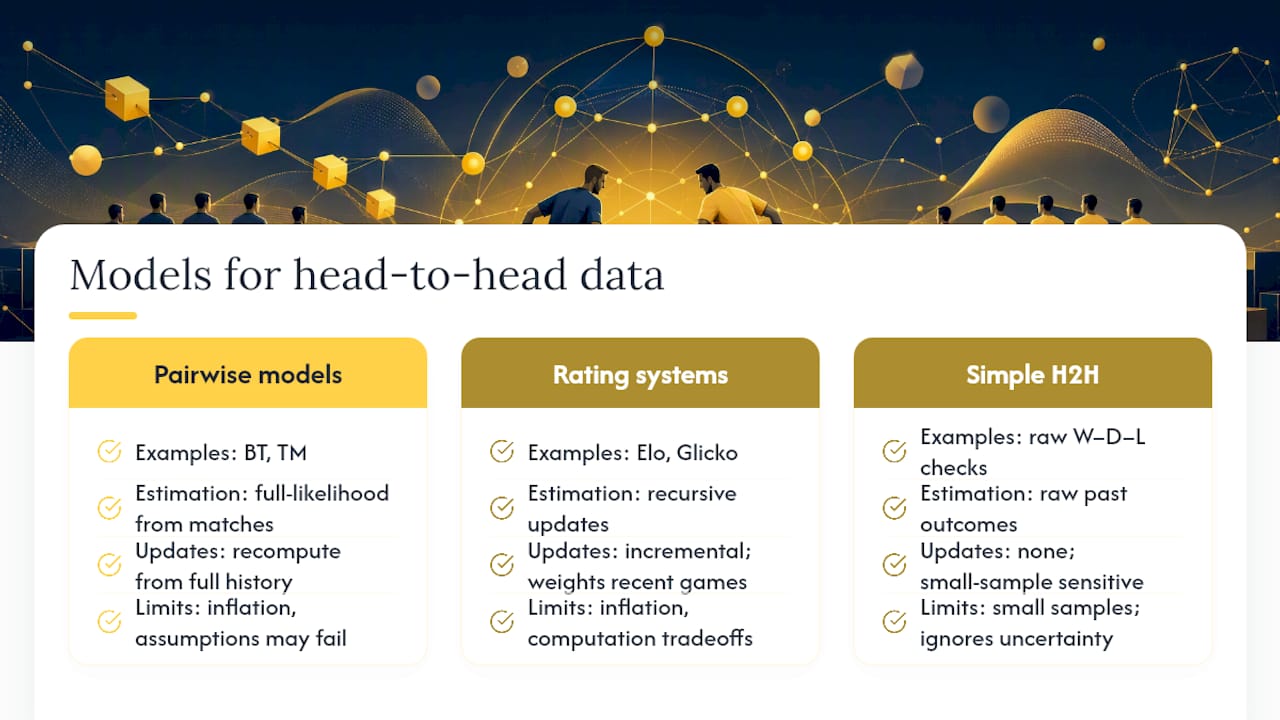
Serious analysts don’t just eyeball a W-D-L record. They use paired-comparison models built specifically to turn head-to-head outcomes into strength estimates that update over time.
The Bradley–Terry model estimates the probability that one competitor beats another based purely on their relative strength parameters, calibrated from past win/loss results. The Thurstone–Mosteller model does something similar using a different underlying distribution. Both were built for exactly this kind of binary outcome data, which is why they remain foundational in how modern statistical models shape the odds you see on a betting slip.
Elo and Glicko take a more practical, recursive approach. Instead of recalculating from the entire match history every time, they update a team’s rating incrementally after each result, weighting recent games more heavily. Here’s roughly how it works in plain terms: if Team A rates 100 points higher than Team B on the Elo scale, that difference typically translates to something in the neighborhood of a 60-65% implied win probability for Team A, before accounting for venue. The bigger the ratings gap, the more lopsided the implied probability becomes.
These systems aren’t flawless. A review of paired-comparison and rating-system methods documents real problems: rating inflation and deflation over time, computational tradeoffs between full likelihood models and simplified recursive ratings, and breakdowns when the model’s assumptions (like consistent home-field advantage) don’t hold for a specific league or era. Small sample sizes create the same problem here that they create for raw H2H. A related review of common statistical misinterpretations makes a broader point worth remembering: effect sizes and uncertainty ranges matter more than a clean significant/not-significant label, especially when you’re working with a handful of matches.
The practical takeaway for bettors: lean on formal ratings like Elo for long-run team strength assessments across a season, and reserve simple head-to-head checks for fixture-specific tactical questions, like whether one manager’s system has consistently struggled against another’s.
When Does Head-to-Head Data Mislead Bettors?
H2H gives false confidence more often than it gives real edge, and the failure modes repeat across almost every sport.
- Small sample size. Three or four meetings is not enough to separate genuine skill differences from randomness.
- Squad turnover. A “dominant” H2H record built four years ago tells you nothing if eight of the eleven starters have since left.
- Manager or tactical change. A new manager can flip a team’s entire approach within weeks, erasing whatever pattern the old H2H record captured.
- Mixed competition types. Blending league form with cup upsets and friendlies muddies the signal beyond usefulness.
- Home/away confounding. A record that looks lopsided often just reflects that one team hosted more of the meetings.
- Cherry-picked memorable matches. Bettors tend to remember the 4-0 thrashing and forget the three routine 1-1 draws that followed it.
- Survivor bias in remembered fixtures. The games that stick in memory are usually the dramatic outliers, not the representative ones.
A breakdown of common H2H misreadings in modern football makes the same case: long historical records typically reflect entirely different squads, managers, and tactical eras, and without recency weighting they generalize poorly to next weekend’s fixture. The core statistical risk underneath all of this is straightforward. A pattern that looks like signal is very often just noise, unless you can point to a repeatable mechanism, like a specific tactical clash or a genuine home-ground effect, that explains why it happened and why it should happen again.
How to Build H2H Into a Repeatable Betting Routine
Two contrasting scenarios show exactly why process matters more than the raw record.
Scenario A: H2H points toward a real upset. A mid-table team has beaten a stronger rival in three of their last four league meetings, all at the same venue, all with a similar low-block, counter-attacking setup against a rival that struggles to break down organized defenses. The mechanism is consistent and the personnel involved haven’t changed much. That’s a case where H2H genuinely nudges your probability estimate toward the underdog.
Scenario B: H2H would have misled you. A team has won 4 of the last 5 meetings against a rival, but two of those wins came in a cup competition with a rotated lineup, the manager on the winning side has since left, and the rival has overhauled its back line. The “dominant” record is a relic. Betting on it now means betting on a team that no longer exists in practice.
Build a routine that catches the difference between those two cases every single time:
- Set your baseline probability using current form, xG, and injury news before touching the H2H record.
- Pull and filter the H2H using the recency and venue rules from earlier in this guide.
- Identify the mechanism, if any, behind the pattern; if you can’t name one, discard the pattern.
- Log the fixture and your reasoning in a betting journal, including whether you used H2H and why. Tracking your betting history this way lets you review months later whether H2H-informed calls actually beat your baseline.
- Check the market price against your adjusted probability before staking anything.
Pro Tip: When H2H is genuinely your only edge on a fixture, with no confirmation from form or xG, size the bet smaller than usual rather than skipping it entirely. Treat it as a low-confidence lean, not a headline pick.
An Experienced Bettor’s Take on Head-to-Head Data
A few seasons back, I flagged a match where one side had won most of the last several meetings against their opponent, all by at least two goals. On paper, it looked like the clearest bet of the weekend. But running it through the checklist changed everything: three of those five wins came in a domestic cup with second-string lineups, the winning manager had left for a rival club that same summer, and the opponent had just signed a new center-back pairing that fixed the exact defensive gap that pattern had exploited. The “obvious” bet wasn’t obvious at all once the mechanism behind it disappeared.
That experience shaped the rules I still apply to every H2H record before it influences a stake:
- Two years or three meetings, whichever is shorter, is my hard cutoff for what counts as “recent” enough to matter.
- Venue gets checked before the scoreline does. A record built mostly on home legs tells me almost nothing about an away trip.
- I reach for Elo-style ratings for season-long strength questions, and save raw H2H strictly for fixture-specific tactical checks, like a known matchup problem between two specific systems.
The honest truth is that most bettors treat H2H as a shortcut past the harder work of checking form, personnel, and tactics. It’s the opposite. H2H is only worth anything once you’ve already done that harder work and are looking for a final, narrow confirmation.
Put Your H2H Analysis to Work on Goldbet888
Spotting a genuine head-to-head pattern is only half the job. You still need a platform that lets you act on it before the line moves, and that settles your winnings without the multi-day wait that eats into your edge. Goldbet888 gives Singapore-based bettors deep market coverage across Asian Handicap lines and Over/Under totals, the exact markets where a well-checked H2H mechanism tends to carry the most weight.

Live, in-play markets mean you’re not stuck waiting for kickoff to apply a last-minute lineup check against your H2H filter. Withdrawals through PayNow and USDT are processed in minutes rather than days, so a winning read on a matchup actually turns into usable funds fast. On top of that, a Telegram community of more than 5,000 bettors shares match previews and tips in real time, which is a useful sanity check against your own analysis before you commit a stake. Browse the current World Cup 2026 betting markets on Goldbet888 to see how odds are priced around the tournament fixtures this guide has been walking through, and bet only what you’re comfortable risking.
Frequently Asked Questions
Why do head-to-head stats matter in football betting?
They matter when a pattern reflects something real and repeatable, like a tactical mismatch or a genuine venue effect, rather than a coincidental streak from years of mixed competitions and different squads.
How many head-to-head meetings count as a reliable sample?
Most practical guides suggest treating anything under four recent, same-competition meetings as too thin to draw firm conclusions from on its own.
Is head-to-head more useful than current form?
No. Current form and underlying metrics like expected goals should set your baseline probability; H2H works best as a secondary check that confirms or challenges that baseline.
Do leagues always use head-to-head as a tiebreaker instead of goal difference?
No, the rule varies by competition. Some prioritize head-to-head results between tied teams, others use overall goal difference, and the choice changes how clubs approach late-season fixtures.
Can rating systems like Elo replace head-to-head analysis entirely?
Not entirely. Elo and similar systems are strong for season-long strength comparisons, but raw H2H still has value for spotting fixture-specific tactical patterns that a general rating won’t capture.
Sources
A handful of sources are worth bookmarking if you want to go deeper than this guide:
- Annual Review: Paired comparison and rating-system methods for head-to-head games
- How to Read Head-to-Head Stats — A Practical Guide | Sportspred
- Head-to-Head Football Records: A Validity Check | SportSignals
- How Head-to-Head Records Shape Match Predictions | ScoreBadger
- World Cup Head-to-Head Calculator — Compare Teams | CalcMora