Statistical models produce probability forecasts that bookmakers convert into decimal odds, then inflate with a margin called overround. The role of statistical models in odds is direct: every price you see on an Asian Handicap or Over/Under market started as a model output. For Singapore bettors, the practical consequence is clear. Convert any offered price to an implied probability, compare it against an independent model estimate, and bet only when your model shows a genuine edge. Three names anchor this field: Dixon & Coles (the bivariate Poisson framework most sportsbooks still reference), the Shin probability method (the cleanest way to strip overround from posted prices), and Goldbet888 (where Singapore bettors access live Asian Handicap and Over/Under markets with real-time odds).
Key actions to keep in mind:
- Convert decimal odds to implied probability: p = 1 / decimal odds
- Normalize the full market so probabilities sum to 1 (or use the Shin method for greater accuracy)
- Compare your normalized market probability against an independent model estimate
- Bet only when the gap is positive and exceeds your decision threshold
Key Takeaways
Statistical models produce probability forecasts that bookmakers convert to odds with added overround, and Singapore bettors who normalize those prices and compare them to independent model outputs can identify genuine value in Asian Handicap and Over/Under markets.
| Point | Details |
|---|---|
| Convert and normalize first | Use p = 1/decimal odds, then divide by bookmaker sum or apply the Shin method for less biased estimates. |
| Require an explicit edge | Only bet when model probability exceeds normalized market probability by at least 3–5 percentage points. |
| Backtest across multiple seasons | Single-season ROI figures are unreliable; optimal thresholds shift year to year per multi-season AH research. |
| Maximum odds change everything | GAP-based Over/Under edges vanish with average odds; always line-shop for the best available price. |
| Goldbet888 for live AH and O/U | Live Asian Handicap and Over/Under markets, Telegram alerts, and PayNow/USDT withdrawals support fast, model-informed decisions. |
Table of Contents
- How do bookmakers turn model probabilities into posted odds?
- What statistical models actually drive football odds?
- How do 1X2, Asian Handicap, and Over/Under markets compare for model bettors?
- Why do odds move so fast now, and how should you respond?
- A step-by-step checklist for Singapore bettors using model insights
- What do statistical models miss, and where do bettors go wrong?
- Goldbet888 gives Singapore model bettors a real edge
- A data-focused tipster’s honest take on model edges
- Sources
How do bookmakers turn model probabilities into posted odds?
Every posted price starts as a probability estimate. A bookmaker’s model assigns, say, 0.45 to a home win, 0.30 to a draw, and 0.25 to an away win. Those three sum to 1.00. The bookmaker then shrinks each decimal odd so the implied probabilities sum above 1.00, creating the overround (also called vig or margin). According to SportBot AI, modern sportsbooks use AI and machine-learning pipelines to convert model probabilities into prices and update them in near real time.
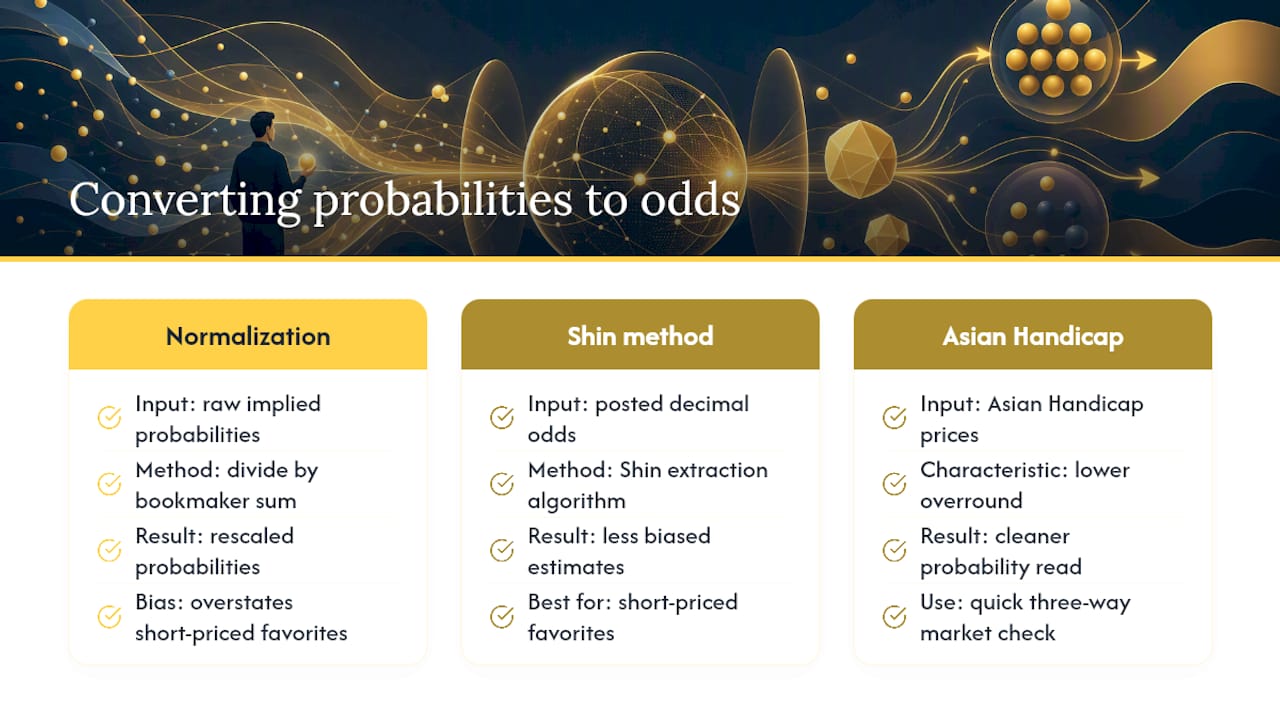
The basic conversion: p = 1 / decimal odds. A price of 2.20 implies p = 1 / 2.20 = 0.455. Sum all three raw implied probabilities in a 1X2 market and you typically get 1.05–1.12, not 1.00. That excess is the overround.
Normalization divides each raw probability by the bookmaker sum. If the sum is 1.08, the home-win raw probability of 0.455 normalizes to 0.455 / 1.08 = 0.421. Simple, but not perfectly unbiased.
The Shin method goes further. Research published in the International Journal of Forecasting shows that Shin probabilities outperform simple normalization and several regression-based approaches when extracting unbiased estimates from posted odds. Use Shin when precision matters most, particularly for shorter-priced favorites where normalization tends to overstate true probability.
Pro Tip: For a quick three-way market check in Singapore time, pull the Asian Handicap line alongside the 1X2 prices. AH lines carry lower overround in most markets, so they often give you a cleaner read on the model’s true probability split.
What statistical models actually drive football odds?
Bookmakers and independent forecasters draw from several model families, each suited to different markets and data inputs.
- Bivariate Poisson / Dixon & Coles models treat home and away goals as correlated Poisson processes. They take historical attack and defense ratings, adjust for home advantage, and output a full scoreline probability matrix. A University of Reading study found that a standard bivariate Poisson model produced better scoreline forecasts than bookmaker-implied probabilities across two EPL seasons, yet simple betting strategies on those forecasts still failed to generate consistent positive ROI because of the bookmakers’ overround of approximately 12% in the sample.
- Pi-ratings and Elo-style systems update team strength ratings after each match result. Anthony Constantinou’s pi-rating variants weight recent results more heavily and feed naturally into hybrid models. Constantinou’s research emphasizes that effective models should simulate the process creating goals: possession leads to shots, shots lead to goals.
- Bayesian Networks model that possession-to-shots-to-goals chain explicitly, combining prior ratings with in-match event probabilities. A pi-rating plus Bayesian Network hybrid demonstrated strong forecasting ability in the Asian Handicap market, though profitability depended on whether bettors accessed average or maximum available odds.
- ML/AI hybrids ingest tracking data, expected goals (xG), player availability, referee tendencies, and even weather. They output result probabilities, expected total goals, and handicap probabilities simultaneously.
“Backtesting across multiple seasons is the only honest test of a model. A single-season ROI figure is almost meaningless — variance alone can produce it.” This principle runs through the academic literature on football forecasting and applies directly to any model you use for Asian Handicap or Over/Under decisions.
Typical inputs across model families: historical goals and shots, xG, possession share, recent form (last 5–8 matches), head-to-head records, player availability, and competition stage.
How do 1X2, Asian Handicap, and Over/Under markets compare for model bettors?
Market structure shapes how well a model’s output translates into a betting edge.
| Market | States | Typical model fit | Common bias |
|---|---|---|---|
| 1X2 | Three-way (home / draw / away) | Scoreline models, Poisson | Favourite–longshot bias; draw pricing often imprecise |
| Asian Handicap | Binary after handicap applied | Binary classifiers, rating systems | More efficient; lower overround than 1X2 |
| Over/Under 2.5 | Binary (more / fewer goals) | Total-goals models, GAP/shot ratings | Edge sensitive to average vs. maximum odds |
Research comparing AH and 1X2 markets finds that Asian Handicap odds are often more efficient than 1X2, and that favourite–longshot bias is more pronounced in the three-way market. For model-driven bettors, that means AH lines are harder to beat but also less distorted by bookmaker pricing heuristics.
Over/Under markets reward models that focus on total-goals processes. GAP shot-based ratings produced a small but persistent edge in long-run tests when maximum odds were available. With average odds, that edge disappeared entirely. The lesson: the market you choose and the odds tier you access both determine whether a model edge survives to profit.
Why do odds move so fast now, and how should you respond?
AI-driven pricing pipelines have compressed the window between new information and a price change to seconds. A late lineup announcement, a weather update, or a surge of sharp money on one side triggers an automated model recalibration and an immediate odds update. SportBot AI explains that these pipelines ingest market signals and new data continuously, not just at scheduled intervals.
Value windows that once lasted 30 minutes now close in under 60 seconds on liquid markets. Singapore bettors targeting Asian Handicap lines for World Cup 2026 matches need alerts, not just awareness.
For Singapore bettors, the practical response has three parts. First, set price alerts on the specific lines you are tracking so you catch the pre-movement price. Second, understand how late team news shifts odds so you can anticipate direction before the market moves. Third, use Goldbet888’s live odds feed and Telegram community alerts to act on model-identified edges before liquidity tightens.
A step-by-step checklist for Singapore bettors using model insights
This workflow applies to Asian Handicap and Over/Under markets, the two formats most relevant to Goldbet888 users.
- Convert the offered odds to raw implied probability. p = 1 / decimal odds. Do this for every outcome in the market.
- Normalize or apply the Shin adjustment. Divide each raw probability by the bookmaker sum for simple normalization. For higher-stakes decisions, use the Shin method for a less biased estimate.
- Pull an independent model probability. Use a trusted third-party model output or the statistics-based match tips available through Goldbet888’s guides. The gap between model probability and normalized market probability is your estimated edge.
- Apply a decision threshold. Only act when model_p minus market_p exceeds a pre-set minimum, typically 3–5 percentage points for AH markets. A threshold below 2% rarely survives overround after variance.
- Size your stake. Use a fixed-fraction rule: 1–2% of bankroll per bet is conservative and survives losing runs. Kelly Criterion sizing is theoretically optimal but amplifies variance; a half-Kelly or quarter-Kelly fraction is more practical. For rapid-turnaround Telegram tips, drop to 0.5–1% because the edge estimate is less certain.
- Line-shop, then place quickly or skip. Check maximum vs. average odds across available markets before committing. If the best available price has already moved past your threshold, skip the bet entirely.
Pro Tip: Singapore bettors have an advantage on early Asian markets: AH lines for Asian leagues and World Cup group-stage matches open during SGT business hours, giving you time to run your model check before European sharp money floods in.
What do statistical models miss, and where do bettors go wrong?
Model accuracy and betting profit are not the same thing. Several gaps consistently trip up bettors who rely too heavily on statistical outputs.

Favourite–longshot bias inflates the implied probability of heavy favorites and deflates longshots in 1X2 markets. A model that prices a favorite at 0.72 may find the market at 0.68 after normalization, suggesting value, when the bias is actually the bookmaker’s pricing heuristic rather than a genuine edge.
Overfitting to a single season is the most common technical mistake. Backtesting research shows that optimal decision thresholds and ROI vary widely between seasons. A threshold that produced strong returns in one EPL season may lose money the next. Always test across at least three seasons before trusting a model’s parameters.
“Profitability and optimal decision thresholds are not stable across seasons. Bettors who optimize on one season and bet the next are effectively overfitting.” This finding from multi-season AH backtesting is the single most important warning in the academic literature on football betting models.
Non-quantitative signals that models miss include late lineup leaks not yet reflected in official team sheets, player motivation in dead-rubber matches, and referee tendencies that shift foul rates. These factors move odds but rarely appear in standard model inputs.
Require a larger gap, not a smaller one, when the market is less liquid.
Mitigations: hold out the most recent season from any parameter optimization, recalibrate ratings on a rolling basis, and size stakes conservatively until a model has proven itself across multiple seasons.
Goldbet888 gives Singapore model bettors a real edge
Knowing the theory is only half the work. Goldbet888 puts the tools in your hands: live Asian Handicap and Over/Under odds updated in real time, World Cup 2026 Asian Handicap markets built for Singapore bettors, and a 5,000+ member Telegram community that surfaces model-aligned tips before lines move.

Three concrete advantages for model-driven bettors: fast odds that let you act before value closes, a market range covering AH and O/U across all World Cup 2026 group and knockout fixtures, and community alerts that flag line movements as they happen. Withdrawals process via PayNow or USDT, typically within three minutes. Sign up at Goldbet888 sports betting and join the Telegram community to receive real-time tips calibrated to the Asian Handicap and Over/Under markets covered in this guide.
A data-focused tipster’s honest take on model edges
The gap between a model’s probability and the posted price looks clean on paper. In practice, you will face losing runs that last longer than any backtest suggests. The model is a filter, not a guarantee.
Pro Tip: After three or more consecutive losses on model-identified bets, reduce your next stake by half rather than increasing it to chase. Variance is the most likely explanation, and protecting your bankroll keeps you in the game long enough for the edge to materialize.
Sources
- How Bookmakers Set Odds: Data, Math & AI… | SportBot AI
- Evaluating a standard statistical model of football match scoreline forecasting | University of Reading
- Investigating the efficiency of the Asian handicap football betting market with ratings and Bayesian networks
- Investigating the efficiency of the Asian handicap football betting market with ratings and Bayesian networks | arXiv
- On determining probability forecasts from betting odds | ScienceDirect