Crypto sportsbook payouts are on-chain transactions that can reach your wallet in minutes, but your total wait time depends on three things: operator processing, blockchain network confirmation, and whether your wallet address and network match correctly. The sportsbook initiates the transaction after approving your withdrawal request, the blockchain confirms it, and the funds land in your wallet. That’s the full chain. Understanding where each step can stall is what separates bettors who get paid fast from those stuck waiting 24 hours wondering what went wrong.
Pro Tip: Before you commit a serious bankroll, run a small test withdrawal of 50 USDT to your personal wallet. This single step verifies payout speed and exposes any hidden manual review queues before real money is on the line.
Table of Contents
- How do crypto sportsbook payouts actually work, step by step?
- What causes payout delays and how long should you actually wait?
- Who pays what? Understanding crypto payout fees
- Which cryptocurrencies should you use for sportsbook payouts?
- Where should you receive payouts and how do you keep them safe?
- Pre-withdrawal checklist: how to get paid faster and avoid mistakes
- Risks and U.S. tax considerations you can’t afford to ignore
- How smart contracts and oracles are changing payout guarantees
- Key Takeaways
- Why “instant” payout claims deserve a closer look
- Goldbet888: fast crypto payouts for football bettors
- Authoritative sources and further reading
How do crypto sportsbook payouts actually work, step by step?
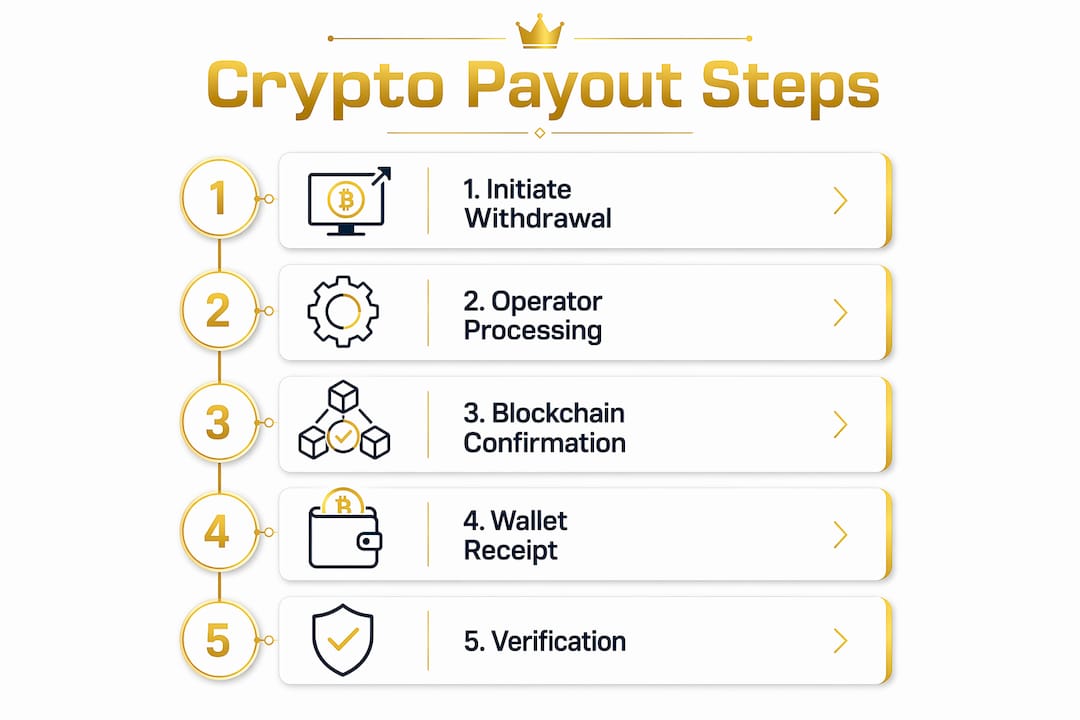
When you click “Withdraw,” you’re starting a process that moves through two distinct phases: the operator’s internal system and the public blockchain. Most bettors only think about the blockchain part. The operator part is where delays actually happen.
Here’s the exact flow:
- Submit the withdrawal request. You enter your wallet address, select your cryptocurrency and network (e.g., USDT on TRC-20), and specify the amount. The cashier assigns a request ID. Save it.
- Operator queue and approval. The sportsbook’s system receives the request. Automated platforms approve instantly; others route to a manual review queue, especially for first-time withdrawals or large amounts. Operator processing time is often the real bottleneck, not the blockchain.
- KYC and compliance check. If your account isn’t fully verified, the withdrawal may pause here. Unverified accounts can sit in queue for hours or longer.
- On-chain broadcast. Once approved, the sportsbook signs and broadcasts the transaction to the blockchain. You’ll receive a Transaction ID (TXID). Copy it immediately.
- Network confirmations. The blockchain processes the transaction and validators confirm it. Required confirmation counts vary: USDT on TRC-20 typically needs 20 confirmations (roughly 1–3 minutes), Bitcoin may require 3–6 confirmations (10–60 minutes).
- Funds arrive in your wallet. Confirmation count reached, transfer complete. Open your wallet or block explorer to verify.
Some platforms go further than this manual flow. Smart contracts and oracles like Chainlink can automate settlement entirely, triggering payouts the moment an event result is verified on-chain. That removes the human approval step for eligible markets. Platforms that publish audited contract logic give you independent proof that payouts can’t be arbitrarily reversed.
Pro Tip: Paste your TXID into a block explorer like Etherscan (for ERC-20 tokens) or Tronscan (for TRC-20) immediately after broadcast. You can watch confirmations tick up in real time and confirm the funds are moving before your wallet even refreshes.
What causes payout delays and how long should you actually wait?
“Instant” is a marketing word. The blockchain might be fast. The operator might not be. Withdrawal-speed tests consistently show that platforms can hold funds in manual review even when the underlying network processes transactions in minutes.

Here’s how realistic timelines break down:
| Scenario | Operator Processing | Network Confirmation | Total Expected Time |
|---|---|---|---|
| Small test withdrawal (USDT/TRC-20) | 5 minutes (auto) | 1–3 minutes | Under 1 hour |
| Standard bet-sized withdrawal (USDT/TRC-20) | 4 hours | 1–3 minutes | 1–5 hours |
| Large high-value withdrawal (any coin) | 4–24 hours (manual review) | 1–60 minutes | — |
| Bitcoin withdrawal (standard) | 1–4 hours | 10–60 minutes | 2–6 hours |
Large payouts almost always trigger enhanced security checks. Public cases show platforms can process multi-million dollar withdrawals, but large amounts routinely trigger automatic review protocols that add hours to the process regardless of network speed.
Common causes of delay you should know:
- Unverified KYC: The single most preventable delay. Complete identity verification before you need to withdraw.
- Manual review queue: First withdrawals, new wallet addresses, or amounts above a platform threshold often trigger human review.
- Wrong network selection: Sending USDT on TRC-20 to an ERC-20 address doesn’t just delay funds, it can lose them permanently.
- Network congestion: Bitcoin and Ethereum gas fees spike during high-traffic periods, slowing confirmations.
- Exchange address freezes: Centralized exchanges sometimes freeze incoming crypto from gambling platforms. A personal wallet avoids this entirely.
- Withdrawal batching: Some operators batch multiple withdrawals together and process them on a schedule rather than individually.
Always review the terms and conditions for withdrawal rules before depositing. Processing windows, minimum amounts, and review triggers vary widely across platforms.
Who pays what? Understanding crypto payout fees
Crypto fees are lower than fiat, but they’re not zero. Three distinct fee types affect your payout amount, and knowing who pays each one helps you pick the cheapest route.
| Fee Type | Who Pays | Typical Range | Notes |
|---|---|---|---|
| Network/miner fee | Sender (sportsbook or you) | up to $20 | Varies by network and congestion |
| Operator withdrawal fee | Bettor (deducted from payout) | up to $5 flat or % | Some platforms absorb this |
| Exchange conversion fee | Bettor | up to 1% of amount | Only if converting to fiat on exchange |
| Bridge/cross-chain fee | Bettor | $1–$15 | Only if switching networks mid-transfer |
A practical comparison: withdrawing 10,000 USDT on TRC-20 costs under $1 in network fees. The same amount on ERC-20 (Ethereum) could cost $5–$20 depending on gas prices. Bitcoin carries miner fees of $2–$15 per transaction regardless of amount, which makes small BTC withdrawals proportionally expensive.
Common fee scenarios to watch:
- Reprocessing fees: If you submit a withdrawal to a wrong or unwhitelisted address and the operator has to cancel and reprocess it, some platforms charge an additional fee.
- Conversion spread: If you withdraw BTC but the sportsbook converts your USD balance to BTC at the time of withdrawal, the exchange rate spread is an implicit fee.
- Exchange withdrawal fees: If you receive funds to a centralized exchange and then move them to a personal wallet, the exchange charges its own withdrawal fee on top.
Pro Tip: Use USDT on TRC-20 for routine withdrawals. It’s the lowest-fee, fastest-confirming stablecoin option at most sportsbooks. Whitelist your withdrawal address in advance so the operator doesn’t flag it for reprocessing review, which can add both time and fees.
Which cryptocurrencies should you use for sportsbook payouts?
The right coin depends on what you’re optimizing for: speed, cost, or protection from price swings. Here’s how the main options compare:
| Cryptocurrency | Deposit Time | Withdrawal Time | Typical Fees | Volatility |
|---|---|---|---|---|
| USDT (TRC-20) | 1–3 min | 1–4 hrs | under $1 | None (stablecoin) |
| USDC (ERC-20) | 2–5 min | 1–4 hrs | $1–$20 | None (stablecoin) |
| Bitcoin (BTC) | 10–60 min | 1–6 hrs | $2–$15 | High |
| Ethereum (ETH) | 2–5 min | 1–4 hrs | $1–$20 | High |
| Litecoin (LTC) | 2–5 min | 1–4 hrs | under $0.05 | High |
| BNB (BEP-20) | 1–3 min | 1–4 hrs | under $1 | Moderate |
Stablecoins like USDT maintain a 1:1 peg to the U.S. dollar, which means your winnings don’t shrink between the moment you win and the moment you withdraw. If you win $2,000 on a match and Bitcoin drops 8% before your withdrawal clears, you’ve effectively lost $160 to volatility. USDT eliminates that risk entirely.
Key pitfalls to avoid when selecting a network:
- TRC-20 vs. ERC-20 mismatch: This is the most common and costly mistake in crypto betting. Sending USDT on TRC-20 to an ERC-20 address results in fund loss or prolonged support disputes. Always verify the network string matches between the sportsbook cashier and your wallet.
- Assuming all USDT is the same: USDT exists on multiple blockchains. TRC-20 (Tron), ERC-20 (Ethereum), and BEP-20 (BNB Chain) are three separate networks. They are not interchangeable.
- Choosing BTC for small amounts: Miner fees make small Bitcoin withdrawals inefficient. For amounts under $500, a stablecoin on TRC-20 or BEP-20 is almost always cheaper.
Pro Tip: If your sportsbook supports both TRC-20 and BEP-20 for USDT, TRC-20 is generally faster for confirmations. BEP-20 is a solid backup if TRC-20 is congested. Either beats ERC-20 on cost for routine payouts.
Where should you receive payouts and how do you keep them safe?
Your choice of receiving wallet matters as much as your coin selection. Sending winnings to a centralized exchange address introduces risks that a personal wallet eliminates.

Non-custodial wallets (MetaMask for ERC-20/BEP-20 tokens, TronLink for TRC-20, Ledger hardware wallet for large balances) give you full control. No third party can freeze your funds, and no exchange compliance policy can block an incoming gambling transaction. Bettors should prefer personal non-custodial wallets for receiving payouts to maintain control and reduce freeze risk from centralized exchanges.
Custodial exchange addresses (Coinbase, Kraken, Binance) are convenient but carry real risks: exchanges can freeze accounts flagged for gambling-related deposits, and you don’t control the private keys. If the exchange goes down or restricts your account, your funds are inaccessible.
Security checklist before every withdrawal:
- Whitelist your withdrawal address in the sportsbook’s cashier settings at least 24 hours before you need it.
- Triple-check the first and last 6 characters of the wallet address. Clipboard-hijacking malware can silently swap addresses.
- Verify the network matches between the cashier and your wallet. This step alone prevents the most common fund-loss scenario.
- Save the TXID immediately after broadcast. It’s your proof of transaction.
- Use a block explorer to confirm the transaction reached the correct address with the required number of confirmations.
Once funds arrive, here’s how to confirm finality:
- Copy your TXID from the sportsbook cashier or your email confirmation.
- Open the relevant block explorer: Tronscan for TRC-20, Etherscan for ERC-20, Blockchain.com for BTC.
- Paste the TXID and check the confirmation count. Most sportsbooks consider a transaction final at 20 confirmations for TRC-20 and 3–6 for Bitcoin.
- Verify the receiving address and amount match your withdrawal request exactly.
Pro Tip: For balances above $5,000, use a hardware wallet like Ledger as your primary receiving address. Software wallets are convenient but vulnerable to device compromise. A hardware wallet keeps your private key offline, which is the only real protection against remote theft.
Pre-withdrawal checklist: how to get paid faster and avoid mistakes
Running through this checklist before every withdrawal takes under five minutes and eliminates the most common causes of delays and errors.
- Confirm KYC is complete. Log into your account settings and verify your identity documents are approved. An unverified account will stall at the compliance step every time.
- Whitelist your wallet address. Add your withdrawal address to the sportsbook’s approved list in advance. Many platforms require a 24-hour waiting period after adding a new address.
- Select the correct network. Match the network in the cashier exactly to the network your wallet accepts. Write it down if you have to.
- Check withdrawal minimums and limits. Confirm your amount meets the minimum and doesn’t exceed daily or per-transaction limits. Amounts outside these bounds are rejected automatically.
- Run a small test withdrawal first. Run a small test withdrawal first as a payout health check to verify the platform’s processing speed before committing larger funds.
- Save your cashier request ID. This is your reference number for support if anything goes wrong.
- Record the TXID after broadcast. Open the block explorer and confirm the transaction is moving.
Two scenarios that play out differently:
Fast small withdrawal: With KYC complete and address whitelisted, smaller withdrawals on TRC-20 can be approved quickly and confirmed by the blockchain within minutes, completing in under an hour.
Large withdrawal that triggers review: You’re withdrawing a significant amount for the first time. The operator flags it for manual review, compliance checks your account history, and the process takes 8–24 hours. Having your KYC complete and your address whitelisted in advance cuts that window meaningfully. Reading the platform’s payout limits before you request also prevents surprises.
Run a payout health check every few months or whenever you plan to move a significant balance. If the platform’s behavior has changed, you’ll catch it before it costs you.
Risks and U.S. tax considerations you can’t afford to ignore
Crypto payouts carry real risks beyond slow processing. Knowing them lets you manage exposure before it becomes a problem.
Operational risks:
- Wrong address or network: On-chain transactions are irreversible. Sending to the wrong address or wrong network means permanent fund loss in most cases.
- 51% attacks: On smaller blockchains, a majority attack can theoretically reverse confirmed transactions. Stick to established networks (Tron, Ethereum, Bitcoin) where this risk is negligible.
- Frozen exchange accounts: Centralized exchanges can freeze accounts that receive gambling-related deposits. A personal wallet is the only reliable protection.
- Phishing and clipboard malware: Malware can replace your copied wallet address with an attacker’s address. Always verify the first and last 6 characters after pasting.
Financial risks:
- Volatility between bet and withdrawal: If you hold BTC or ETH during an event, price swings can erode winnings before you withdraw. Stablecoins eliminate this.
- Conversion spreads: Converting crypto to fiat at an exchange adds an implicit cost through the bid-ask spread, which varies by exchange and market conditions.
- Liquidity limits: Some exchanges impose daily withdrawal limits that can delay access to large payouts even after the sportsbook has paid you.
U.S. tax basics for crypto gambling winnings
The IRS treats cryptocurrency as property. Gambling winnings paid in crypto are taxable at their fair market value in U.S. dollars at the time of receipt, exactly like cash winnings. You must report them as income regardless of whether you receive a W-2G form.
Recordkeeping requirements for U.S. bettors:
- TXID: Your on-chain proof of receipt.
- Timestamp: The date and time the transaction confirmed.
- USD value at receipt: The dollar value of the crypto at the exact moment it arrived in your wallet.
- Screenshots of the cashier: The sportsbook’s withdrawal confirmation showing the amount and request details.
These records support IRS reporting if gambling income is material to your finances. The IRS has increased scrutiny of crypto transactions, and exchanges are required to report certain activity. Keeping clean records from the start is far easier than reconstructing them later.
Pro Tip: Use a crypto tax tool like Koinly or CoinTracker to automatically pull TXID data and calculate USD values at receipt. These tools generate IRS-compatible reports and save hours of manual work at tax time.
How smart contracts and oracles are changing payout guarantees
The traditional sportsbook model puts a human in the loop between your winning bet and your payout. Smart contracts and oracles are removing that human entirely for eligible markets.
“Platforms that publish smart-contract logic and use audited oracle feeds enable verifiable, automated settlement and remove discretionary reversal power — payouts can be independently confirmed on-chain by anyone.” (BTC-Newswire)
Here’s how it works in practice. An oracle network like Chainlink pulls verified event results from multiple data sources and delivers them to a smart contract on-chain. The contract checks the result against your bet, calculates the payout, and executes the transfer automatically. No manual approval, no discretionary hold, no human who can decide to delay your withdrawal.
The difference between settlement models matters for bettors:
- Fully on-chain model: Bet placement, settlement, and payout all happen via smart contract. Payouts are automatic once the oracle delivers the result. Counterparty risk is minimal because the contract logic is public and auditable.
- Hybrid model: Bets are recorded off-chain on the operator’s ledger, but settlement is periodically batched and settled on-chain. Faster for the operator, but introduces a window where the operator’s internal system controls your funds.
What to look for when evaluating a platform’s settlement model:
- Published smart contract addresses you can verify on a block explorer.
- Third-party audit reports from recognized security firms.
- On-chain transaction history showing consistent payout patterns.
- Oracle integration documentation (Chainlink or equivalent).
A platform that can show you its contract address and audit report is making a verifiable claim. One that only promises “instant payouts” in marketing copy is not.
Key Takeaways
Crypto sportsbook payouts are fast when operators process automatically and you use the right network, but operator behavior, not blockchain speed, determines your real wait time.
| Point | Details |
|---|---|
| Operator processing drives timing | Blockchain confirms in minutes; manual review by the operator is where delays of 4–24 hours actually occur. |
| Run a test withdrawal first | Run a test small withdrawal and record the TXID to verify a platform’s real payout speed before committing larger funds. |
| Use USDT on TRC-20 for most payouts | Low network fees and fast confirmations make TRC-20 a cost-efficient option for routine withdrawals. |
| Network mismatch loses funds permanently | Sending USDT on TRC-20 to an ERC-20 address results in permanent loss; always verify the network string matches your wallet. |
| Keep TXID, timestamp, and USD value | U.S. bettors must record these three data points per withdrawal to meet IRS reporting expectations for crypto gambling income. |
| Goldbet888 processes USDT withdrawals fast | Goldbet888 reports withdrawals processed in as little as three minutes, with PayNow and USDT as primary payout methods for Singapore players. |
Why “instant” payout claims deserve a closer look
The gap between a platform’s marketing and its actual withdrawal behavior is wider than most bettors expect. Blockchain speed is real. A TRC-20 transaction genuinely confirms in under three minutes. But that number only describes the network, not the operator. Withdrawal-speed tests show that a platform can still hold your funds in manual review for hours even when the blockchain is ready to move them in seconds.
The smarter approach is to treat “instant” as a claim to verify, not a feature to assume. Run the test withdrawal. Check whether the platform auto-approves or routes to a queue. Look for published contract addresses and audit reports if instant settlement genuinely matters to you. And diversify where you hold large balances: keeping everything on a single sportsbook’s custodial ledger concentrates both counterparty risk and liquidity risk in one place.
Pro Tip: Keep a small USDT buffer in a personal wallet separate from your sportsbook balance. If you need to move funds quickly, you’re not dependent on a withdrawal queue to access liquidity.
Goldbet888: fast crypto payouts for football bettors
Football bettors who want USDT payouts processed in minutes rather than days have a direct path at Goldbet888. The platform reports withdrawals processed in as little as three minutes via USDT and PayNow, with no drawn-out bank transfer queues. For World Cup 2026 markets including Asian Handicap and Over/Under, you get live odds, a 5,000+ member Telegram community sharing real-time match insights, and a cashier built for fast in-and-out transactions.

If you’re coming from this article and want to put the payout process into practice, the Goldbet888 sports betting guide walks you through account setup, cashier navigation, and USDT withdrawal steps specific to the platform. Register, complete KYC upfront, whitelist your wallet address, and you’re set up to withdraw the same day you win.
Authoritative sources and further reading
- IRS: Virtual Currency Guidance — IRS rules on crypto as property and tax reporting for gambling winnings paid in cryptocurrency.
- Tronscan Block Explorer — Verify TRC-20 TXIDs, confirmation counts, and wallet addresses for USDT withdrawals.
- Etherscan Block Explorer — Verify ERC-20 transactions, gas fees, and confirmation status for Ethereum-based tokens.
- Blockchain.com Explorer — Track Bitcoin transactions, confirmation counts, and miner fee data.
- Chainlink Documentation — Technical reference for oracle-based settlement and how Chainlink delivers verified event data to smart contracts.
- National Council on Problem Gambling — U.S. resource for responsible gambling support and self-exclusion tools.
Keep your TXIDs, timestamps, and USD-equivalent values for every withdrawal. These records are your first line of defense for IRS reporting and any platform dispute.