Yes — you can reliably spot value bets from community insights when you convert sentiment and volume into quantitative inputs and cross-check them against sharp-weighted no-vig probabilities. Community signals alone are not a bet trigger. They are an early-warning system that points you toward markets worth analyzing.
Here is the one-line method you can run tonight: measure community consensus on a pick, compute a no-vig fair probability anchored to a sharp exchange, and bet only when your fair probability exceeds the market-implied probability by at least 2–3%.
Quick-start process:
- Step 1: Scan Reddit threads, Telegram tip channels, or tip boards for a specific pick. Record the consensus percentage (what share of posts favor one side) and the post volume.
- Step 2: Pull the no-vig fair probability from a sharp-exchange-weighted source (Betfair or Pinnacle pricing stripped of margin).
- Step 3: If your community-adjusted probability beats the bookmaker’s implied probability by your chosen EV threshold, the bet qualifies. Log it and track Closing Line Value (CLV) after the game closes.
Pro Tip: +EV is a long-run concept. A single qualifying bet can still lose. Size stakes conservatively and commit to tracking a substantial number of bets before drawing conclusions about your edge.
Table of Contents
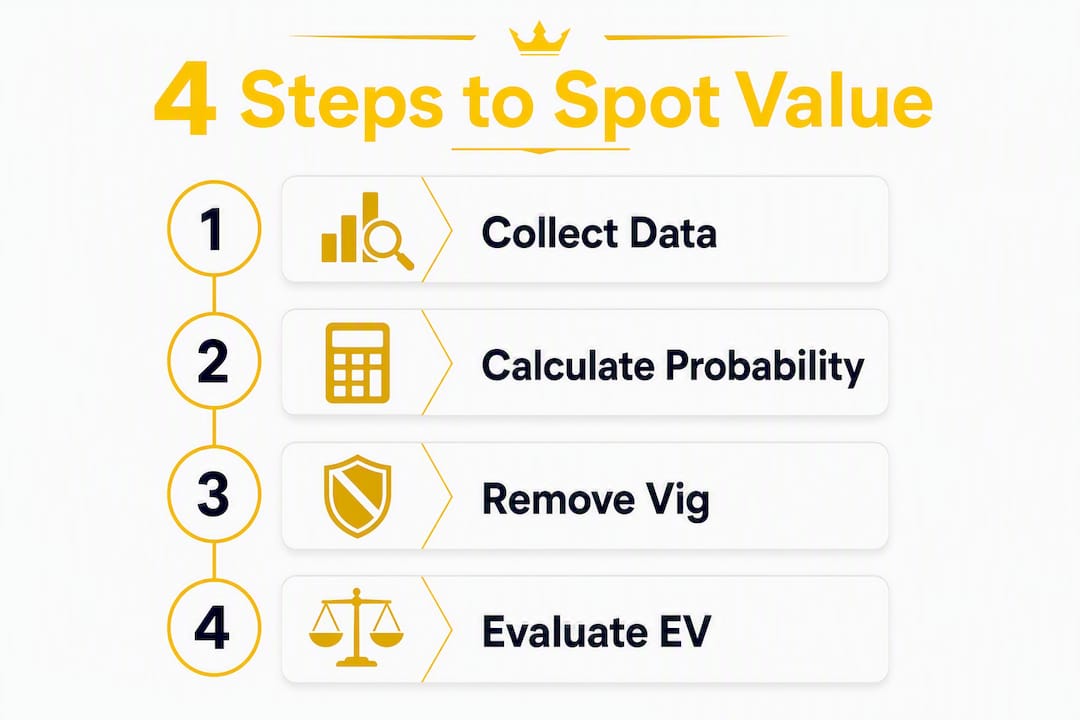
- How to spot value bets from community insights in 4 steps
- How to turn Reddit, Telegram, and tip-board signals into numbers you can use
- How to calculate implied probability, remove the vig, and use CLV to verify your edge
- Which signals are real value and which ones are just noise?
- Bankroll, staking, sample size, and how to verify +EV over time
- Practitioner’s checklist for integrating community sentiment with sharp-market consensus
- Tools and data sources you need to operationalize this method
- Worked example: NFL Chiefs vs. Bills from community signal to bet decision
- Verdict: your action plan to start testing tonight
- Bankroll management, sample-size patience, and tracking +EV over time
- A full worked calculation: converting a match preview to a bet decision
- How to tell reliable community insights from biased or manipulated information
- How to blend quantitative community data with qualitative context
- Common pitfalls and cognitive biases that distort community betting signals
- How to adjust your value-betting approach for different sports and markets
- Key Takeaways
- Why experienced bettors still get community signals wrong
- Goldbet888 gives you the community signals and live odds to run this method now
- Useful sources and further reading
How to spot value bets from community insights in 4 steps
The workflow below is the operational checklist you return to every time you monitor a community and compare odds. Follow it in order.
Collect and quantify community signals. Record consensus percentage (what share of picks favor one outcome), absolute post volume, upvote-weighted sentiment, timing of picks relative to kickoff, and source credibility tier. A 70% consensus from 200 posts on a specialized tip board carries more weight than 70% from 15 Reddit comments.
Build a sharp-weighted no-vig probability. Pull closing-line pricing from Betfair or Pinnacle, strip the margin, and use that as your fair-price anchor. Weighting toward sharp exchanges prevents soft-book averages from inflating your perceived edge.
Calculate EV and apply your staking rule. Use the formula: EV = (decimal odds × fair probability) − 1. A result above your threshold (suggested: 2–3% per EVBets) means the bet qualifies. Apply your pre-set stake — fractional Kelly or 1% flat.
Track CLV and outcomes; adjust thresholds over time. After the market closes, compare the odds you took to the closing line. Consistent positive CLV confirms your process is finding real edges, not noise.
Pro Tip: Act early when community consensus is high and the market has not yet moved. Sharp money tends to enter 24–48 hours before kickoff; public volume peaks in the final hours and often closes the gap.
Statistic callout: EVBets recommends a 2–3% EV floor for retail bettors, noting that edges above 8–10% visible to the public are often stale or limit-prone by the time most bettors reach them.
How to turn Reddit, Telegram, and tip-board signals into numbers you can use
Raw community sentiment is qualitative. Your job is to make it quantitative before it touches your bankroll.
Which community metrics to capture:
- Consensus percentage: What share of picks favor one side? Calculate it as (picks for outcome A) ÷ (total picks).
- Absolute post volume: Higher volume reduces noise. A 65% consensus from 500 posts is more reliable than 80% from 20 posts.
- Upvote-weighted signals: On Reddit, weight picks by upvote count, not just post count. A heavily upvoted pick carries more community conviction.
- Timing: Picks appearing 48+ hours before kickoff are more likely to reflect research; picks flooding in 30 minutes before kickoff are often reactive and public-driven.
- Source credibility tier: Assign each source a tier (1 = sharp-adjacent tip channels, 2 = specialized forums, 3 = general public boards).
How to weight sources and build a model probability:
Assign confidence multipliers by tier: Tier 1 sources get a multiplier of 1.0, Tier 2 get 0.75, Tier 3 get 0.5. Multiply raw consensus by the multiplier, then damp the result toward 50% by a factor that reflects your overall confidence in community data. A 70% raw consensus from a Tier 3 source, damped by 0.5, produces a community signal of 60%. Blended with a sharp-exchange no-vig fair probability of 52%, your model probability might settle at roughly 55% — meaningfully above the market’s implied 50%, but not the full 70% the crowd claimed.
“Public opinion often moves lines faster than statistics. Use community sentiment as an input, but confirm direction with sharp-market signals before committing stake.” — EdgeAI Sports
Pro Tip: Use a rolling 24–72 hour window when scraping community picks. Combine sentiment with objective event data — confirmed injuries, lineup reports, weather — before finalizing your model probability. Sentiment without context is just noise with a percentage attached.
Red flags that indicate manipulation or bias:
- A single account posting the same pick across multiple threads within minutes
- Picks accompanied by affiliate links or referral codes
- Identical phrasing across different usernames (bot behavior)
- A sudden surge of posts in the final two hours before kickoff with no supporting rationale
Reddit sentiment analysis can flag these contrarian opportunities automatically when model and sharp signals disagree with the crowd — a useful cross-check before you commit.

How to calculate implied probability, remove the vig, and use CLV to verify your edge
This is where community signals meet hard math. Every step below has a formula you can run in a spreadsheet tonight.
Converting odds to implied probability:
- Decimal odds: Implied probability = 1 ÷ decimal odds. At 1.90, implied probability = 1 ÷ 1.90 = 52.6%.
- American odds (positive): Implied probability = 100 ÷ (American odds + 100). At +150, implied probability = 100 ÷ 250 = 40%.
- American odds (negative): Implied probability = |American odds| ÷ (|American odds| + 100). At −120, implied probability = 120 ÷ 220 = 54.5%.
Removing the bookmaker margin (no-vig):
Add the implied probabilities for both sides of a market. The sum exceeds 100% — that excess is the vig. Divide each side’s implied probability by the total to get the no-vig fair probability. Example: Side A = 52.6%, Side B = 52.6%, total = 105.2%. No-vig fair probability for Side A = 52.6% ÷ 1.052 = 50%. Anchoring this calculation to sharp exchanges like Betfair or Pinnacle avoids the inflated edges that soft-book averages produce.
EV formula and worked example:
EV = (decimal odds × fair probability) − 1
| Input | Value |
|---|---|
| Market decimal odds (bookmaker) | 2.10 |
| Bookmaker implied probability | 47.6% |
| No-vig fair probability (sharp-weighted) | 52.6% |
| Community-adjusted model probability | 54.5% |
| EV (using model probability) | (1.90 × 0.54) − 1 = +2.6% |
| EV (using no-vig fair only) | (1.90 × 0.52) − 1 = -1.1% |
Both figures exceed the recommended 2–3% retail floor, so the bet qualifies. Use the conservative no-vig EV figure (9.2%) for staking decisions — the community-adjusted figure is your upside estimate, not your baseline.
Closing Line Value (CLV):
CLV measures whether the odds you took were better than the market’s closing price. If you bet Side A at 2.10 and it closed at 1.85, you beat the closing line — positive CLV. Consistent positive CLV is one of the most reliable validators that your process is genuinely finding edges, not getting lucky. Track it for every bet, not just winners.
Statistic callout: Value-finder services that publish trimmed-mean CLV metrics show that edges flagged by sharp-weighted no-vig calculators close positively over time — confirming the method works when applied consistently.
Which signals are real value and which ones are just noise?
Not every community signal deserves a stake. Here is how to separate the two.
Reliable signals:
- Reverse line movement: The line moves against the direction of public bet volume. If 70% of bets are on Team A but the line moves toward Team B, sharp money is on Team B. Reverse line movement is one of the clearest indicators of professional action.
- Fast moves against public volume: A line that shifts quickly in the first 24 hours after opening, opposite to public sentiment, signals sharp entry.
- Early sharp entry: Significant line movement 24–48 hours before kickoff, before public volume builds, points to informed money.
- Cross-platform agreement: When a forum consensus, exchange line movement, and a credible tip channel all point the same direction, the signal is stronger than any single source alone.
Red flags — ignore these:
- A single post or user driving the majority of picks in a thread
- Picks that appear only in the final two hours before kickoff with no analysis
- Affiliate-linked tip posts (the poster profits from clicks, not accuracy)
- Bandwagon posts that reference a team’s recent form without any odds context
How to combine signals into a confidence score:
Assign each reliable signal a point: reverse line movement (+2), early sharp entry (+2), cross-platform agreement (+1), high-volume community consensus from Tier 1 source (+1). A score of 4 or above justifies full stake. A score of 2–3 justifies half stake. Below 2, skip or paper-trade.
Pro Tip: Public bettors predictably favor favorites and overs. Books shade lines to account for this. When you see a favorite’s line drift longer (better odds) despite heavy public backing, that drift is a sharp fade signal worth investigating.
Bankroll, staking, sample size, and how to verify +EV over time
Your edge means nothing if variance wipes out your bankroll before the long run arrives. Staking discipline is what keeps you in the game.
Three staking frameworks:
- Full Kelly: Stake = (EV ÷ decimal odds − 1) × bankroll. Mathematically optimal but produces large swings that most bettors cannot tolerate emotionally or financially.
- Fractional Kelly (25–50%): The practical choice. Reduces stake size and drawdown risk while preserving most of the growth advantage. Use 25% Kelly until you have confirmed positive CLV over 200+ bets.
- Flat 1% staking: The safest starting point. Bet 1% of your bankroll on every qualifying bet regardless of EV size. Slower growth, but it survives long losing streaks and lets you accumulate a clean data set.
Sample staking table:
| Method | Bankroll | EV | Stake |
|---|---|---|---|
| Full Kelly | $1,000 | 9% | ~$47 |
| 25% Fractional Kelly | $1,000 | 9% | — |
| 1% Flat | $1,000 | Any qualifying | $10 |
Why sample size matters:
Value betting is a long-run concept. Variance can produce losing runs even with a genuine edge. You need hundreds of bets to separate skill from luck. Check CLV after a sizable number of bets and draw meaningful conclusions after accumulating a large sample.
Record-keeping fields to log for every bet:
- Timestamp and market (sport, league, bet type)
- Community signal score (your composite from the checklist)
- Odds taken and bookmaker
- No-vig fair probability and EV at time of bet
- CLV at market close
- Result (win/loss) and profit/loss in units
Pro Tip: Start with 1% flat staking until you confirm positive CLV over 500+ bets. Only then consider scaling to fractional Kelly. Scaling before you have evidence of edge is how bettors blow up accounts during normal variance.
Practitioner’s checklist for integrating community sentiment with sharp-market consensus
Print this. Run through it before every community-informed value bet.
Pre-bet checklist:
- ☐ Verify source credibility. Assign a tier (1, 2, or 3) to every community source contributing to your consensus. Reject Tier 3-only signals.
- ☐ Compute community consensus score. Calculate weighted consensus percentage using your tier multipliers and damp toward 50% by your confidence factor.
- ☐ Compute no-vig fair price (sharp-weighted). Pull Betfair or Pinnacle pricing, strip the margin, and record the fair probability.
- ☐ Calculate EV. Apply EV = (decimal odds × model probability) − 1. Proceed only if EV ≥ 2–3%.
- ☐ Check for reverse line movement. Confirm whether the line has moved opposite to public volume in the past 24 hours.
- ☐ Set stake per bankroll rule. Apply your pre-chosen method (1% flat or fractional Kelly). Do not deviate based on gut feel.
- ☐ Log the bet. Record all fields: timestamp, market, signal score, odds, stake, no-vig fair prob, EV.
- ☐ Monitor CLV at close. Return after the market closes and log the closing line. Calculate CLV.
Sample filled example:
| Field | Value |
|---|---|
| Market | NFL — Chiefs vs. Bills, Bills ML |
| Community consensus | 68% favor Bills (Tier 2 source, multiplier 0.75) |
| Weighted consensus | 50% |
| No-vig fair probability (Pinnacle) | 53% |
| Model probability (blended) | 52% |
| Market odds | +150 (decimal 2.50) |
| EV | (1.90 × 0.52) − 1 = -1.1% |
| Reverse line movement | Yes — line moved from +110 to +100 despite heavy public on Chiefs |
| Confidence score | 5 (full stake) |
| Stake | 1% flat = $10 |
Pro Tip: Add a “post-mortem” entry for every bet. Note what the community signal score was, whether CLV was positive, and what you would change. After 50 bets, patterns in your post-mortems will tell you which signal types are actually predictive for your markets.
For a printable version tailored to football markets, the football odds value checklist at Goldbet888 covers the same framework with sport-specific examples.
Tools and data sources you need to operationalize this method
The right monitoring stack does not need to be expensive. It needs to be consistent.
Tool categories and what each does:
- Odds aggregators / multi-book scanners: Pull live odds from dozens of bookmakers and recalculate no-vig probability on a set refresh interval. Scanners that refresh every 30 minutes surface steady small edges more reliably than chasing rare outliers.
- No-vig calculators: Standalone tools or spreadsheet formulas that strip margin and output fair probability. Essential for any market where you cannot access sharp-exchange pricing directly.
- Sentiment scrapers and APIs: Tools that aggregate Reddit posts, forum threads, or Telegram message counts and output consensus percentages. EdgeAI Sports is one example that combines Reddit sentiment with model signals.
- CLV trackers: Spreadsheets or dedicated dashboards that log your odds at bet time and the closing line, then calculate CLV automatically.
- Line-movement alert services: Push notifications when a line moves by a set threshold (e.g., 0.5 points or 5 cents on a moneyline) within a defined time window.
Which exchanges to weight as sharp:
Betfair and Pinnacle are the standard benchmarks for sharp-exchange pricing. Both operate high-volume, low-margin markets where informed money flows freely. Anchoring no-vig calculations to these exchanges rather than averaging across soft books gives you a more accurate fair price. For Asian Handicap markets, Asian bookmakers often carry sharper pricing than their Western counterparts — a structural difference worth understanding before you build your no-vig baseline.
Minimal monitoring stack for a laptop:
- Open an odds aggregator tab and set a filter for your EV threshold (2–3% minimum).
- Open a sentiment dashboard or manually check your top two community sources.
- Cross-reference any qualifying pick against Betfair or Pinnacle pricing.
- Log the bet in your CLV spreadsheet before placing it.
Pro Tip: Free tools cover the basics for bettors placing under 20 bets per week. If you scale past that volume, paid scanners with API access and automated CLV logging save enough time to justify the cost. Start free, upgrade when your data confirms a consistent edge.
Worked example: NFL Chiefs vs. Bills from community signal to bet decision
Here is the full method applied to a sample NFL matchup. Every number is illustrative; the process is what matters.
Raw inputs:
- Market: Kansas City Chiefs (−130) vs. Buffalo Bills (+110) moneyline
- Community consensus: 65% of picks on Reddit’s r/sportsbook and two Telegram tip channels favor the Bills
- Timing: Picks appeared 36 hours before kickoff (Tier 2 timing, research-driven)
- Line movement: Bills opened at +105, moved to +110 — line moved toward Bills despite 58% of public bets on Chiefs
Step-by-step calculations:
- Implied probability (Chiefs −130): 130 ÷ (130 + 100) = 56.5%
- Implied probability (Bills +110): 100 ÷ (110 + 100) = 47.6%
- Total overround: 56.5% + 47.6% = 104.1%
- No-vig fair probability (Bills): 47.6% ÷ 1.041 = 45.7% (bookmaker’s fair price)
- Pinnacle no-vig fair probability (Bills): 48.5% (pulled from sharp exchange — slightly higher, indicating soft-book is shading Chiefs)
- Community-adjusted model probability: 65% raw consensus, Tier 2 source (multiplier 0.75), damped 50% toward 50% = 57.5% × 0.5 + 50% × 0.5 = 53.75%. Blended with Pinnacle fair (48.5%) at 40/60 weight = 50.7%
- EV (Bills +110, decimal 2.10): (2.10 × 0.507) − 1 = +6.5%
Decision: EV of 6.5% exceeds the 2–3% threshold. Reverse line movement confirms sharp interest. Confidence score = 5. Full stake applied: 1% flat = $10.
Post-mortem note: After the game closes, log the Bills’ closing line. If it closes at +105 or shorter, CLV is negative — you paid more than the market ultimately valued the bet. If it closes at +115 or longer, CLV is positive. Over 500 bets, consistent positive CLV confirms the method is working.
Statistic callout: A 6.5% EV on a single bet does not mean you profit 6.5% of your stake on this game. It means that if you placed this exact bet 1,000 times under identical conditions, your average return per bet would approach 6.5% of stake. Single outcomes are noise; the distribution is the signal.
Verdict: your action plan to start testing tonight
Three things to do before you go to bed:
- Set up a monitoring tool. Open an odds aggregator (free tier is fine) and set your EV filter to 2% minimum. Bookmark your top two community sources.
- Test 10 bets with a low flat stake. Use 0.5–1% of your bankroll per bet. The goal is data, not profit. You are calibrating your signal weights, not funding a lifestyle.
- Start a CLV spreadsheet. Create six columns: date, market, odds taken, closing line, CLV, and community signal score. Fill it in after every bet, win or lose.
Threshold guidance:
- Minimum EV threshold to consider a bet: 2–3%
- First check-in: after 100 bets — look at CLV average, not win rate
- Second check-in: after 250 bets — adjust source weights if CLV is flat or negative
- Meaningful conclusions: after 500+ bets — only now does ROI data carry statistical weight
Pro Tip: Do not adjust your staking method mid-experiment. Pick 1% flat, run it for 500 bets, and let the CLV data tell you whether to scale. Changing rules mid-run contaminates your data and makes it impossible to know what is working.
Bankroll management, sample-size patience, and tracking +EV over time
Bankroll management is not a secondary concern — it is what separates bettors who survive long enough to profit from those who go broke during normal variance. The math of value betting only pays out if you are still in the game when the edge accumulates.
The core principle: never risk more on a single bet than you can afford to lose repeatedly without emotional or financial damage. For most retail bettors, that means 1–2% of total bankroll per bet. At 1% flat staking on a $500 bankroll, a 20-bet losing streak costs $100 — painful but survivable. At 10% per bet, the same streak is catastrophic.
Sample size is the uncomfortable truth of value betting. Patience and accurate probability tools are non-negotiable because short-term results are dominated by variance, not skill. A bettor with a genuine 5% edge can lose 15 bets in a row. That is not a broken system; it is a normal distribution. The edge only becomes visible across hundreds of bets, which is why your CLV tracker matters more than your win/loss record in the first 50 bets.
Track three metrics from day one: average CLV per bet, ROI per 100 bets, and your community signal score distribution. If your average CLV is positive after 200 bets, your process is sound. If it is flat or negative, your source weighting or EV threshold needs adjustment — not your staking size.
A full worked calculation: converting a match preview to a bet decision
Take a UEFA Champions League group-stage match: Team A at decimal odds 2.40 (underdog), Team B at 1.65 (favorite), draw at 3.50.
Step 1 — Implied probabilities:
- Team A: 1 ÷ 2.40 = 41.7%
- Team B: 1 ÷ 1.65 = 60.6%
- Draw: 1 ÷ 3.50 = 28.6%
- Total: 130.9% (overround = 30.9% — a soft book)
Step 2 — No-vig fair probabilities:
- Team A: 41.7% ÷ 1.309 = 31.9%
- Team B: 60.6% ÷ 1.309 = 46.3%
- Draw: 28.6% ÷ 1.309 = 21.8%
Step 3 — Community signal:
Telegram tip channel (Tier 1) shows 72% of picks on Team A. Weighted consensus after damping: 61%. Blended with no-vig fair (31.9%) at 30/70 weight: (0.61 × 0.30) + (0.319 × 0.70) = 18.3% + 22.3% = 40.6% model probability for Team A.
Step 4 — EV on Team A:
(2.40 × 0.406) − 1 = +2.4%. Marginally above the 2% floor. Half stake applied.
This example shows why damping community signals matters. The raw 72% consensus would have produced a wildly inflated EV. The damped, blended model produces a modest but real edge — the kind that compounds over time without exposing you to catastrophic loss when the crowd is simply wrong.
How to tell reliable community insights from biased or manipulated information
The single most dangerous mistake in community-based betting is treating volume as truth. A thread with 200 posts all favoring one team is not evidence of a value bet — it may be evidence of a coordinated pump, a viral narrative, or simple recency bias after a big win.
Structural red flags:
- Posts from accounts created within the past 30 days dominating a thread
- Picks that reference odds without citing a source or showing any calculation
- Identical or near-identical phrasing across multiple usernames
- A sudden spike in pick volume in the 90 minutes before kickoff with no new information driving it
Credibility markers that increase signal weight:
- Track record: does the poster or channel publish historical results with verifiable odds?
- Reasoning quality: does the pick include a probability estimate, a line-movement observation, or an injury context?
- Consistency: does the source post picks across multiple markets and sports, or only on high-profile games where engagement is easy?
The affiliate-link problem deserves specific attention. Many tip channels on Telegram earn revenue from bookmaker referrals. Their incentive is clicks and sign-ups, not accurate picks. A channel that consistently posts picks for the same bookmaker’s featured markets is almost certainly affiliate-driven. Weight these sources at Tier 3 or exclude them entirely.
Cross-referencing is your best defense. If a community pick aligns with reverse line movement on a sharp exchange, the signal is credible. If the community pick runs opposite to exchange movement, the community is likely wrong — and the contrarian fade may be the actual value play.
How to blend quantitative community data with qualitative context
Numbers without context mislead. A 68% community consensus on a team means something different when that team’s starting quarterback is confirmed out versus when the lineup is unchanged and the consensus is driven by brand loyalty.
The integration framework:
Treat quantitative inputs (consensus percentage, post volume, upvote weight, EV calculation) as your filter. They determine whether a bet qualifies mathematically. Treat qualitative inputs (injury reports, tactical matchup analysis, weather, referee assignments) as your override layer. A bet that passes the quantitative filter but fails the qualitative check gets skipped or reduced to half stake.
Concretely: if your model probability for Team A is 54% and EV is 4.2%, but a key player was ruled out two hours ago and the community picks predate that news, the quantitative signal is stale. Recalculate with the updated lineup context before placing.
The reverse also applies. A bet that barely misses your EV threshold (1.8% vs. 2% minimum) but has strong qualitative support — confirmed sharp entry, lineup advantage, favorable weather for a low-scoring game — can be elevated to a qualifying bet at reduced stake. The key is documenting the override reason in your log so you can audit it later.
Common pitfalls and cognitive biases that distort community betting signals
The community betting space is a minefield of cognitive traps. Knowing them by name is the first step to avoiding them.
Recency bias: After a team wins three straight, community picks flood toward them regardless of odds. The market has already priced the winning streak. Chasing it produces negative EV.
Bandwagon effect: High-profile games attract casual bettors who pick the popular team. This inflates consensus percentages without adding predictive value. A 75% consensus on a Super Bowl favorite is almost always public noise, not sharp signal.
Confirmation bias: You already like Team A. You weight the community picks that agree with you and dismiss the ones that do not. The fix: record your pre-community probability estimate before you look at sentiment data, then update it systematically rather than selectively.
Anchoring to the opening line: The first odds you see become your reference point. If a line opens at −110 and moves to −130, you perceive −130 as expensive even if the fair price is −140. Always anchor to the no-vig fair probability, not the opening line.
Volume as validation: A thread with 500 comments feels authoritative. It is not. Volume measures engagement, not accuracy. Weight source credibility and reasoning quality over post count.
The most expensive bias in community betting is overconfidence after a short win streak. Three consecutive CLV-positive bets do not confirm your edge. Five hundred do. Treat early wins as variance and early losses the same way.
How to adjust your value-betting approach for different sports and markets
The method is universal. The calibration is sport-specific.
NFL and college football: Public betting is heavily skewed toward favorites and overs. Books shade lines to exploit this predictable behavior, creating counter-patterns on underdogs and unders. Community signals are most useful in prop markets, where sharp volume is lower and reverse line movement is more visible with less capital. The National Football League regular season offers 272 games — enough volume to build a meaningful CLV data set within a single season.
NBA: High game frequency (82 regular-season games per team) means more opportunities and faster feedback loops. Community signals in NBA tend to be noisier because casual bettors engage heavily with star-player narratives. Weight injury reports and rest-game data heavily as qualitative overrides. The National Basketball Association also offers extensive player-prop markets where sharp action is detectable with relatively low volume.
MLB: The Major League Baseball season’s 162-game schedule per team is the best environment for building a large sample quickly. Pitcher matchups dominate community discussion; weight picks that include starting pitcher ERA and park factors more heavily than those based on team record alone.
College sports: NCAA markets are less efficient than professional leagues. Soft bookmakers misprice niche conference games more frequently, and community signals from specialized college forums carry higher credibility than general-public boards. The tradeoff: lower limits mean smaller stakes before books restrict you.
Football (soccer) and World Cup markets: Asian Handicap and Over/Under markets in football tend to be priced sharper than moneyline equivalents, particularly on Asian books. Community signals from football-specific Telegram channels often carry higher credibility than general sports forums because the audience is more specialized. For World Cup 2026 markets specifically, early-tournament group-stage games offer the most mispricing opportunity as books set initial lines with limited data.
Key Takeaways
Community signals become reliable value-bet inputs only when converted to weighted probabilities, cross-checked against sharp-exchange no-vig pricing, and validated by consistent positive CLV over hundreds of bets.
| Point | Details |
|---|---|
| Convert sentiment to numbers | Weight community consensus by source tier and damp toward 50% before blending with sharp-exchange fair probability. |
| Always remove the vig | Strip bookmaker margin and anchor no-vig calculations to Betfair or Pinnacle to avoid inflated perceived edges. |
| Use CLV to validate your process | Consistent positive CLV over 500+ bets is the only reliable confirmation that your method finds real +EV. |
| Protect your bankroll | Start with 1% flat staking; scale to fractional Kelly only after confirming positive CLV over a meaningful sample. |
| Goldbet888 community access | Goldbet888’s 5,000+ member Telegram community provides real-time match previews and community signals you can use as one quantified input in this workflow. |
Why experienced bettors still get community signals wrong
The practitioners who struggle most with community-based betting are not beginners. They are experienced bettors who have developed enough pattern recognition to feel confident — and that confidence is exactly what gets them in trouble.
The most common mistake is treating volume as validation. A Telegram channel with 10,000 members posting the same pick feels like consensus. It is not. It is one person’s pick amplified by a distribution list. The moment you stop asking “what is the reasoning behind this pick?” and start asking “how many people agree with it?” you have stopped betting and started following a crowd.
Misreading reverse line movement is the second trap. Reverse line movement is a signal, not a guarantee. A line moving against public volume means sharp money disagrees with the crowd. It does not mean sharp money is right. Sharp bettors lose too. The value of reverse line movement is that it raises your probability estimate — it does not replace the EV calculation.
The third mistake is over-leveraging after a short win streak. Three or four consecutive CLV-positive bets feel like confirmation. They are not. They are a sample of four. The correct response to a short win streak is to keep staking at your pre-set level and keep logging data. The correct response to a short losing streak is identical. Discipline means the same behavior regardless of recent results.
Community tips are most valuable when they surface information the market has not yet priced — a lineup change, a travel burden, a referee known for tight officiating. When community picks are driven by narrative, brand loyalty, or recent form that the market has already absorbed, they are noise. Your job is to tell the difference before you place the bet, not after.
Goldbet888 gives you the community signals and live odds to run this method now
The method described in this article requires three things: a live odds source, a community generating real picks, and a way to compare the two quickly. Goldbet888 delivers all three in one place.

Goldbet888’s live sports betting hub pulls real-time odds across football, Asian Handicap, and Over/Under markets — exactly the markets where soft-book mispricing is most common. The platform’s Telegram community of 5,000+ members shares match previews and picks before kickoff, giving you a ready-made community signal to quantify using the tier-weighting method above. Withdrawals process in three minutes via PayNow or USDT, so when you find an edge and need to move funds quickly, the platform does not slow you down.
This article is published by Goldbet888 and reflects the platform’s commercial interest in your registration. Test the method with small stakes first. Check the betting community guide to understand how the Telegram group works, then head to the sports betting page to start comparing live odds against your no-vig calculations tonight.
Gambling involves risk. Bet only what you can afford to lose.
Useful sources and further reading
Odds scanners and no-vig calculators:
- EVBets: Free value bet finder covering 270+ picks with no-vig probability calculations and a CLV tracker. Recommended starting point for retail bettors building their first monitoring stack.
- Bet Better Value Finder: Compares best available prices across 50+ books against a sharp-exchange-weighted consensus. Useful for identifying soft-book mispricing in real time.
Sentiment and line-movement tools:
- EdgeAI Sports Reddit Sentiment: Aggregates Reddit community consensus and flags contrarian opportunities when model signals disagree with public sentiment. Useful as a Tier 2 sentiment input.
- DumbMoneyPicks — Sharp vs. Public Money: Detailed breakdown of reverse line movement mechanics and how to identify sharp action in prop markets.
Value betting fundamentals:
- OddsPortal Value Bets: Covers the long-run nature of expected value, probability tools, and patience requirements. Good reference for bettors new to the +EV framework.
Goldbet888 internal guides:
| Resource | What it covers |
|---|---|
| Value Betting in Football: 2026 Guide | Sport-specific value identification with Asian Handicap and Over/Under examples |
| Expected Value Betting Explained | EV math, staking approaches, and long-run expectations |
| Compare Bookmaker Odds | Practical guide to finding best prices across multiple books |
| Best Practices for Following Betting Tips | How to vet community tips responsibly before staking |
Priority note: When computing no-vig probabilities, always weight your consensus toward sharp-exchange pricing (Betfair, Pinnacle) rather than averaging across soft books. A simple average inflates your perceived edge and leads to overbetting on markets where the real edge is smaller or nonexistent.
This article is for general information purposes only and does not constitute professional gambling advice. Confirm current regulations with the relevant authority for your jurisdiction before placing real-money bets.