Arbitrage betting is defined as placing wagers on all possible outcomes of a match across different sportsbooks, guaranteeing a profit when the combined implied probabilities fall below 100%. The role of arbitrage in odds comparison is to expose pricing gaps between bookmakers before those gaps close. For football bettors in Singapore analyzing World Cup 2026 markets, this means scanning multiple books simultaneously, calculating implied probabilities, and acting fast. Approximately 98% of arbitrage opportunities yield less than 1.2% profit on invested capital. That thin margin makes speed and systematic odds comparison non-negotiable.
How does arbitrage work in practice for football bets?
Arbitrage, known in professional circles as “arbing,” works by exploiting the fact that different sportsbooks price the same event differently. When those differences are large enough, you can bet every outcome and lock in a profit regardless of the final score.
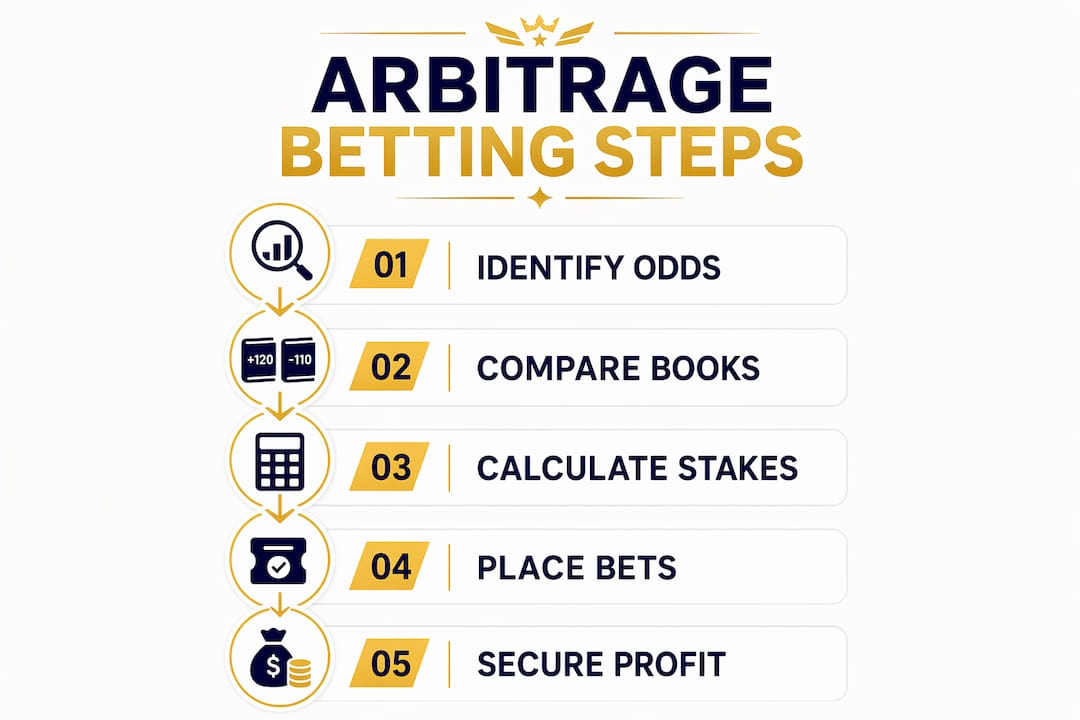
Here is how the process works, step by step:
- Identify a candidate match. Focus on high-liquidity football markets like match result or Over/Under totals. These markets attract the most pricing variation between books.
- Calculate implied probability. Convert each book’s odds to a percentage. For decimal odds, the formula is: 1 ÷ odds × 100. If Book A prices Team X to win at 2.10 and Book B prices the draw at 4.00 and the loss at 3.80, add all three implied probabilities together.
- Confirm the arb. If the total implied probability is below 100%, an arbitrage opportunity exists. The gap below 100% represents your guaranteed profit margin.
- Calculate stakes. Divide your total stake proportionally across each outcome so every result returns the same profit. Stake calculators handle this instantly.
- Place bets simultaneously. Speed is everything. Execution failure is a leading risk because line movements can cause you to miss the second leg of the bet, leaving you exposed on one side.
Pro Tip: Set up your accounts and fund them before you start scanning. Logging in and depositing mid-arb costs you the window entirely.
Arbitrage opportunities in football are rare and time-sensitive. Sharp sportsbooks update lines quickly and efficiently. Soft books lag behind, creating windows that typically last 10–20 minutes. You need to be ready before the opportunity appears, not after.

What is the relationship between odds comparison and arbitrage betting strategies?
Odds comparison is the practice of checking prices across multiple sportsbooks to find the best available number for a given bet. Arbitrage betting strategies depend entirely on this practice. Without systematic odds comparison, you cannot identify the pricing gaps that make arbing possible.
Line shopping is the everyday version of this discipline. Where arbitrage requires a gap large enough to cover all outcomes at a profit, line shopping focuses on finding the best price for a single bet. Both approaches share the same foundation: the belief that the price you get matters as much as the pick itself.
The data on sportsbook access is striking:
- Two sportsbooks yield a better price than a single book roughly 30% of the time.
- Six sportsbooks push that figure to over 70%, according to professional line shopping research.
- Manual odds checking is too slow for arbitrage. Professional odds comparison tools are the standard for bettors who arb seriously.
- Soft books update lines more slowly than sharp books, making them the primary source of mispriced odds.
- The football odds value checklist approach works best when you already have accounts funded at six or more books.
The table below shows how access to more books changes your ability to find value:
| Number of sportsbooks | Chance of finding a better price |
|---|---|
| 1 | Baseline (no comparison possible) |
| 2 | ~30% improvement over single book |
| 6+ | Over 70% improvement over single book |
Most bettors overlook the impact of varying vigorish across books. Reducing the juice you pay improves expected value even without changing how many bets you place. That insight alone separates break-even bettors from profitable ones over a full season.
What are common challenges and risks in arbitrage odds comparison?
Arbitrage carries real operational risks that most guides understate. Understanding them before you start protects your bankroll and your accounts.
The biggest dangers fall into three categories:
- Execution failure. A line moves between placing your first and second bet. You are now exposed on one outcome with no hedge in place. This is called “naked exposure,” and it can turn a guaranteed profit into a significant loss.
- Account limitations. Bookmakers detect arbitrage bettors by spotting round-number stakes, unusual timing patterns, activity in low-volume markets, and irregular withdrawal behavior. Detection leads to bet limits or account closures.
- Transaction costs. Withdrawal fees and currency conversion costs eat into margins that are already below 1.2%. Accounting for these costs is the difference between a profitable arb and a losing one.
Pro Tip: Never use round-number stakes like $100 or $500 on every bet. Vary your amounts slightly. It looks more natural and slows down detection.
Professional arbitrageurs mix in recreational-looking bets alongside their arbs. This masks the pattern of activity and reduces the speed of account restriction. The tradeoff is efficiency. You place bets you do not need to place, which ties up capital and adds noise to your records. Tracking your betting history carefully helps you monitor which accounts are still healthy and which are showing signs of restriction.
What tactics enhance arbitrage and odds comparison in football betting?
The most effective approach combines vig shopping, multi-account management, and timing discipline. No single tactic works in isolation.
- Shop for the lowest vig first. The average gap in vigorish between the best and worst books ranges from 2.5 to 3.5 percentage points. Vig shopping saves bettors approximately $2,500–$3,500 per 1,000 bets at $100 stakes. That is a structural edge that compounds over time, with no need to find a true arb.
- Maintain accounts at six or more books. Access is the foundation of every odds comparison tactic. More accounts mean more data points and more chances to find a mispriced line. Fund each account in advance so you can act immediately.
- Use sharp books as your baseline. Most profitable arbitrageurs treat sharp sportsbooks as the market benchmark. When a soft book’s line diverges from the sharp book’s number, that divergence signals a potential opportunity.
- Time your bets around market windows. Soft books lag behind sharp books by 10–20 minutes after major news or line moves. The window is short. Bettors who compare bookmaker odds systematically are positioned to catch these gaps before they close.
- Factor in promotional boosts. Sportsbooks regularly offer enhanced odds on featured football matches. A boosted price on one book can create an arb with a standard price on another. These opportunities are legal, low-risk, and often overlooked.
The table below compares vig shopping and full arbitrage as long-term tactics:
| Tactic | Profit source | Sustainability | Account risk |
|---|---|---|---|
| Vig shopping | Lower juice on every bet | High | Low |
| Full arbitrage | Odds gap across all outcomes | Low to medium | High |
| Promotional arbing | Boosted odds vs. standard price | Medium | Medium |
Line shopping is the most sustainable long-term strategy of the three. Arbitrage is a skill-builder and an occasional profit source, not a reliable income model. Bettors who treat it as a primary strategy burn through accounts faster than they build returns.
Key Takeaways
Arbitrage betting delivers guaranteed profits only when systematic odds comparison, fast execution, and disciplined account management work together.
| Point | Details |
|---|---|
| Arbitrage requires sub-100% implied probability | Only bet all outcomes when combined implied probabilities fall below 100% across books. |
| Six books outperform two by a wide margin | Access to six sportsbooks improves your chance of finding a better price to over 70%. |
| Execution speed is the critical variable | Arbitrage windows in football markets last 10–20 minutes; delayed action creates naked exposure. |
| Vig shopping is more sustainable than arbing | Saving 2.5–3.5 percentage points in juice per bet compounds into thousands of dollars over time. |
| Account management protects your edge | Mixing bet types and varying stakes slows bookmaker detection and extends account life. |
Why I treat arbitrage as a training tool, not a paycheck
Arbitrage taught me more about odds pricing in six months than years of casual betting did. Calculating implied probabilities on every match forces you to see odds as a market, not a prediction. That shift in thinking is genuinely valuable.
The problem is that arbitrage is rarely sustainable as a primary income source. Margins below 1.2% leave almost no room for error. One missed bet, one account restriction, one withdrawal fee, and the profit disappears. I have seen bettors spend hours chasing arbs only to net less than a single well-placed value bet would have returned.
What arbitrage does well is sharpen your odds comparison discipline. Once you understand how vig works and why prices differ across books, you start applying that knowledge to every bet you place. You stop accepting the first price you see. You check multiple books automatically. You notice when a line looks soft. Those habits build long-term profitability far more reliably than hunting for the next guaranteed arb.
My honest recommendation: use arbitrage to learn the math, use vig shopping to build the edge, and use sound handicapping to find the real value. The statistics-based approach to match analysis pairs naturally with odds comparison discipline. Together, they produce better decisions than any single tactic alone.
— Jaye
Goldbet888 gives football bettors a real odds comparison edge
Goldbet888 is built for football bettors who take pricing seriously. The platform covers live football odds across a wide range of markets, including Asian Handicap and Over/Under, giving you the price data you need to spot value and act fast.

Goldbet888’s community of 5,000+ Telegram members shares match previews and odds insights in real time, which is exactly the kind of edge that supports faster odds comparison decisions. Withdrawals are processed in as little as three minutes, so your capital stays liquid and ready for the next opportunity. Explore live football odds and the full 2026 betting guide to put your odds comparison skills to work on World Cup 2026 markets.
FAQ
What is arbitrage betting in simple terms?
Arbitrage betting means placing bets on every outcome of a match across different sportsbooks so that you profit regardless of the result. It works only when the combined implied probabilities of all outcomes fall below 100%.
How long do arbitrage opportunities last in football?
Arbitrage windows in football markets typically last 10–20 minutes. Sharp books price lines efficiently, and soft books catch up quickly once the market moves.
Is arbitrage betting legal for football bettors?
Arbitrage betting is legal in most jurisdictions. Sportsbooks may restrict or close accounts of bettors they identify as arbitrageurs, but the practice itself is not illegal.
What is the difference between arbitrage and line shopping?
Arbitrage covers all outcomes across books to guarantee a profit. Line shopping finds the best available price for a single bet. Line shopping is more sustainable long-term and carries far less account risk.
Why do most arbitrage profits stay below 1.2%?
Sportsbooks build a margin into their odds called the vigorish or juice. That margin means combined implied probabilities almost always exceed 100%, leaving only small gaps for arbitrage. Approximately 98% of arb opportunities fall below the 1.2% profit threshold.