Football betting markets are defined as structured hierarchies of events, individual markets, and selections, each priced and settled by precise rules that directly shape your betting strategy. A single match can contain over 200 markets, spanning everything from the basic match result to player-specific props and bet builders. Understanding this structure is not optional background knowledge. It is the foundation of every smart wagering decision you make. This guide breaks down how football betting markets are organized, how bookmakers price them, and how you can use that knowledge to bet with a real edge.
How football betting markets are organized: events, markets, and selections
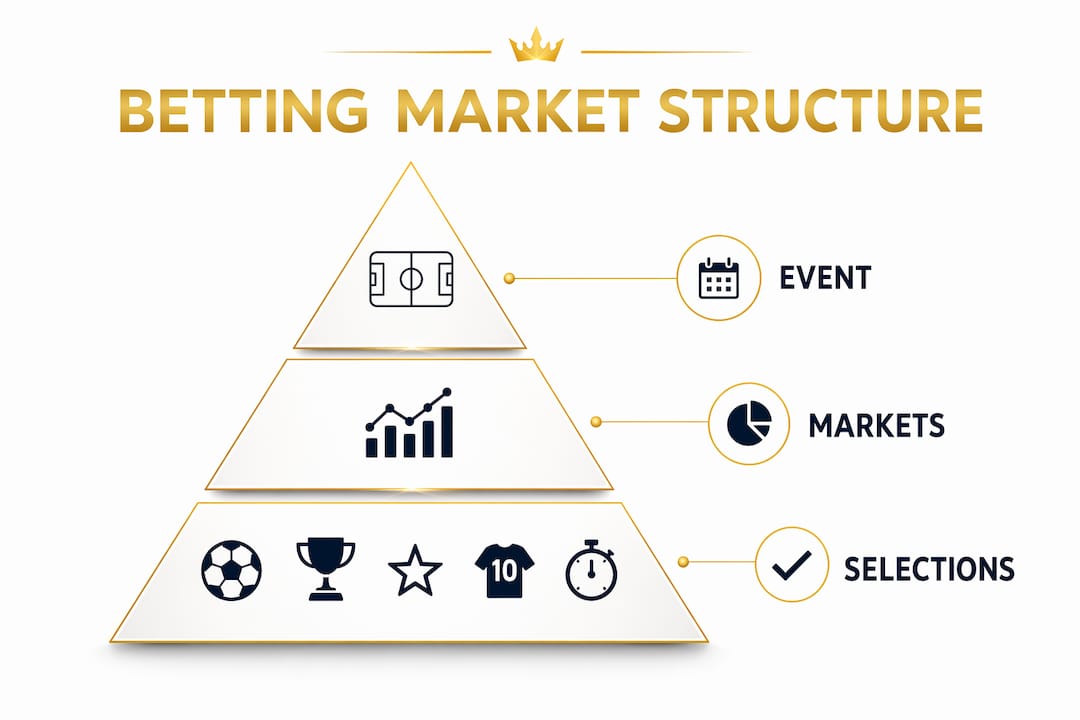
The organizational structure of betting follows a three-level hierarchy. At the top sits the event, which is the match itself. Inside each event, bookmakers create dozens to hundreds of individual markets, each asking a different outcome question. Inside each market sit the selections, which are the specific outcomes you bet on, each carrying its own odds.
Think of a Premier League match between Arsenal and Manchester City. The event is the match. One market inside it is the 1X2 result. The three selections are Arsenal win, draw, and Manchester City win. A separate market asks about total goals. Its selections are Over 2.5 and Under 2.5. This clean separation is why multiple market categories exist within a single game. Bookmakers divide one match into many independent outcome questions, each priced separately.

This hierarchy also explains why the types of betting markets available per match keep growing. Digital sportsbooks now offer player specials, corner counts, card markets, and same-game multis alongside the traditional categories. Each one is a distinct market with its own rules and settlement conditions.
What are the main types of football betting markets?
Football betting markets fall into several core categories. Each one works differently and rewards a different analytical approach.
- 1X2 (Match Result): The most common market. You pick a home win (1), draw (X), or away win (2). Settlement is based on 90 minutes plus stoppage time. Extra time and penalties are excluded unless the market title says otherwise. FanDuel’s World Cup advice confirms this as the standard rule across major sportsbooks.
- Asian Handicap: This market removes the draw outcome by applying goal handicaps to each team. A -1.0 handicap on the favorite means they must win by more than one goal for your bet to win. If they win by exactly one, the bet pushes and your stake is refunded. Quarter-line handicaps split your stake across two lines, creating partial wins and losses.
- Totals (Over/Under): The sportsbook sets a numerical line, such as 2.5 goals. You predict whether the total goals scored land over or under that threshold. Common lines include 1.5, 2.5, and 3.5 goals.
- Goalscorer and player props: These markets ask whether a specific player scores anytime, first, or last. They carry higher margins than 1X2 markets.
- Bet builders / same-game multis: These combine multiple selections from one match into a single wager. All legs must win for the bet to pay out. Sportsbooks increasingly offer these across 1X2, totals, and player specials.
Pro Tip: Asian Handicap markets attract sharper bettors because the elimination of the draw reduces variance and the defined push rules create clear refund scenarios. If you are new to Asian Handicap, start with whole-line handicaps before moving to quarter lines.
How do bookmakers price and organize football betting odds?
Bookmakers do not price markets as pure probability estimates. They embed a profit margin called the overround into every market. The overround means the implied probabilities of all selections in a market add up to more than 100%. For example, a market with an overround of 2.33% means the implied probabilities sum to 102.33%. That extra 2.33% is the bookmaker’s built-in edge.
This is a critical insight for bettors. A common mistake is reading bookmaker odds as direct reflections of team strength. They are not. They reflect both the bookmaker’s probability estimate and the margin layered on top. Bookmaker margins reflect how the entire market is priced to ensure profit, not just individual team chances. Stripping out the margin to find the true implied probability is a core skill in betting market analysis.
Odds also move dynamically after opening. Sportsbooks shift lines to balance wagering volume and manage risk exposure. When heavy money lands on one side, the bookmaker shortens those odds to reduce liability and lengthen the other side to attract balancing action. Line movement is not just a signal of changing probability. It reflects market forces and risk management decisions by the bookmaker.
Betting exchanges like Betfair operate differently. They use an order book where bettors trade against each other rather than against the house. This creates tighter margins but requires understanding liquidity and lay betting mechanics. For most recreational bettors in Singapore, traditional sportsbook markets remain the primary structure to master.
What are the settlement rules for football betting markets?
Settlement rules determine when and how your bet is resolved. Getting these wrong is one of the most common and costly bettor mistakes.
The standard rule across 1X2, Asian Handicap, totals, and Both Teams to Score markets is 90 minutes plus stoppage time. Extra time and penalty shootouts do not count unless the market title explicitly includes them. This matters most in knockout competitions like the FIFA World Cup 2026, where matches can go to extra time and penalties. A bet on the match result market settles on the 90-minute score, not the final outcome after penalties.
Markets labeled “including extra time” or “to lift the trophy” do include all play. Settlement labels like “regular time” versus “including extra time” materially change the outcome of your bet. Always read the market title and rules before placing.
Asian Handicap push rules add another layer. A -1.0 handicap that results in a one-goal win returns your stake in full. Quarter-line handicaps like -0.75 split your stake: half settles on the -0.5 line and half on the -1.0 line. This creates partial refunds and partial wins depending on the margin of victory.
Pro Tip: Before betting any knockout-stage match at the 2026 World Cup, check whether your chosen market settles on 90 minutes or full tournament result. The difference between “match result” and “to qualify” can mean the difference between a winning and losing bet on the same game.
How can understanding market structure improve your football betting strategies?
Knowing how football wagering systems are built changes how you approach every bet. Each market type rewards a different analytical model.
- Match 1X2: Focus on match outcome modeling. Team form, head-to-head records, home advantage, and motivation all feed into this market. It has the tightest margins among football markets, reflecting its high liquidity.
- Asian Handicap: Requires handicap translation. You are not just predicting a winner. You are predicting the margin of victory. Treating Asian Handicap as a separate risk model from 1X2 improves your edge. Late team news, such as a key striker ruled out, moves Asian Handicap lines faster than 1X2 lines.
- Totals (Over/Under): Expected goals (xG) models are the most relevant tool here. Match pace, defensive records, and weather conditions all affect goal totals. A match between two low-block teams calls for a different totals analysis than an open attacking fixture.
- Pre-match vs. in-play markets: Pre-match and in-play markets are distinct micro-markets with different liquidity and pricing dynamics. In-play odds react faster to events on the pitch. Bettors who read the game well can find value in live markets that pre-match models miss.
- Margin awareness: Identifying markets with lower overround gives you better value per bet. Comparing bookmaker odds across platforms before placing is a direct way to reduce the margin you pay on every wager.
The practical takeaway is this: match your analytical strength to the right market. If you understand xG models, focus on totals. If you track team news closely, Asian Handicap is your edge market. Betting across all market types without a specific model for each spreads your attention and dilutes your edge.
Key Takeaways
Football betting markets are organized as three-level hierarchies of events, markets, and selections, each with distinct pricing, settlement rules, and analytical requirements that define your betting edge.
| Point | Details |
|---|---|
| Three-level hierarchy | Every match contains an event, multiple markets, and individual selections with their own odds. |
| Settlement is 90 minutes | Most markets settle on regular time only; extra time counts only when the market title says so. |
| Overround reduces true value | Bookmaker margins inflate implied probabilities above 100%, so always strip out the margin to find real value. |
| Match your model to the market | Use xG for totals, handicap translation for Asian Handicap, and outcome modeling for 1X2 bets. |
| In-play is a different market | Live markets have faster odds movement and different liquidity from pre-match; treat them as separate opportunities. |
Why market structure is the edge most bettors overlook
I have spent years watching bettors focus entirely on picking winners while ignoring the mechanics of the market they are betting into. That is the wrong order of operations. The market structure tells you the rules of the game before you even analyze a match.
The biggest misconception I see is treating bookmaker odds as a direct read on team quality. They are not. Once you understand that a 2.33% overround is baked into every market, you stop reading odds as truth and start reading them as a starting point for your own probability estimate. That shift alone changes how you evaluate value.
Asian Handicap is where I see the sharpest improvement in bettors who take the time to learn the push rules. The elimination of the draw and the defined refund mechanics make it a more structured market for disciplined bettors. It rewards research on team news and line movement in a way that 1X2 markets simply do not.
My honest advice: pick one market type, learn its pricing mechanics and settlement rules completely, and build your analysis around it. Depth in one market beats shallow coverage of ten. The bettors who consistently find edge are not the ones who bet everything. They are the ones who know one market better than the bookmaker expects.
— Jaye
Goldbet888: apply your market knowledge with live odds
Goldbet888 is built for football bettors in Singapore who want to put this kind of market knowledge to work with real odds and real markets.

The platform covers football betting markets across the Premier League, La Liga, and the FIFA World Cup 2026, with Asian Handicap and Over/Under markets available alongside standard 1X2 options. Goldbet888 reports withdrawal processing in as little as three minutes, so your winnings move fast. The platform’s 5,000+ Telegram community shares match previews and market insights that complement your own analysis. For World Cup 2026 betting, Goldbet888’s live odds and market coverage give you the range to apply every strategy covered in this guide.
FAQ
What is a football betting market?
A football betting market is a specific outcome question within a match, such as the final result or total goals scored, with individual selections priced by the bookmaker. A single match can contain over 200 markets.
How does Asian Handicap differ from 1X2?
Asian Handicap removes the draw by applying goal handicaps to each team, with push and refund rules when the margin of victory matches the handicap line exactly. The 1X2 market offers three outcomes with no refund mechanics.
Do football betting markets include extra time?
Most football markets settle on 90 minutes plus stoppage time only. Markets that include extra time or penalties state this explicitly in their title or rules, which is especially relevant for World Cup knockout matches.
What is overround in football betting?
Overround is the bookmaker’s profit margin, embedded by pricing all selections so their implied probabilities total more than 100%. A 2.33% overround means bettors collectively pay that percentage above fair odds on every market.
What is the difference between pre-match and in-play markets?
Pre-match markets are priced before kickoff with stable liquidity, while in-play markets react faster to on-pitch events with higher odds volatility. Treating them as separate micro-markets improves your strategic approach to each.