Diversifying high stakes World Cup wagers means spreading your betting capital across tournament phases, bet types, and correlated outcomes to control variance and improve risk-adjusted returns. The FIFA World Cup 2026 runs 48 teams across 104 matches, creating more betting complexity than any previous tournament. That scale demands a structured portfolio approach, not a series of isolated bets. The core tools are phased bankroll allocation, fractional Kelly sizing, and correlation-aware parlay construction. Get these three right and you protect your capital during cold runs while staying positioned for the big swings that knockout rounds deliver.
How to diversify high stakes World Cup wagers by tournament phase
Bankroll allocation by tournament phase is the foundation of any serious World Cup betting portfolio. The group stage gives you the most data volume but the least team-specific information. Knockout rounds flip that equation: fewer matches, sharper information, and bigger market inefficiencies to exploit.
A phased allocation approach distributes roughly 40% of your bankroll to the group stage, 35% to the Round of 32 and Round of 16, and 25% to the quarterfinals and beyond. That structure keeps your largest stakes reserved for the rounds where you know the most about each team’s form, fitness, and tactical setup.

| Tournament Phase | Allocation | Rationale |
|---|---|---|
| Group stage | ~40% | High match volume; use smaller units to gather information |
| Round of 32 and Round of 16 | ~35% | Form data builds; market inefficiencies increase |
| Quarterfinals onward | ~25% | Highest information quality; justify larger individual stakes |
The group stage is where you build your read on teams, not where you go heaviest. Many high-stakes bettors make the mistake of front-loading capital on group matches because the odds look attractive. The smarter play is treating the group stage as a paid research phase. You are betting to learn as much as you are betting to profit.
A maturity plan transitions your portfolio from safer early-stage markets into Asian handicaps and live betting as your bankroll cushion grows. That shift lets you access higher-variance markets only after you have demonstrated an edge in lower-variance ones.
Pro Tip: Track your group stage results by market type, not just by win or loss. If your Asian handicap bets outperform your match result bets by the end of the group stage, shift more of your Round of 16 allocation toward handicap markets.
What bet sizing techniques reduce risk on high-stakes wagers
Fractional Kelly sizing is the most reliable framework for controlling bet size without sacrificing long-term growth. Full Kelly staking produces aggressive bet sizes that create large drawdowns even when your edge is real. Quarter or half Kelly cuts those drawdowns significantly while still compounding your bankroll at a healthy rate.
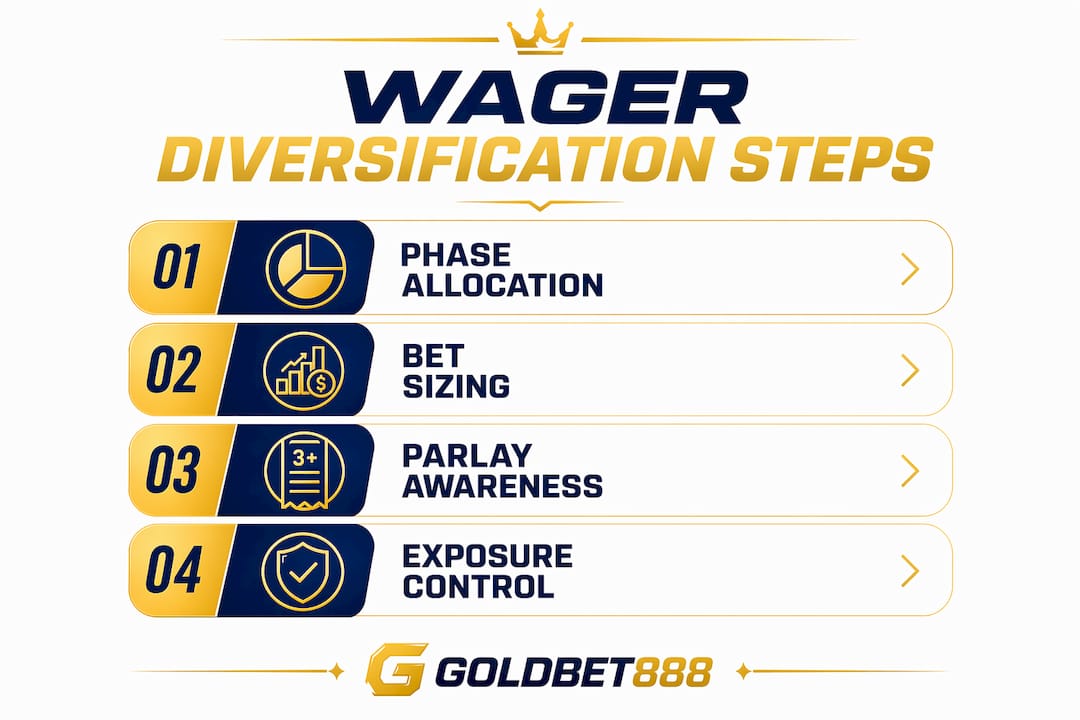
The practical starting point for most high-stakes bettors is setting unit sizes at 0.5%–1% of total bankroll per bet. That range keeps any single loss from doing structural damage to your portfolio. It also forces you to think in terms of edge frequency rather than chasing one big score.
Key bet sizing rules for a World Cup portfolio:
- Unit size: Set each single bet at 0.5%–1% of your total bankroll
- Futures cap: Allocate a fixed percentage to futures separately from match bets; avoid over-concentration on longshot futures in early phases
- Parlay sizing: Size parlays at a lower unit than singles (see parlay section below)
- Kelly inputs: Use conservative edge estimates; overestimating your edge inflates Kelly outputs dangerously
- Drawdown ceiling: Set a maximum daily loss limit and stop betting when you hit it
Fractional Kelly staking provides both a mathematical and psychological safeguard against catastrophic drawdowns. The psychological side matters more than most bettors admit. When you are down during a tournament, the temptation to increase stakes is intense. A pre-set fractional Kelly framework removes that decision from the heat of the moment.
Pro Tip: Track every bet in a spreadsheet with your estimated edge, the Kelly-recommended stake, and the actual stake you placed. After 30 bets, compare your estimated edges to actual results. If your edge estimates are consistently wrong, recalibrate before scaling up.
How to diversify parlays with correlation risk awareness
Correlation risk is the single most misunderstood concept in parlay betting. Sportsbooks price parlays assuming each leg is statistically independent. That assumption is often wrong, and sharp bettors exploit the gap. Correlation-aware parlays focused on strongly related outcomes within the same match exploit that mispricing and reduce variance at the same time.
The practical structure is a 2–3 leg parlay anchored on outcomes that are genuinely connected. A heavy favorite winning combined with the match going over the total is a classic correlated pair. If the favorite controls the game, they are likely to score multiple goals, which pushes the total over. The book prices these legs as if they are independent. They are not.
| Parlay structure | Correlation level | Risk profile |
|---|---|---|
| 2-leg: favorite win + match over | High positive | Lower failure risk; legs move together |
| 2-leg: draw + match under | Moderate positive | Survivable; defensive games tend to stay low |
| 3-leg: favorite win + over + first scorer from favorite | Moderate | Manageable if anchor legs are correlated |
| 4+ legs: mixed markets across multiple matches | Near zero | High failure probability; avoid for high-stakes play |
Short parlays with 2–3 legs anchored on correlated outcomes are more survivable than long accumulators. Each additional leg multiplies the failure probability. That is not a linear increase. It is exponential, because each leg introduces conditional risk on top of the previous one.
Sizing rules for parlays:
- Cap parlay stakes at 60–70% of your normalized single bet unit
- Never chase a busted parlay with a larger ticket on the next match
- Treat parlays as a separate exposure class with their own weekly budget
- Avoid leg-count creep where you add legs to increase payout without increasing your actual edge
The most common mistake high-stakes bettors make with parlays is adding legs to justify the excitement of a bigger payout. More legs do not mean more edge. They mean more ways to lose.
How to implement a daily exposure and variance control plan
Daily exposure limits are the operational layer that keeps your bankroll allocation strategy intact across a 104-match tournament. Without hard daily caps, a bad run of group stage results can wipe out the capital you need for the knockout rounds where your edge is sharpest.
A practical daily exposure control system works like this:
- Set a daily unit cap. Decide the maximum number of active units you will have in play on any single day. A common ceiling for high-stakes bettors is 5–8 units across all open bets.
- Separate your exposure buckets. Track futures, parlays, and singles as three distinct exposure categories. Each gets its own daily limit. A futures position should not eat into your singles budget for that day.
- Stop when the cap is reached. Stopping after your daily cap prevents tilt-driven bets and compounding losses. This is the rule most bettors break first and regret most.
- Review before the next session. Spend five minutes reviewing your open positions before placing any new bets the following day. Knowing your current exposure prevents accidental doubling up on correlated markets.
- Adjust caps as the tournament progresses. If your bankroll grows through the group stage, you can scale your unit size up slightly for the knockouts. If it shrinks, scale down. The percentage stays fixed; the dollar amount adjusts.
Managing daily exposure prevents emotional overbetting and bankroll depletion across a long tournament. The World Cup runs for weeks. Bettors who blow their capital in the group stage miss the highest-value markets in the semifinals and final. Pacing is a competitive advantage, not a conservative limitation.
A practical example: if your total bankroll is $10,000 and your unit size is 1%, each unit is $100. A daily cap of 6 units means your maximum daily exposure is $600 across all bet types. That leaves your portfolio intact even if every bet that day loses.
Key takeaways
Structured diversification across tournament phases, bet sizing frameworks, and correlation-aware parlay construction is the most reliable way to protect and grow a high-stakes World Cup betting portfolio.
| Point | Details |
|---|---|
| Phase-based allocation | Put ~40% on group stage, 35% on Round of 32/16, and 25% on quarterfinals onward. |
| Fractional Kelly sizing | Use quarter or half Kelly and set unit sizes at 0.5%–1% of bankroll per bet. |
| Correlation-aware parlays | Build 2–3 leg parlays on connected outcomes and cap stakes at 60–70% of a single unit. |
| Daily exposure caps | Set separate daily limits for futures, parlays, and singles to prevent tilt and overexposure. |
| Maturity plan | Shift from safer early markets into Asian handicaps and live betting as your bankroll cushion builds. |
What I’ve learned from betting the World Cup at high stakes
The hardest part of executing a diversified World Cup betting portfolio is not the math. The math is straightforward once you commit to fractional Kelly and phase-based allocation. The hard part is discipline when the tournament atmosphere is at its loudest.
I have seen bettors with solid frameworks abandon them completely after a three-match losing streak in the group stage. They double their parlay stakes, chase losses with same-day bets, and blow their knockout round capital before the Round of 16 even starts. The tournament excitement is real, and it works against you if you are not tracking every bet meticulously.
The insight that changed my approach was treating the group stage as a data collection exercise first and a profit opportunity second. When you frame it that way, a losing group stage bet still has value. It tells you something about how a team performs under pressure, how a referee crew calls fouls, or how a market misprices a specific type of match. That information feeds better decisions in the knockouts.
Correlation-aware parlay construction also rewards patience. The best correlated pairs are not always obvious before kickoff. Sometimes you spot them in the first 15 minutes of a match through live betting markets, where the odds shift faster than the underlying probability actually changes. That gap is where the real edge lives for high-stakes bettors who have done the preparation.
The bettors who consistently profit across a full World Cup tournament are not the ones with the boldest picks. They are the ones who protect their capital long enough to be active and well-funded when the knockout rounds deliver their highest-value opportunities.
— Jaye
Goldbet888: built for World Cup portfolio betting
Goldbet888 gives high-stakes bettors the market depth and speed needed to execute a diversified World Cup portfolio across all tournament phases.

The platform covers futures, in-play markets, Asian handicap, and Over/Under across all 104 FIFA World Cup 2026 matches. That range lets you run singles, parlays, and live bets as separate exposure classes without switching platforms. Goldbet888 reports withdrawal processing in three minutes, which matters when you need to move capital quickly between tournament phases. The platform’s 5,000+ member Telegram community shares match previews and odds analysis that support the kind of informed, phase-based betting this article describes. Apply your diversification strategy where the World Cup odds and markets are competitive and the execution is fast. You can also check the full sports betting markets to compare lines before locking in your units each day.
FAQ
What does it mean to diversify World Cup wagers?
Diversifying World Cup wagers means spreading your betting capital across tournament phases, bet types, and correlated outcomes rather than concentrating it on single matches or markets. The goal is to control variance while staying positioned for high-value opportunities throughout the tournament.
How much of my bankroll should I bet per match?
Set each single bet at 0.5%–1% of your total bankroll. That unit size limits damage from any single loss and keeps your capital intact for the knockout rounds where market inefficiencies are greatest.
What is fractional Kelly and why use it?
Fractional Kelly means betting a quarter or half of what the full Kelly Criterion recommends. Full Kelly produces large drawdowns even with a real edge. Quarter Kelly reduces those drawdowns significantly while still growing your bankroll over time.
How do correlated parlays reduce risk?
Correlated parlays link outcomes that move together, such as a heavy favorite winning and the match going over the total. Sportsbooks price these legs as independent, creating a mispricing that sharp bettors exploit. Two-leg correlated parlays are more survivable than long accumulators built from unrelated legs.
Why do daily exposure limits matter in a long tournament?
A 104-match tournament runs for weeks. Without daily caps, a bad group stage run can deplete the capital you need for the semifinals and final, where your information edge is strongest. Daily limits prevent tilt-driven bets and keep your portfolio funded through the full tournament.