A post-match betting review is a structured 2–5 minute session where you evaluate your wagering decisions independently of the match result to build long-term discipline and profitability. This practice, known in professional betting circles as post-bet analysis, separates decision quality from outcome luck. Bettors in Singapore who adopt this habit consistently outperform those who only track wins and losses. Goldbet888 recommends this approach as a core part of any serious football betting strategy, especially heading into the FIFA World Cup 2026 season.
What is post-match betting review and why does it matter?
A post-match betting review is a brief, focused evaluation of your betting decisions after a football match concludes. The goal is not to replay the game emotionally. The goal is to ask one question: “Was my decision process sound, regardless of what the scoreboard said?”
Reviewing both wins and losses uncovers process leaks that emotional bias hides. A winning bet can still be a bad decision if you placed it on impulse or at poor value. A losing bet can still be a good decision if your reasoning was solid and the odds were in your favor.

Professional bettors apply a decision–outcome matrix that labels each bet as a good or bad decision, independent of whether it won or lost. This framework forces you to evaluate your process, not your luck. Systematic comparison of pre-match reasoning to actual outcomes is the single greatest factor separating improving bettors from those who stagnate.
Reviews kept to 2–5 minutes prevent emotional venting and keep the focus on process analysis. Longer sessions tend to drift into rationalization or frustration, which defeats the purpose entirely.
What are the key components of an effective post-match betting review?
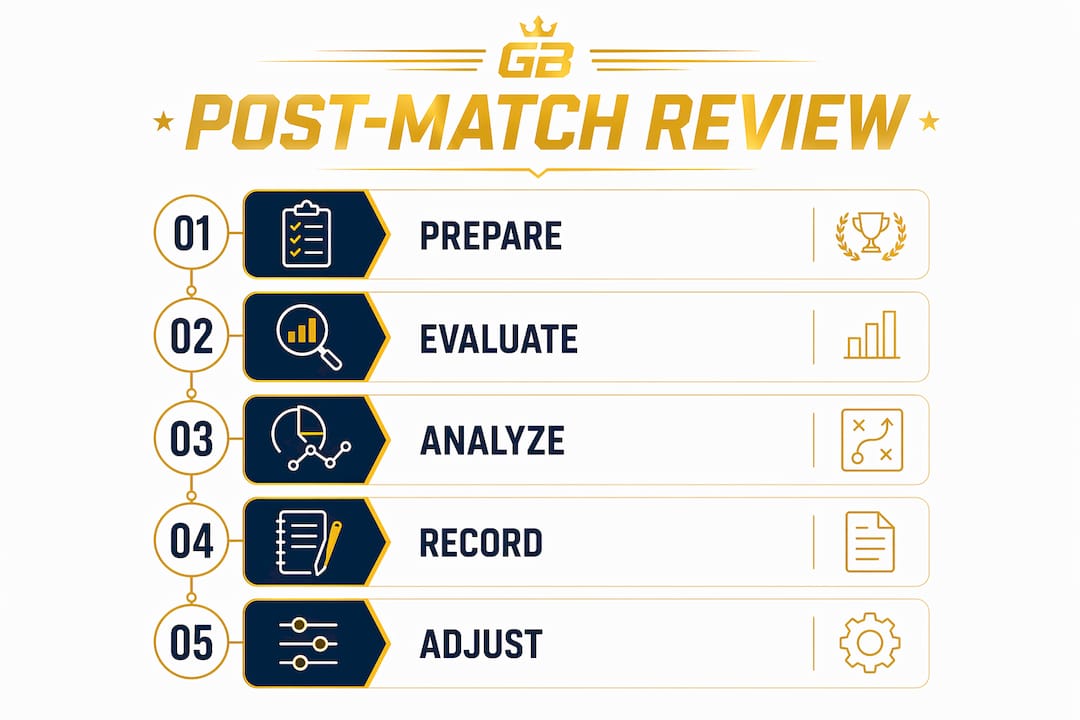
An effective review covers five core areas. Each one targets a specific source of betting error.
- Decision quality check. Label each bet using the decision–outcome matrix: good decision/win, good decision/loss, bad decision/win, bad decision/loss. This is the foundation of honest self-assessment.
- Assumption vs. reality comparison. Write down your pre-match assumptions, then compare them to actual match statistics like expected goals (xG), possession percentages, and key events such as red cards or VAR decisions.
- Closing Line Value (CLV) check. CLV measures whether you placed your bet at odds better than the closing line. A positive CLV means your bet had real edge, even if it lost.
- Emotion log. Note your emotional state at the time of betting. Anxiety, overconfidence, and recency bias all distort judgment in predictable ways.
- Bet tags and rationale notes. Tagging bets by type, confidence level, and reasoning builds a dataset you can mine for patterns over time.
Pro Tip: Keep a simple spreadsheet with columns for bet type, pre-match reasoning, CLV result, and emotion rating. After 30 bets, patterns become visible that you cannot spot in real time.
Here is a quick reference for the decision–outcome matrix:
| Decision Quality | Outcome | What It Means |
|---|---|---|
| Good decision | Win | Process and result aligned. Reinforce this approach. |
| Good decision | Loss | Variance. Do not change your process. |
| Bad decision | Win | Lucky. Identify and correct the flaw before it costs you. |
| Bad decision | Loss | Expected. Diagnose the root cause immediately. |
How does analyzing losses as data enhance betting strategies?
Most bettors treat a loss as a verdict. The best bettors treat it as a data point. That shift in mindset is where real strategy improvement begins.
The first step is loss categorization. Every loss falls into one of four buckets: variance (you were on the right side but ran bad), wrong side (your analysis was incorrect), bad line (you accepted poor value), or model error (your framework for evaluating the match was flawed). Each category demands a different response.
- Identify the loss type. Before doing anything else, assign the loss to one of the four categories above. This prevents you from making changes for the wrong reason.
- Check CLV first. Positive CLV on a loss means variance beat you, not your process. Do not adjust your strategy based on variance losses.
- Wait for a meaningful sample. Adjust strategies only after analyzing at least 30–50 bets within the same market segment. Reacting to five losses in a row is the most common mistake Singapore bettors make.
- Look for repeating patterns. If “wrong side” losses cluster around a specific league or bet type, that is a signal worth acting on. One-off losses are noise.
- Document corrective actions. Write down what you will do differently and why. Vague intentions do not change behavior. Specific written adjustments do.
Pro Tip: After every 10 bets, run a quick tally of your loss categories. If variance accounts for most losses and your CLV is positive, your process is working. Stay the course.
The most damaging mistake is overreacting to emotionally charged losses, particularly big ones on high-profile matches. A single bad night on a Champions League final tells you almost nothing statistically. It tells you a great deal emotionally, which is exactly why you need the 24–48 hour waiting rule before reviewing it.
What betting statistics and market factors should be reviewed post-match?
Match statistics give you the objective truth that the scoreline often hides. Analyzing xG, possession, and key match events alongside your pre-match assumptions reveals whether the match played out as the market expected or whether something unusual shifted the result.
- Expected goals (xG). A team that lost 2-0 but generated 2.4 xG to the opponent’s 0.8 xG was statistically the better team. That context changes how you evaluate your pre-match read entirely.
- Possession and press stats. Dominant possession teams that concede on the counter skew Over/Under markets. Reviewing these stats helps you spot when your pre-match model missed a tactical mismatch.
- Key match events. Red cards, VAR overturns, and injury-time goals create narrative swings that distort both live and pre-match betting markets. Log these events and note whether they were predictable or random.
- Odds movement and closing line. Compare the odds you took to the closing line. Understanding market odds movements and whether the market overreacted to team news or public sentiment is a core skill for serious bettors.
- Bet entry timing. Note when you placed your bet relative to market movement. Early entry on a line that moved in your favor confirms edge. Late entry on a line that moved against you suggests you were following the crowd.
Here is a post-match data review checklist:
| Statistic | What to Compare | Why It Matters |
|---|---|---|
| xG (expected goals) | Pre-match model vs. actual xG | Reveals whether the result reflected true team quality |
| Possession % | Your assumption vs. actual split | Exposes tactical misreads in your pre-match analysis |
| Closing line vs. your odds | Your entry price vs. final market price | Confirms or denies whether you had real edge |
| Key events (red cards, VAR) | Predicted vs. actual disruptions | Separates skill from luck in your result |
For football specifically, xG is a more reliable post-match review tool than for most other sports because football is a low-scoring game where single goals carry outsized weight. You can use statistics in high-stakes matches to sharpen this analysis further.
How can football bettors in Singapore implement post-match reviews?
A practical framework makes the difference between a review habit that sticks and one that fades after two weeks. Here is a step-by-step process built for Singapore football bettors.
- Wait 24–48 hours after the match. Immediate reviews risk distorted analysis driven by frustration or elation. Let the emotion settle before you open your log.
- Use a simple template. Your template needs four fields: the decision you made, the assumptions behind it, the actual result, and your emotional state at bet time. Nothing more is needed to start.
- Tag every bet at placement time. Do not wait until the review. Tag each bet with market type (Asian Handicap, Over/Under, 1X2), confidence level (high, medium, low), and your primary reason for the bet. This makes the review far faster and more accurate.
- Review your football odds value alongside match data. Cross-reference your CLV result with the xG and possession stats from the match. This combination tells you whether your edge was real or imaginary.
- Adjust only after 30–50 bets. Singapore bettors frequently over-adjust after short losing runs during the English Premier League or Champions League group stages. Patience is a competitive advantage.
Pro Tip: Set a recurring calendar reminder for 36 hours after each major match you bet on. This automates the waiting period and builds the review habit without relying on willpower.
Common process leaks specific to Singapore football bettors include over-betting on Southeast Asian leagues where data quality is lower, chasing losses after late-night European matches, and placing bets based on Telegram tip channels without independent verification. A structured review exposes all three patterns within a month of consistent logging.
Key takeaways
A post-match betting review is the most direct tool for separating decision quality from outcome luck, and bettors who apply it consistently build a measurable edge over time.
| Point | Details |
|---|---|
| Review duration | Keep reviews to 2–5 minutes to stay focused on process, not emotion. |
| Decision–outcome matrix | Label every bet as a good or bad decision independent of the result. |
| Closing Line Value | Positive CLV on a loss means variance beat you, not your process. |
| Sample size discipline | Wait for 30–50 bets before adjusting any strategy in a given market. |
| Timing of review | Wait 24–48 hours post-match to review with a clear, objective mindset. |
Why I think most bettors skip the one habit that would change everything
I have watched hundreds of football bettors in Singapore go through the same cycle. They win a few bets, feel confident, scale up, hit a bad run, and then either quit or reset to square one. The missing piece is almost always the same: they never built a review habit.
The uncomfortable truth is that most bettors avoid post-match reviews because honest self-assessment is harder than blaming the referee or a late equalizer. Ego-driven betting is the norm, not the exception. A disciplined review forces you to confront bad decisions that happened to win, which is psychologically uncomfortable in a way that losing never quite is.
What I have found actually works is treating the review as a two-minute admin task, not a deep reflection session. The moment it feels like homework, it stops happening. Keep the template minimal, tag bets at placement, and let the data accumulate. After 50 bets, the patterns speak for themselves without you having to force any insight.
Community benchmarking adds another layer. Goldbet888’s Telegram community of 5,000+ members gives you a reference point for your reasoning. When you see how other Singapore bettors analyzed the same match, you spot blind spots in your own thinking that solo review misses entirely. That external check is underused and genuinely valuable.
Short-term variance will always feel louder than long-term process. The review habit is how you tune out the noise.
— Jaye
Goldbet888: where your post-match insights become better bets
Applying post-match review principles works best when you have access to competitive odds, clear market data, and expert analysis before your next bet. Goldbet888 is built specifically for Singapore football bettors who want all three in one place.

Goldbet888 offers live odds across Asian Handicap, Over/Under, and 1X2 markets, with withdrawals processed in as little as three minutes. The platform’s Singapore betting guide covers everything from reading line movement to applying CLV in real bets. Whether you are preparing for a World Cup 2026 fixture or reviewing last night’s Premier League result, Goldbet888 gives you the tools and the live football odds to act on what your review reveals.
FAQ
What is a post-match betting review?
A post-match betting review is a structured 2–5 minute evaluation of your betting decisions after a match, focused on decision quality rather than the result. It uses frameworks like the decision–outcome matrix and Closing Line Value to separate process errors from variance.
How long should a post-match betting review take?
Reviews should last 2–5 minutes to stay focused and prevent emotional venting. Longer sessions tend to drift into rationalization rather than objective analysis.
When is the best time to review a bet after a match?
Wait 24–48 hours after the match before conducting your review. Immediate post-match analysis risks distorted conclusions driven by frustration or excitement rather than clear thinking.
What is Closing Line Value and why does it matter in reviews?
Closing Line Value (CLV) measures whether you placed your bet at odds better than the final market price before kickoff. Positive CLV indicates genuine edge, even when the bet loses, making it the most reliable indicator of long-term betting skill.
How many bets should I review before changing my strategy?
Analyze at least 30–50 bets within the same market segment before making any strategy adjustments. Reacting to fewer bets risks confusing normal variance with a genuine process flaw.