Using statistics in high-stakes match betting is the single most reliable method for identifying genuine value and managing financial risk across football markets. Football accounts for 42% of global betting activity, making it the most data-rich sport for analytical bettors. Metrics like Expected Goals (xG), shots on target, and rolling 5-match form give you a measurable edge over bettors relying on instinct alone. Goldbet888 is built for exactly this kind of disciplined, data-driven approach, offering live odds and match analysis tools tailored to Singapore’s high-stakes football bettors.
Which football statistics matter most for high-stakes betting?
The three statistics that consistently predict match outcomes are Expected Goals (xG), shots on target, and recent 5-match form. Each one tells you something different, and together they paint a picture no single number can.
xG measures the quality of scoring chances, not just the number of goals scored. A team that scores two goals from low-quality chances is less dangerous than a team that scores one goal from high-probability positions. That gap between actual goals and xG is where value bets hide.

Shots on target reveal attacking pressure and defensive vulnerability. High shots on target correlate with matches suited to Over 2.5 goals and Both Teams To Score (BTTS) markets. When both teams average six or more shots on target per game, BTTS becomes a statistically grounded bet, not a coin flip.
Situational metrics like home/away splits and rolling 5-game form outperform aggregated season stats for match analysis. A team sitting third in the league table may have won only one of its last five road games. That context changes your bet entirely.
| Statistic | What it measures | Best betting market |
|---|---|---|
| Expected Goals (xG) | Chance quality, not just volume | Match result, Asian Handicap |
| Shots on target | Attacking pressure and defensive weakness | Over/Under, BTTS |
| Home/away splits | Venue-specific performance patterns | Asian Handicap, match result |
| Rolling 5-match form | Current momentum and fitness | Match result, Over/Under |
| Head-to-head trends | Historical patterns between specific teams | Correct score, match result |
Pro Tip: Focus on xG differential over the last five matches rather than season totals. A team with a positive xG differential in four of its last five games is trending upward, regardless of where it sits in the standings.
How do you apply statistical analysis to your betting strategy?
A repeatable process separates profitable bettors from those who rely on hunches. The expected value betting framework is the industry standard for turning raw stats into bet decisions.
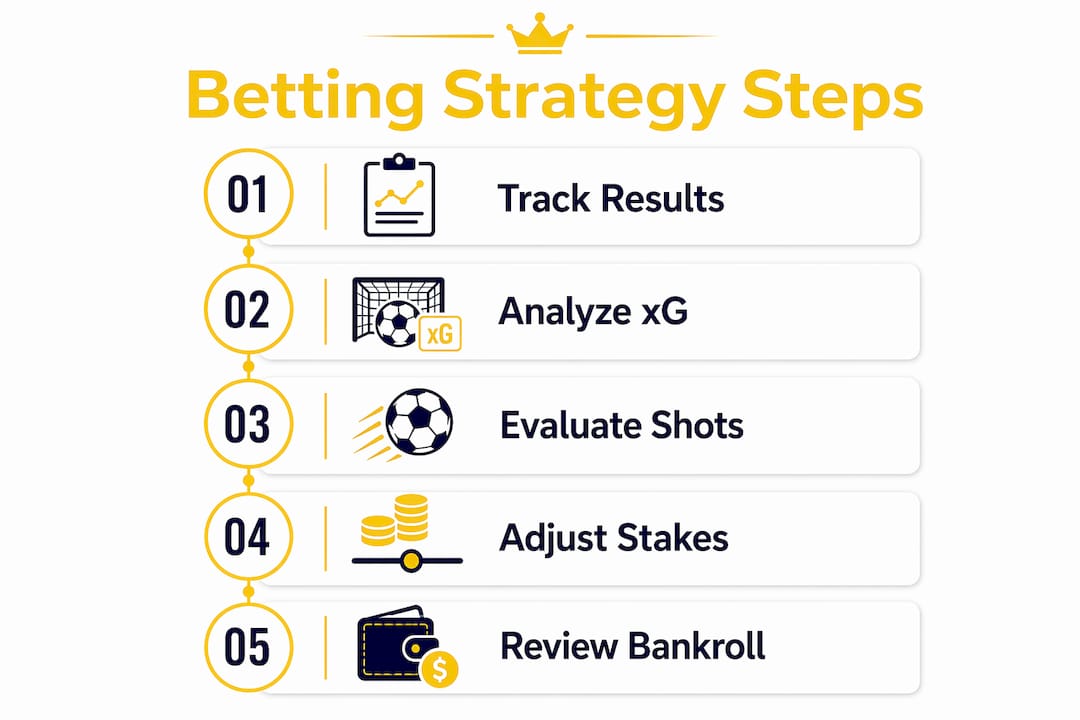
Follow this step-by-step approach before placing any high-stakes wager:
- Gather team data. Pull xG, shots on target, goals scored and conceded, and home/away records from a trusted stats source for both teams. Use the last 5–8 matches, not the full season.
- Evaluate current form. Score each team’s last five results on a simple scale. Note whether wins came against strong or weak opposition.
- Compare xG with actual goals. A team overperforming its xG is likely to regress. A team underperforming its xG may be due for a positive correction.
- Check head-to-head trends. Some matchups consistently produce low-scoring or high-scoring games regardless of current form. Three or more historical data points make this reliable.
- Identify the value bet. Compare bookmaker odds against your statistical probability estimate. If your model gives a 60% probability to an outcome priced at 2.00 (implied 50%), you have found value.
- Record every bet. Log the match, the stat rationale, the odds, the stake, and the result. Tracking your betting history is how you identify which statistical signals actually work for your style.
Consistency and rigorous record-keeping separate professional bettors from amateurs. Bettors who track their results over 100 or more bets can measure which stat combinations produce the highest return on investment.
Pro Tip: Use Google Sheets to build a simple tracker with columns for xG differential, shots on target ratio, your predicted probability, the bookmaker’s implied probability, and the outcome. After 50 bets, patterns will emerge that refine your model.
What are the most common pitfalls in statistical betting?
Statistical analysis gives you an edge only when you apply it without bias. The most common mistakes undermine the very advantage that data is supposed to provide.
- Emotional bias toward team reputation. Emotional betting based on team loyalty is a beginner mistake. Betting on a historically strong club because of its name, rather than its current xG and form, is how high-stakes bettors lose money on paper-thin value.
- Relying on season aggregates. Full-season stats smooth out the peaks and valleys that matter most. A team’s September form tells you nothing useful about its february performance after key injuries.
- Ignoring live match dynamics. Statistical models form a baseline; live match observation captures momentum and tactical nuances that raw data misses entirely. A team dominating possession but failing to create shots on target is a live signal to reconsider your pre-match read.
- Mug betting patterns. Placing bets that are too predictable or too frequent triggers account limitations on many platforms. Vary your markets and stake sizes based on statistical confidence, not habit.
- Skipping bankroll discipline. High-stakes bettors who skip structured staking plans amplify variance. A single bad run wipes out weeks of careful analysis.
Pair each pitfall with a direct fix. For emotional bias, create a checklist that requires three statistical justifications before placing any bet. For aggregate stats, set a rule that no bet gets placed without checking the last five matches specifically. For live dynamics, watch at least 15 minutes of the match before placing in-play bets.
How does bankroll management connect to statistical confidence?
Bankroll management is not separate from statistical analysis. It is the direct application of statistical confidence to stake sizing. When your model shows a strong edge, you stake more. When the edge is marginal, you stake less.
The most reliable staking method for high-stakes bettors is the flat-stake or percentage-of-bankroll approach. Flat staking means every bet is the same size regardless of confidence. Percentage staking means each bet is a fixed percentage of your current bankroll, typically 1–5%. Both methods protect you from ruin during losing streaks.
| Staking approach | Risk level | Best for |
|---|---|---|
| Flat stake | Low | Bettors building a track record |
| Percentage of bankroll | Medium | Bettors with proven models |
| Kelly Criterion | High | Advanced bettors with precise probability estimates |
Built-in deposit and wagering limits in betting apps are effective controls that prevent overspending during losing runs. Goldbet888 offers responsible gaming tools including deposit limits that align with structured staking plans. Use them as a hard floor, not a suggestion.
Betting-related support intake calls increased by 40% between 2021 and 2025. That figure reflects what happens when high-stakes bettors skip disciplined bankroll rules. Statistical confidence without financial discipline produces the worst outcomes.
High-stakes bettors who treat betting as a business, using spreadsheets and app controls together, sustain their edge far longer than those who rely on memory and instinct. Diversifying your wagers across multiple markets also reduces single-match variance without diluting your statistical edge.
Key Takeaways
Statistical analysis is the foundation of profitable high-stakes football betting, but only when combined with disciplined bankroll management, live match observation, and consistent record-keeping.
| Point | Details |
|---|---|
| xG beats raw goals | Expected Goals predicts future performance better than actual goal counts. |
| Situational stats win | Home/away splits and rolling 5-match form outperform full-season averages. |
| Record every bet | Tracking results over 50+ bets reveals which statistical signals actually produce value. |
| Bankroll discipline is non-negotiable | Percentage staking and app deposit limits protect your edge during losing runs. |
| Live observation fills the gap | Stats provide the baseline; watching the match captures momentum and tactical shifts data cannot. |
My honest take on statistics and high-stakes football betting
Statistics give you a framework, not a guarantee. I have seen bettors build genuinely impressive models using xG differentials and home/away splits, then blow their edge by ignoring what was happening on the pitch in real time. Data is always a snapshot of the past. Football is played in the present.
The bettors I respect most treat their spreadsheet as a starting point, not a conclusion. They check the stats, form a hypothesis, then watch the match. If the live action contradicts the model, they adjust. That combination of pre-match analysis and live observation is where the real edge lives.
Record-keeping is the habit that separates serious bettors from everyone else. Not because it feels productive, but because it forces honesty. When you log every bet with its statistical rationale, you cannot hide from your own mistakes. You see exactly which signals work and which ones you followed out of wishful thinking.
One more thing: emotional discipline is harder than statistical discipline. You can learn xG in an afternoon. Learning to pass on a bet when the stats are marginal but your gut says otherwise takes months of practice. The bettors who last are the ones who treat every wager like a business decision, not a personal statement.
— Jaye
Goldbet888: your edge for data-driven football betting
High-stakes football bettors need live odds, real-time match data, and a platform that keeps pace with fast-moving markets. Goldbet888 delivers all three for Singapore’s most serious football bettors.

Goldbet888’s live sports betting platform covers football markets including Asian Handicap and Over/Under, the two markets most directly informed by xG and shots-on-target analysis. The platform’s 5,000+ member Telegram community shares match previews and statistical insights before kickoff, giving you a second layer of analysis beyond your own model. Withdrawals are processed in three minutes, so your bankroll stays liquid and ready. For bettors preparing for FIFA World Cup 2026, the World Cup odds and tips page provides specialized statistical breakdowns on every competing team.
FAQ
What is Expected Goals (xG) in football betting?
Expected Goals (xG) measures the quality of scoring chances rather than just the number of goals scored. It is more predictive of future performance than raw goal counts, making it the most reliable single metric for match betting analysis.
Which statistics are best for Over/Under betting markets?
Shots on target and xG are the strongest indicators for Over/Under markets. High shots on target from both teams correlate with matches suited to Over 2.5 goals and BTTS bets.
How many matches of form should I analyze before betting?
Focus on the last 5–8 matches rather than full-season stats. Situational metrics from recent games capture current momentum and form far more accurately than season averages.
How do I find value in bookmaker odds using statistics?
Calculate your own probability for an outcome using xG and form data, then compare it to the bookmaker’s implied probability. When your estimate exceeds the implied probability, you have identified a value bet.
Why is record-keeping critical for high-stakes bettors?
Tracking every bet with its statistical rationale over 50 or more wagers reveals which signals produce consistent returns. Consistency and rigorous record-keeping are what separate professional bettors from those who rely on instinct.