Real-time odds settlement is the automated process that grades and pays in-play wagers within seconds of an event outcome being confirmed. The system verifies the result, applies your bet’s rules, calculates the payout, and credits your wallet, all without a human pressing a button.
TL;DR: On platforms like Goldbet888, top-tier settlement engines resolve most in-play bets in seconds. Replayable deterministic systems hit dispute resolution under two minutes, compared to days on manual setups.
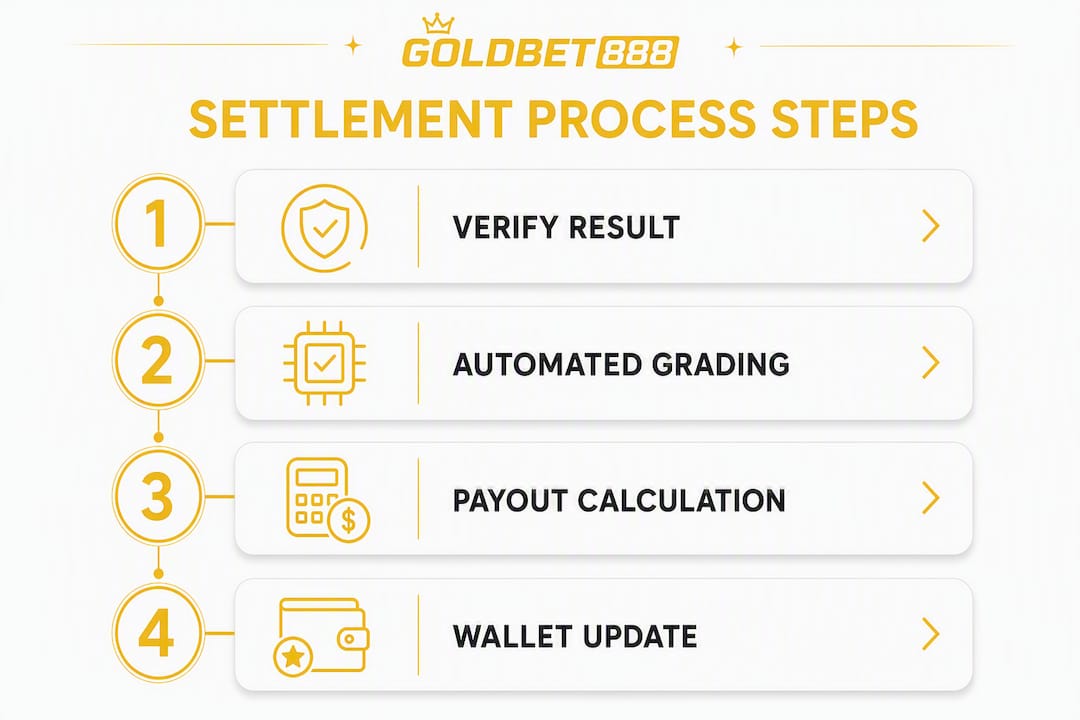
Every settlement system must handle four core elements.
- Verification: Confirming the event outcome from an authoritative data source
- Grading: Applying the bet’s rules to determine win, loss, or void
- Payout calculation: Computing the exact amount owed based on stake and odds
- Wallet update: Crediting or debiting the player’s account instantly
Quick example: you place a next-goal in-play bet during a World Cup match. The goal is scored. Within seconds, the settlement engine verifies the goal via an official feed, grades your bet as a winner, calculates your return, and credits your wallet before the replay finishes on your screen.
Table of Contents
- What does ‘settlement’ actually mean vs. payout and cash-out?
- How does real-time odds settlement work step by step?
- What data sources power live settlement, and how should feeds be structured?
- How fast should settlement be, and what SLAs should you expect?
- What causes settlement errors, and how do you resolve a dispute?
- How should operators build a reliable real-time settlement system?
- What U.S. regulatory requirements affect settlement design?
- What should bettors watch for, and when should you escalate?
- Key Takeaways
- Why settlement speed is the trust metric operators keep underestimating
- Useful sources for further reading
- Goldbet888 brings fast settlement to live football betting
What does ‘settlement’ actually mean vs. payout and cash-out?
These three terms get mixed up constantly, and the confusion costs bettors time when they need to escalate a problem.
Settlement is the grading and ledger update: the system decides whether your bet won, lost, or was voided, and records that outcome in the database. Payout is the monetary transfer that follows a winning settlement, moving funds from the operator’s account to yours. Cash-out is something different entirely: a player-initiated action that closes a bet early at a live price, before the event concludes.
| Dimension | Settlement | Payout | Cash-Out |
|---|---|---|---|
| Trigger | Event outcome confirmed | Winning settlement completed | Player request (live price) |
| Actor | Automated settlement engine | Wallet bridge / payment processor | Player + pricing engine |
| Timing | Seconds to minutes after event | Immediately after settlement | Any time market is open |
| Who initiates | System | System | Bettor |
Settlement applies differently depending on the market type. Pre-match settlement waits for the final whistle and a confirmed result, then grades all bets in a single batch. In-play settlement is more granular: a next-goal market settles the moment a goal is confirmed, a half-time result market settles at the break, and micro-event markets like “next throw-in” settle within a few seconds of the action. Live in-play betting systems introduce void scenarios far more often than pre-match markets do, because events can be overturned by VAR, replays, or referee corrections mid-match.
Understanding this distinction matters when you’re checking your bet history. If your wallet hasn’t updated, the question to ask is whether the bet has been settled yet, not whether the payout is delayed. Those are two separate steps with two separate failure points.
How does real-time odds settlement work step by step?
Automated settlement follows four core steps. Here’s what happens inside the engine from the moment an event occurs to the moment your wallet reflects the result.
Step 1: Result verification
The settlement engine listens to an official results feed, separate from the odds display feed. When a qualifying event fires (a goal, a red card, a match end), the engine receives a signed, sequenced message from the data provider. It cross-checks the event ID, timestamp, and match context before proceeding. No unverified signal triggers a grade.

Step 2: Automated grading
The engine applies the bet’s stored rules to the verified outcome. This is a deterministic function: given the same inputs (bet type, selection, outcome), it always returns the same result. That determinism is what makes replay and auditing possible, since you can re-run the exact same logic against historical data and get identical outputs every time.
Step 3: Payout calculation
Once graded as a winner, the engine multiplies the stake by the accepted odds, applies any applicable bonuses or deductions, and produces a final payout figure. This calculation is logged before the wallet is touched.
Step 4: Wallet update
The wallet bridge receives an instruction with an idempotency key derived from the bet ID and leg ID. That key prevents double-credits if the network times out and the instruction is retried. The wallet updates, the player receives a notification, and the audit log records the completed transaction with a timestamp.

The full flow looks like this: event source → odds engine → suspension layer → settlement engine → wallet bridge → player notification → audit log. The suspension layer is critical: when a significant in-play event occurs, affected markets must be suspended immediately to prevent bettors with faster information from placing bets at stale odds before the settlement engine catches up.
Real-world example: you’ve backed Over 2.5 goals in a live match at 1.85. The third goal goes in. The official feed fires a “goal confirmed” event. The settlement engine verifies it, grades your bet as a winner, calculates your return (stake × 1.85), passes the instruction with an idempotency key to the wallet bridge, and credits your account. If the wallet bridge times out and retries, the idempotency key blocks a second credit. The audit log captures every step with timestamps.
What data sources power live settlement, and how should feeds be structured?
Settlement is only as reliable as the data feeding it. The sources operators typically rely on include:
- Official league and federation APIs (FIFA, UEFA, NBA, NFL) for authoritative event data
- Tier-1 data vendors such as Sportradar and Stats Perform, which aggregate and distribute official feeds with low-latency transport
- Automated scouting feeds that use computer vision or on-site scouts to capture micro-events
- Referee reports and video-assistant-referee (VAR) confirmation signals for overturned decisions
Feed architecture matters as much as the sources themselves. Best practices for operators:
- Separate your settlement feed from your odds display feed. Using the same feed for both creates a single point of failure: if the feed misreports an event, you’ve both displayed wrong odds and settled incorrectly. An independent secondary feed for result confirmation is non-negotiable.
- Require signed, verified messages with sequence numbers so the engine can detect gaps or replays in the data stream.
- Use low-latency transport: WebSocket connections or streaming APIs keep the event-to-settlement pipeline tight. On tier-1 platforms, odds update within roughly 300–500ms of a real-world event, with pipelines targeting sub-400ms end-to-end to close exploitable arbitrage windows.
- Build a fallback path: if the primary feed drops, the system should pause settlement and queue events rather than settle on incomplete data.
Pro Tip: Never settle from the same feed you use to display odds. Beyond the single-point-of-failure risk, it creates a conflict of interest: an odds-display feed is optimized for speed and continuity, while a settlement feed must prioritize accuracy and official confirmation. These are different requirements that demand different sources.
How fast should settlement be, and what SLAs should you expect?
Speed is where settlement quality becomes visible to bettors. Here’s a realistic timeline:
Settlement speeds vary by market type, with micro-event markets settling very quickly on well-architected systems, standard in-play markets settling within a minute after event confirmation, dispute resolution happening rapidly on replayable deterministic engines compared to manual systems which take longer, and pre-match markets and manual workflows potentially taking longer due to official result confirmations or reviews.
Benchmark: Replayable settlement engines resolve disputes in under two minutes. Non-replayable systems can take days for the same resolution.
Fast, precise settlement is a cornerstone of player trust. When settlement lags, bettors don’t sit quietly: they open support tickets, post on forums, and churn to faster platforms. A 5-minute settlement delay on a high-volume in-play market can generate hundreds of support contacts in minutes.
Practical SLA targets operators can publish and defend:
- In-play micro-events: settled within 10 seconds of official confirmation
- Standard in-play markets: settled within 60 seconds
- Pre-match markets: settled within 15 minutes of official result
- Dispute resolution with audit log: under 2 minutes for replayable systems
- Player notification: within 5 seconds of wallet update
Publishing these targets publicly does two things: it sets bettor expectations accurately, and it forces internal engineering teams to build monitoring that catches SLA breaches before customers do.
What causes settlement errors, and how do you resolve a dispute?
Most settlement failures fall into a small set of categories. Knowing them helps both operators diagnose problems faster and bettors frame their support requests more precisely.
Common failure modes:
- Mismatched feeds: the settlement feed and the odds feed report different outcomes for the same event, causing the engine to receive conflicting signals
- Race conditions: two events fire nearly simultaneously (a goal and a red card in the same second), and the engine processes them out of order
- Partial wallet writes: the settlement engine grades the bet correctly but the wallet bridge times out before completing the credit
- Ambiguous event rulings: a VAR overturn arrives after initial settlement has already run, requiring a void-and-regrade cycle
- Void rule gaps: the T&Cs don’t clearly define how a specific scenario (abandoned match, player substitution before kick-off) should be graded, leaving the engine without a rule to apply
When a bettor reports a missing or incorrect payout, operators should follow this workflow:
- Open a ticket and assign it a unique audit event ID that the bettor can reference
- Pull the audit log for the bet ID and replay the settlement logic against the stored event data
- Validate against the secondary feed: confirm the result the settlement engine received matches what the independent results feed recorded
- Identify the failure point: was it a feed mismatch, a partial write, a void rule gap, or a race condition?
- Apply a manual override only if the audit log and secondary feed both confirm an error, and document the override with a supervisor sign-off
- Notify the customer with the audit event ID, a plain-language explanation of what happened, and the corrected payout timeline
Pro Tip: When you close a dispute, send the bettor their audit event ID and a timestamped replay link. Bettors who can see the exact sequence of events rarely reopen the same ticket. Transparency here is the fastest way to rebuild trust after a settlement failure.
How should operators build a reliable real-time settlement system?
The architecture for a production settlement system has eight functional layers. Each one has a specific job, and failures in any layer cascade downstream.
The eight layers:
- Event ingestion: receives signed, sequenced messages from primary and secondary data feeds; validates signatures and sequence numbers before passing events downstream
- Pricing engine: maintains live odds and suspends markets when significant events arrive, closing the acceptance window before settlement begins
- Suspension layer: gates new bet acceptance during the window between event detection and settlement completion, preventing information-asymmetry losses
- Settlement engine (deterministic): applies stored bet rules to verified outcomes; produces an append-only audit log entry for every decision
- Wallet bridge: executes payout instructions using idempotency keys to prevent double-credits on retries
- Audit log: append-only, immutable record of every settlement decision, input, and output
- Replay harness: nightly job that re-runs settlement logic against historical bets to detect rule drift before customers notice
- Notification bus: pushes real-time settlement confirmations to the bettor’s UI and email/SMS
Testing and monitoring checklist for operators:
- Run synthetic bets through the full pipeline daily to verify end-to-end settlement timing
- Set alerting thresholds for settlement lag (e.g., alert if any in-play market takes over 90 seconds)
- Maintain SLA dashboards visible to both engineering and customer support teams
- Run the nightly replay harness and review any bets where the replayed result differs from the original
- Test race-condition scenarios in staging with simultaneous event injection
Pro Tip: The replay harness is your most underused asset. Most operators run it only after a reported incident. Running it nightly means you catch rule drift, feed changes, and edge-case bugs before they affect real bets. The cost is a few hours of compute; the alternative is a settlement incident at peak match volume.
Operators transitioning from manual button-click settlement to automated API-driven workflows should budget for three primary cost drivers: engineering effort to build and maintain the deterministic engine and replay harness, tier-1 data feed fees (which vary by sport, market depth, and latency tier), and wallet throughput infrastructure costs that scale with bet volume. Monitoring and alerting tooling adds a smaller but ongoing operational cost.
What U.S. regulatory requirements affect settlement design?
U.S. sportsbook operators face a patchwork of state-level gaming regulations, and settlement logic sits squarely in the compliance crosshairs. Requirements vary by state, but common expectations across regulated markets include:
- Recordkeeping: most state gaming commissions require operators to retain complete bet and settlement records for a minimum period (commonly 5 years, though the exact requirement varies by state)
- Audit trails: immutable logs of every settlement decision are typically required to support regulator inquiries and player dispute investigations
- Money-handling timing: some states specify maximum timeframes for crediting winning bets to player accounts after an event concludes
- Dispute resolution procedures: operators must publish clear dispute resolution processes in their terms and conditions, and some states require those processes to meet defined response-time standards
- Data source disclosure: regulators increasingly expect operators to document which official data sources they use for settlement and to make that information available on request
Compliance checklist for operators:
- Preserve immutable audit logs with timestamps for every settlement event
- Retain complete settlement history for the period your state license requires
- Publish accurate, plain-language settlement rules in your T&Cs, including void scenarios and dispute timelines
- Maintain a dispute log that records every escalation, its resolution, and the time to close
- Document your authoritative data sources and update that documentation when feeds change
Pro Tip: Publicly document your settlement data sources in your T&Cs or a dedicated help page. When a regulator or bettor asks “how did you settle this bet,” being able to point to a named official source and an audit event ID resolves the inquiry in minutes rather than days. It also signals operational maturity to regulators during license renewals.
For the most current state-specific requirements, check directly with your state gaming commission. This article provides general operational guidance, not legal advice, and rules change as states update their regulations.
What should bettors watch for, and when should you escalate?
Most settlement delays resolve themselves within the operator’s published SLA. Before you contact support, run through this checklist:
- Check the market type: micro-event markets settle in seconds; markets waiting for official confirmation (e.g., final score) may take minutes to hours
- Refresh your wallet and bet history: some UI caches don’t update instantly even after the wallet has been credited
- Look for an audit or event ID in the bet details: this is the reference number you’ll need if you escalate
- Wait the operator’s published SLA before contacting support: for in-play markets, that’s typically under 60 seconds; for pre-match, up to 15 minutes after the official result
- Check the operator’s T&Cs for void rules if your bet shows as voided rather than won or lost
When you do need to contact support, include this information in your message:
Escalation timeline:
- 0–60 seconds after event: wait; automated settlement is running
- 1–15 minutes: check bet history and refresh; contact live chat if still unresolved
- 15 minutes to 2 hours: file a formal support ticket with the information above
- Over 24 hours with no response: escalate to your state gaming commission or relevant regulatory body with your ticket reference number
For guidance on following up on betting tips and settlement status, Goldbet888’s resource library covers practical steps for bettors navigating live markets. Understanding your betting terms and conditions before you place a live bet is the single best way to avoid unnecessary disputes.
Key Takeaways
Real-time odds settlement is a four-step automated process: verify the result, grade the bet, calculate the payout, and update the wallet, with replayable deterministic engines resolving disputes in under two minutes.
| Point | Details |
|---|---|
| Four core settlement steps | Verification, grading, payout calculation, and wallet update run in sequence for every settled bet. |
| Under-2-minute dispute benchmark | Replayable deterministic engines resolve disputes in under two minutes; manual systems can take days. |
| Separate your feeds | Never settle from the same feed used to display odds; an independent results feed prevents single-point-of-failure errors. |
| Bettors: what to include in a dispute | Provide your Bet ID, event name, stake, timestamp, and market type to speed resolution. |
| Goldbet888 for live betting | Goldbet888 offers live football markets with fast settlement and instant PayNow/USDT withdrawals for Singapore bettors. |
Why settlement speed is the trust metric operators keep underestimating
Settlement speed is treated as a back-end engineering concern at most sportsbooks. That framing is wrong, and the support ticket data makes it obvious.
When settlement lags, the first thing bettors do is assume they’ve been cheated. Not that there’s a feed delay. Not that VAR is reviewing the goal. They assume the worst, and they act on it immediately: support tickets, social posts, chargebacks. The surge in support contacts after a settlement delay isn’t a customer service problem. It’s a product failure that shows up in the wrong department’s metrics.
What operators consistently underestimate is how much of that friction is preventable with transparency rather than speed alone. A bettor who receives a notification saying “your bet is under review pending VAR confirmation, expected resolution in 90 seconds” will wait. A bettor who sees nothing for 3 minutes will open a ticket. The audit log and the notification bus aren’t just engineering tools; they’re retention tools.
Fast, precise settlement combined with public SLA commitments and visible audit IDs creates a feedback loop that reduces churn. Bettors who trust the settlement process bet more frequently, bet larger, and refer others. The operators who’ve figured this out treat their settlement engine as a product feature, not infrastructure. They publish their SLAs, they surface audit IDs in the UI, and they run the replay harness nightly. The ones who haven’t are still wondering why their retention numbers look worse than their acquisition numbers.
Useful sources for further reading
The following sources informed this article and are worth bookmarking if you’re building or auditing a settlement system:
- What Are Betting Settlements? (LSports) — LSports’ operator-focused guide connecting settlement speed to player trust and retention metrics.
- How Live Odds Work (WS Gaming) — Covers the 300–500ms odds update target and the sub-400ms pipeline benchmark; useful context for understanding how settlement timing relates to acceptance windows.
- Sports Betting Industry Overview (Statista) — Market-level data on the U.S. sports betting industry for operators benchmarking growth and volume projections.
For integration or commercial inquiries related to live betting infrastructure, Goldbet888’s main platform is at goldbet888.io.
Goldbet888 brings fast settlement to live football betting
If you’ve read this far, you understand what separates a well-built settlement system from one that generates support tickets and churn. The difference shows up in your wallet speed and your confidence placing in-play bets during high-stakes moments.

Goldbet888 is built for exactly this: live football betting with fast settlement, instant PayNow and USDT withdrawals, and a community of 5,000+ Telegram members sharing real-time match insights. During the FIFA World Cup 2026, that combination matters more than ever. Markets move fast, goals change everything, and you need to know your winning bet is credited before the next kick-off, not hours later.
The platform covers Asian Handicap, Over/Under, and live match-winner markets with odds that consistently outperform standard market rates. Withdrawals are processed in minutes, not days. And for bettors who want to understand the markets they’re betting on, the World Cup 2026 betting guide covers odds, tips, and live market strategies in detail.
Place your first live bet at Goldbet888’s sports betting platform and experience settlement that keeps pace with the game.