The most profitable football bettors in 2026 don’t rely on gut feeling. They use advanced football betting research methods built on statistical modeling, value detection, and disciplined bankroll control to find edges the market hasn’t priced correctly. The gap between recreational and professional bettors comes down to process, not luck.
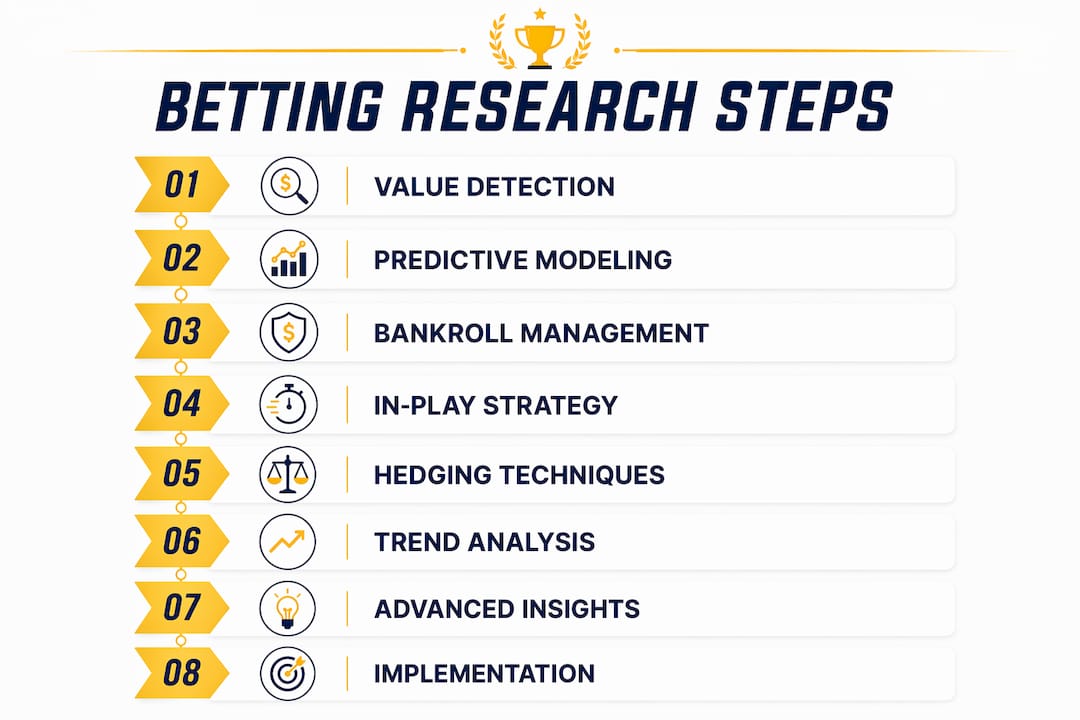
Here are the core methods covered in this article:
- Value betting and expected value (EV) calculation
- Predictive modeling using Poisson regression, Elo, Glicko-2, and ensemble stacking
- Bankroll management with Kelly Criterion and fractional staking
- In-play (live) betting with real-time data adjustments
- Hedging, arbitrage, and diversification for risk control
- Trend, situational, and league specialization analysis
- Ensemble models and prediction market tracking for expert-level edges
- Psychological and physical factor analysis for team and player assessment
1. How value betting helps you find discrepancies in bookmaker odds
Value betting is the foundation of every serious football betting strategy. A bet has positive expected value when your estimated probability for an outcome exceeds the implied probability in the bookmaker’s odds. If you calculate a team’s win probability at 55% but the odds imply only 45%, that’s a value betting opportunity worth taking.
Calculating EV is straightforward: multiply your estimated probability by the decimal odds, then subtract 1. A positive result means the bet is worth placing. The challenge is building accurate probability estimates, which requires historical data, form analysis, and model calibration rather than opinion.
Market inefficiencies appear most often in:
- Less-covered leagues where bookmakers rely on limited data
- Early-week lines before sharp money moves the odds
- Niche markets like Asian Handicap and exact score, where pricing errors are more common
- Public sentiment distortions around popular clubs that inflate favorite odds
Closing line value (CLV) is the sharpest measure of long-term edge. If your bets consistently beat the closing odds, your probability estimates are outperforming the market’s final consensus. Track CLV for every bet, not just outcomes.
Pro Tip: Track your average CLV over many bets. Consistent positive CLV is a stronger signal of real edge than win rate alone, since outcomes carry short-term variance that CLV filters out.
2. Data-driven and predictive modeling techniques that actually work
The best football prediction models don’t pick winners. They assign calibrated probabilities to all three outcomes and identify when sportsbook lines misprice those probabilities. Poisson regression remains the standard starting point, modeling each team’s goal-scoring rate as an independent process based on attack and defense strength parameters.
The Dixon-Coles adjustment improves on standard Poisson by correcting for the higher-than-expected frequency of low-scoring draws. Using a rho parameter around -0.15, it adjusts the probabilities of 0-0 and 1-1 results, which Poisson consistently underestimates. This calibration improvement matters most in tight, defensive matches.

Elo and Glicko-2 ratings add a team strength layer that Poisson alone misses. Glicko-2 is particularly useful because it tracks rating uncertainty, which is high for promoted teams and low for clubs with long, consistent records. Ensemble models that stack Poisson, Elo, and Glicko-2 outputs with a meta-learner outperform market odds in three-way match prediction accuracy.
Key features to engineer for your models:
- Expected goals (xG) for attack and defense, weighted by recency
- Fatigue indicators from fixture congestion and travel distance
- Injury and suspension data for key positional roles
- Referee tendencies for cards, penalties, and home-team favoritism
- Head-to-head historical patterns adjusted for current squad strength
Walk-forward backtesting is the correct validation method for football models. Unlike K-Fold cross-validation, walk-forward only trains on data that existed before the prediction date, preventing look-ahead bias from contaminating your accuracy estimates.
3. Bankroll management and staking strategies that protect your capital
Poor staking destroys profitable models. The Kelly Criterion mathematically optimizes bet size for long-term bankroll growth by scaling stakes to your edge and current bankroll. The formula: stake = (edge / odds-1) × bankroll. Overbetting Kelly stakes risks bankroll exhaustion even when your model has genuine positive expectation.

Fractional Kelly, typically at a fraction of the full Kelly stake, is the practical choice for most bettors. It sacrifices some theoretical growth rate in exchange for dramatically lower variance and drawdown risk. Most professional bettors run fractional Kelly rather than full Kelly for exactly this reason.
Best practices for bankroll discipline:
- Set a stop-loss limit at 20%–30% of your starting bankroll before each session
- Record every bet with stake, odds, market, and your pre-bet probability estimate
- Never chase losses by increasing stakes after a losing run
- Separate your betting bankroll from personal finances entirely
- Review monthly rather than daily to avoid noise-driven decisions
The 1-3-2-6 system is a positive progression staking plan that increases stakes after wins in a fixed sequence. It carries no predictive advantage and creates real risk of bankroll depletion during losing streaks. Use it only if you understand it provides zero edge over flat staking.
Pro Tip: Log your bets in a spreadsheet with columns for EV, CLV, and outcome. After 500 bets, your EV column will tell you whether your model is generating real edge or just variance.
4. In-play (live) betting strategies and tactical adjustments
Live betting rewards preparation, not improvisation. The bettors who profit from in-play markets have already modeled the match before kickoff and know exactly which odds movements signal genuine value versus market overreaction. Real-time data feeds showing possession, shots on target, and pressing intensity let you update your probability estimates as the match evolves.
Momentum swings are the most exploitable in-play signal. A team that concedes early but dominates possession and xG in the first 20 minutes is often available at inflated odds because the scoreline hasn’t caught up to the underlying performance. Fatigue signs in the 70th minute, tactical substitutions, and red cards all create pricing dislocations that prepared bettors can act on quickly.
Practical in-play betting insights:
- Pre-match model your expected in-play scenarios so you have reference odds ready
- Watch the match live rather than relying solely on data feeds for substitution and tactical reads
- Hedge pre-match positions when in-play odds move in your favor before the outcome is settled
- Avoid emotional bets triggered by a single dramatic moment without data support
- Size in-play stakes conservatively, since odds move fast and execution risk is higher
Check out Goldbet888’s live betting feature guide for a breakdown of how live markets are structured and how to navigate them efficiently.
5. Hedging, arbitrage, and diversification techniques
Hedging locks in profit or limits loss by placing a bet on the opposite outcome after your original position has moved in your favor. If you backed a team to win a tournament at long odds and they reach the final, betting against them in the final secures a guaranteed return regardless of the result. The math is simple: calculate the stake on the hedge so that both outcomes return the same net profit.
Arbitrage betting exploits pricing differences between sportsbooks on the same event. When the combined implied probabilities across all outcomes fall below 100%, a risk-free profit exists in theory. In practice, arbitrage requires fast execution, multiple funded accounts, and tolerance for account restrictions from sportsbooks that identify arb activity.
Diversification across leagues and markets reduces variance without requiring any single bet to be a winner. Spreading action across the Premier League, Bundesliga, and MLS means a bad run in one competition doesn’t wipe out a month of work. Key diversification principles:
- Spread bets across at least three leagues to reduce single-market correlation
- Mix market types (match result, over/under, Asian Handicap) to avoid correlated losses
- Limit exposure to any single match to a fixed percentage of bankroll
- Track league-level ROI separately to identify where your models perform best
Sportsbooks actively monitor for arbitrage patterns and may limit or close accounts showing consistent arb behavior. Disguise bet sizing and timing to extend account longevity.
6. Trend, situational, and league specialization analysis
Specializing in one or two leagues gives you a genuine information advantage over bookmakers who price hundreds of competitions simultaneously. A bettor who tracks every La Liga match, knows each manager’s tactical tendencies, and monitors squad depth has better data than a pricing algorithm built on aggregated statistics. The 80/20 principle applied to betting suggests that focusing on a narrow set of high-value opportunities outperforms broad market coverage over time.
Situational factors that bookmakers systematically underweight include:
- Home advantage variation by stadium, crowd intensity, and travel distance for the away team
- Weather conditions affecting high-scoring teams that rely on technical passing
- Referee assignment and their historical card rates, penalty decisions, and home-team bias
- Player morale and squad harmony following public disputes or managerial changes
- Fixture congestion for teams competing in multiple competitions simultaneously
Streaks and form trends carry predictive weight when contextualized correctly. A team on a five-match winning streak against weak opposition is not the same as one on a five-match winning streak against top-half clubs. Always filter trends through opponent quality and match context before drawing conclusions.
7. Advanced research insights: how ensemble models and prediction markets give you an edge
The most sophisticated football betting systems in 2026 combine multiple model architectures into a single ensemble output. A well-built ensemble stacks Dixon-Coles Poisson, Elo, Glicko-2, and gradient-boosted machine learning models, then uses a meta-learner to weight each base model’s contribution based on historical calibration performance. Walk-forward backtesting validates the ensemble honestly by simulating real deployment conditions.
Bayesian priors solve a specific problem that breaks simpler models: the “Promoted Team Problem.” When a newly promoted club enters a top division, maximum likelihood estimation produces unstable parameter estimates because the team has no top-flight history. Bayesian priors shrink those estimates toward historical baseline tiers for promoted teams, reducing mispricing in the first weeks of the season when bookmakers are also uncertain.
Prediction market contracts on CFTC-regulated platforms offer a data source that most bettors ignore entirely. When high-confidence contract probabilities on these markets diverge from sportsbook lines, the divergence often signals that informed money has moved the prediction market before the sportsbook has adjusted. Monitoring these divergences is a genuine information edge.
| Model / Approach | Strength | Key Limitation |
|---|---|---|
| Standard Poisson | Simple, interpretable | Underestimates low-score draws |
| Dixon-Coles Poisson | Corrects low-score draw bias | Requires rho calibration |
| Elo / Glicko-2 ratings | Tracks team strength over time | Ignores match-level context |
| Gradient-boosted ML | Captures non-linear feature interactions | Needs large training datasets |
| Ensemble (stacked) | Combines strengths of all base models | Complex to build and maintain |
| Prediction market tracking | Reflects informed money movements | Requires CFTC-regulated platform access |
AI language models can assist in analyzing historical betting data and surfacing patterns across large datasets, but LLMs don’t predict match outcomes on their own. They work best as a preprocessing and pattern-recognition layer feeding into a calibrated statistical model, not as a standalone prediction engine.
Pro Tip: Build an AI-assisted feedback loop: after each match week, feed actual results back into your model and let a gradient-boosted layer re-weight features automatically. Over a full season, this continuous recalibration compounds into measurably better probability estimates.
8. How to implement and review your advanced betting research strategy
A consistent workflow separates bettors who profit long-term from those who apply methods inconsistently. Start with data collection: pull match statistics, xG data, injury reports, and odds history from reliable sources before each match week. Tools like Python with pandas and scikit-learn handle model training and prediction generation efficiently for bettors comfortable with code. For those who prefer no-code options, platforms built around statistical match analysis provide structured data inputs without requiring programming skills.
Periodic review is where most bettors fall short. Run a monthly audit of your bet log covering:
- Model accuracy vs. market baseline for each league you cover
- CLV distribution to confirm your bets are consistently beating closing lines
- Stake sizing adherence to your Kelly or fractional Kelly rules
- Emotional bet identification, flagging any bets placed without model support
- League-level ROI to reallocate focus toward your strongest markets
Psychological discipline is not a soft skill in this context. It’s a measurable variable. Bettors who deviate from their model’s recommendations during losing streaks consistently underperform their model’s theoretical edge. Commit to the process, review the data, and adjust the model rather than the stakes.
9. Analyzing player and team psychological and physical factors
Physical and psychological factors create some of the most consistent pricing errors in football betting markets. Bookmakers price these variables imprecisely because they’re harder to quantify than goals scored or possession percentage. That imprecision is your opportunity.
Physical load data tells a concrete story. Teams playing their third match in seven days show measurable drops in sprint distance, pressing intensity, and defensive organization. Tracking squad rotation patterns and minutes played by key players across a full season reveals which clubs manage fatigue well and which don’t. This data is publicly available through league statistics portals and sports science publications.
Psychological factors require more qualitative judgment but follow identifiable patterns:
- Post-European match fatigue affects domestic performance, particularly for clubs with smaller squads
- Managerial pressure following a board vote of confidence often produces a short-term performance spike
- Derby match psychology inflates motivation for the underdog and can neutralize form-based advantages
- Relegation battle mentality produces unpredictable results as teams prioritize survival over style
- Title-race pressure affects both leaders and chasers differently depending on squad experience
Player-level psychological data, including public disputes, contract negotiations, and international call-up fatigue, feeds directly into team cohesion and on-pitch performance. A star striker publicly pushing for a transfer in january affects team dynamics in ways that don’t show up in xG models. Tracking these signals through reputable football journalism and club communications gives you a layer of context that pure statistical models miss entirely.
Ready to apply these methods with better odds?

Goldbet888 gives you access to live football odds, Asian Handicap markets, and Over/Under lines built for bettors who do their research. With live football odds updated in real time and a community of 5,000+ Telegram members sharing match previews and analysis, you get both the data environment and the community context that advanced research methods demand.
Apply your models where the odds are sharp. Explore the full 2026 football betting guide on Goldbet888 and put your research to work.
Gambling involves risk. Play responsibly and within your means. For support, visit ncpgambling.org or begambleaware.org.
Key Takeaways
Advanced football betting research methods generate long-term profit only when value detection, calibrated modeling, and disciplined bankroll management work together as a unified system.
| Point | Details |
|---|---|
| Value betting drives edge | Calculate EV using your own probability estimates and track closing line value to confirm real edge. |
| Ensemble models outperform single models | Stacking Dixon-Coles, Elo, Glicko-2, and ML models with walk-forward backtesting improves prediction accuracy over market baselines. |
| Fractional Kelly protects capital | Full Kelly stakes risk bankroll exhaustion; fractional Kelly at reduced fractions of full Kelly reduces drawdown while preserving growth. |
| Specialization beats breadth | Focusing on two or three leagues gives you a deeper information advantage than spreading bets across many competitions. |
| Physical and psychological factors create pricing errors | Fatigue, managerial pressure, and player morale are consistently underpriced by bookmakers and exploitable with qualitative research. |