If your ticket is worth a meaningful portion of your bankroll and the opposing side is available at a price that guarantees locked profit, hedge now. The lock-profit hedge stake formula is simple: Hedge Stake = Potential Payout ÷ Decimal Odds of the Opposing Outcome. That single calculation tells you exactly how much to place on the other side to guarantee equal profit regardless of result.
Three qualifiers determine whether you actually pull the trigger:
- Bankroll threshold: Only hedge when the open ticket represents a meaningful share of your roll, where variance genuinely threatens your ability to keep playing.
- EV check: Compare your model’s estimated win probability against the implied probability in the live hedge price. If the hedge price is worse than your model, you are paying a steep insurance premium.
- Market liquidity: Confirm the hedge market can absorb your stake without significant line movement before you commit.
Your three outcomes at decision time:
- Full hedge: Lock equal profit on both sides when the guaranteed floor meets your pre-committed profit target.
- Partial hedge: Lock a floor while preserving upside when the guaranteed amount exceeds your target but full hedging costs too much EV.
- No hedge: Let it ride when the original position still carries positive expected value and the bankroll impact is manageable.
Pro Tip: Set your hedge trigger thresholds before the event starts. Deciding in the moment, with money on the line and a score on the board, is exactly how emotional hedging happens.
Table of Contents
- What is hedging in football betting, and what it is not
- When should you hedge a high-stakes football bet?
- How to calculate your hedge stake: formulas and worked examples
- Football-specific hedging scenarios you will actually face
- Advanced hedging strategies for high-stakes bettors
- Step-by-step execution checklist for placing a hedge
- Bankroll rules, taxes, and platform notes for U.S. bettors
- Common mistakes and emotional traps to avoid
- Hedge calculator worksheet and decision templates
- Key Takeaways
- Useful sources and tools for executing hedges
- Goldbet888 gives high-stakes bettors a faster path to live markets
What is hedging in football betting, and what it is not
Hedging is the practice of placing one or more opposing bets to guarantee a profit or limit loss on an existing wager. You already hold a ticket. You place a second bet on the opposite outcome. The result is a reduced variance position: you give up some or all of the upside in exchange for a guaranteed floor.
That definition rules out several things bettors often confuse with hedging:
- Arbitrage: Arbing exploits price discrepancies across books to guarantee profit from the opening bet, not from a position that has already moved in your favor. Hedging starts after your original bet has gained value.
- Progressive staking systems (e.g., 1-3-2-6): These are stake-sizing sequences applied to a series of independent bets. They do not involve opposing wagers and carry no guaranteed floor.
- Cash-out: A cash-out is a sportsbook-offered settlement at a price the book sets. Hedging on a separate market gives you more control over the price and the guaranteed amount, though it requires placing an additional bet.
The cost of hedging is real. Because sportsbooks embed a margin on both sides of every market, placing a hedge bet means you pay vig twice: once on the original ticket and once on the hedge. Repeated hedging compounds that drag on long-term returns. Hedging is a variance-reduction tool, not a profit-generation strategy.
A quick concrete example: you bet $500 on the Eagles to win the Super Bowl at +600 (decimal 7.0), giving you a potential payout of several times your stake. The Eagles reach the final, and their odds compress significantly. You can hedge an appropriate amount on the other finalist to lock in a guaranteed profit regardless of the outcome. Both outcomes pay roughly the same guaranteed amount. That is hedging in its simplest form.
When should you hedge a high-stakes football bet?
The decision to hedge is not made at halftime. It is made before the event, in writing, with specific numbers attached. Pro practitioners build payoff tables accounting for commission, voids, and partial matches and decide hedge sizes before checking live odds to avoid outcome bias.
Pre-commitment triggers to define in advance:
- A fixed profit target in dollars (e.g., “I will hedge when I can lock $2,000 guaranteed”).
- A bankroll percentage threshold (e.g., “I will hedge any open ticket worth more than 8% of my roll”).
- A life-changing payout rule: if the potential payout would materially change your financial situation, a partial hedge is automatic.
EV check before executing:
Pull your model’s estimated win probability for the original outcome. Convert the hedge price to implied probability. If the hedge’s implied probability is significantly higher than your model’s estimate, the hedge is expensive. That does not mean you skip it, but it means you are paying a real premium for the certainty. Use the expected value framework to quantify that cost before deciding.

Market liquidity check:
Confirm the opposing market can absorb your full hedge stake. For high-stakes bettors, a $5,000 hedge on a low-liquidity prop market may move the line against you mid-execution. Check book limits and exchange depth first.
Decision flow:
- Is your pre-commitment trigger met? If no, stop. Let it ride.
- Does your model show the original position still has positive EV? If yes, consider a partial hedge rather than a full one.
- Is the hedge market liquid enough to absorb your stake at the quoted price? If no, wait or reduce size.
- Choose: full hedge (lock equal profit), partial hedge (lock floor, keep upside), or no hedge.
Pro Tip: Write your hedge rules on a notepad before the game kicks off. When the score hits and your pulse spikes, you execute the plan, not your feelings.
How to calculate your hedge stake: formulas and worked examples
Core formulas
Converting American odds to decimal:
- Positive moneyline (e.g., +150): Decimal = (Moneyline ÷ 100) + 1 → 2.50
- Negative moneyline (e.g., -120): Decimal = (100 ÷ |Moneyline|) + 1 → 1.833
Lock-profit (equal-profit) hedge stake:
Hedge Stake = Potential Payout ÷ Decimal Odds of Hedge Outcome
This formula equalizes your net return on both sides. Your guaranteed profit equals the potential payout minus the hedge stake.
Partial hedge (target guaranteed amount):
Hedge Stake = (Desired Guaranteed Amount) ÷ (Decimal Odds of Hedge Outcome − 1)
Minimize-loss hedge (break-even sizing):
Hedge Stake = Original Stake ÷ (Decimal Odds of Hedge Outcome − 1)
This sizes the hedge so that if the hedge wins, you recover your original stake exactly.
Worked example 1: single-game in-play hedge
You bet a stake on the Chiefs to win at certain odds offering a potential payout. At halftime, the Chiefs lead and their opponent’s odds have lengthened. By calculating the lock-profit hedge stake using the formula (Potential Payout ÷ Decimal Odds), you can place a hedge bet that locks in approximately equal profits regardless of the outcome.

Worked example 2: parlay final-leg partial hedge
You have a multi-leg NFL parlay with several legs won and one remaining. The parlay offers a large payout relative to your stake. Partial hedging the final leg using the formula (Desired Guaranteed Amount ÷ (Decimal Odds − 1)) lets you lock a minimum profit while preserving upside if your original bet wins.
Worked example 3: futures championship hedge
You placed a futures bet on the Eagles to win the Super Bowl at long odds, giving you a substantial potential payout. At the championship, the opponent’s odds shorten significantly. Using the lock-profit hedge stake formula, you can place a hedge bet that guarantees an equal profit regardless of the winner.
A hedge calculator handles non-round odds and commission adjustments quickly. Keep one open during execution.
Spreadsheet input table
| Input Cell | Value | Formula / Notes |
|---|---|---|
| Original Stake | — | Manual entry |
| Original Odds (decimal) | — | Manual entry |
| Potential Payout | — | = Original Stake × Original Odds |
| Hedge Odds (decimal) | 2.30 | Manual entry |
| Desired Guaranteed Amount | — | = Potential Payout ÷ Hedge Odds |
| Lock-Profit Hedge Stake | — | = Potential Payout ÷ Hedge Odds |
| Partial Hedge Stake | Variable | = Desired Floor ÷ (Hedge Odds − 1) |
| Net Profit (either side) | — | = Potential Payout − Hedge Stake |
Football-specific hedging scenarios you will actually face
Parlay final-leg execution
Size your partial hedge using the formula above. The key decision is your floor target. If the parlay payout is life-changing relative to your bankroll, a higher floor percentage makes sense. If it is a routine ticket, preserving upside by hedging only 30–40% of the exposure is often the sharper play.
Futures hedging near the Super Bowl or World Cup final
Waiting until the final one or two events concentrates risk but produces more efficient hedge pricing. Hedging a futures ticket in the quarterfinals means paying for three remaining rounds of uncertainty. At the final, you pay for one. For World Cup 2026 futures tickets, the championship markets typically offer the tightest spreads and deepest liquidity at the final stage.
Props and player markets
Player prop markets carry lower limits and thinner liquidity than game lines. A $2,000 hedge on a player rushing yards prop may not be executable at the quoted price. Check the market depth before committing to a prop-based hedge strategy. For over/under prop hedges, the in-play market often offers better pricing than pre-game alternatives.
In-play hedges: timing and latency
Live hedging requires speed. Odds move within seconds of significant game events. Decide your hedge size before the event, then execute the moment the trigger price appears. Latency between your decision and execution can cost you the price you planned for.
Warnings for live hedging:
- In-play hedges placed without value — solely to oppose a winning halftime position — are often just additional vig, not true hedges, unless the live price shows positive expected value.
- Bet cancellations and void scenarios: if your original bet is voided (injury, weather, postponement), your hedge bet may still stand as an independent losing wager. Confirm void rules before hedging.
- Book limits: some sportsbooks cap in-play stakes significantly lower than pre-game limits. Know your book’s live-bet ceiling before sizing your hedge.
Advanced hedging strategies for high-stakes bettors
Partial hedging frameworks
Partial hedges let you lock a floor while keeping upside. Two common frameworks:
- Percent-of-upside: Hedge a fixed percentage of your maximum profit exposure. A 50% partial hedge on a $4,000 parlay payout means you guarantee $2,000 and keep the chance to win more.
- Fixed guaranteed amount: Set a dollar floor (your pre-committed target) and back-calculate the hedge stake using the partial hedge formula. This is the more disciplined approach for high-stakes bettors.
Using exchange markets to reduce double-vig
High-stakes bettors commonly use exchange markets to access mid-market pricing and avoid paying the sportsbook margin twice. On a betting exchange, you lay the outcome directly against other bettors at a commission rate (typically 2–5%) rather than against a book’s built-in margin of 5–10% per side. Over a season of hedges, that difference compounds significantly.
Portfolio-level hedging
Treat all open tickets as a single risk surface. If you hold three futures tickets on different teams and two of them are in the same conference championship, your exposure is concentrated. A single hedge on the conference winner covers multiple tickets simultaneously. This is the approach sharp bettors use to diversify across markets rather than hedging each ticket in isolation.
Tactical techniques
- Laddered hedges: Hedge a portion at each stage of a tournament as your ticket gains value, rather than one large hedge at the end. This spreads the EV cost over time but keeps variance declining.
- Staggered hedges: Split a large hedge stake across two or three books to avoid moving the line against yourself.
- Limit orders on exchanges: Set a target hedge price in advance. If the market reaches that price during the game, the bet executes automatically without requiring you to watch every minute.
Trade-offs at a glance
| Dimension | Full Hedge | Partial Hedge | No Hedge |
|---|---|---|---|
| Certainty | Maximum | Moderate | None |
| EV sacrifice | Highest | Moderate | Zero |
| Upside preserved | None | Yes | Full |
| Complexity | Low | Medium | None |
| Best for | Life-changing payouts | Standard high-stakes tickets | Positive-EV positions |
Pro Tip: When exchange markets are available, always price the hedge there first. The mid-market price on an exchange is almost always better than the sportsbook’s opposing line, and the commission is predictable.
Step-by-step execution checklist for placing a hedge
Pre-execution checks
- Confirm your pre-commitment rule is triggered (profit target met, bankroll threshold crossed, or life-changing payout rule applies).
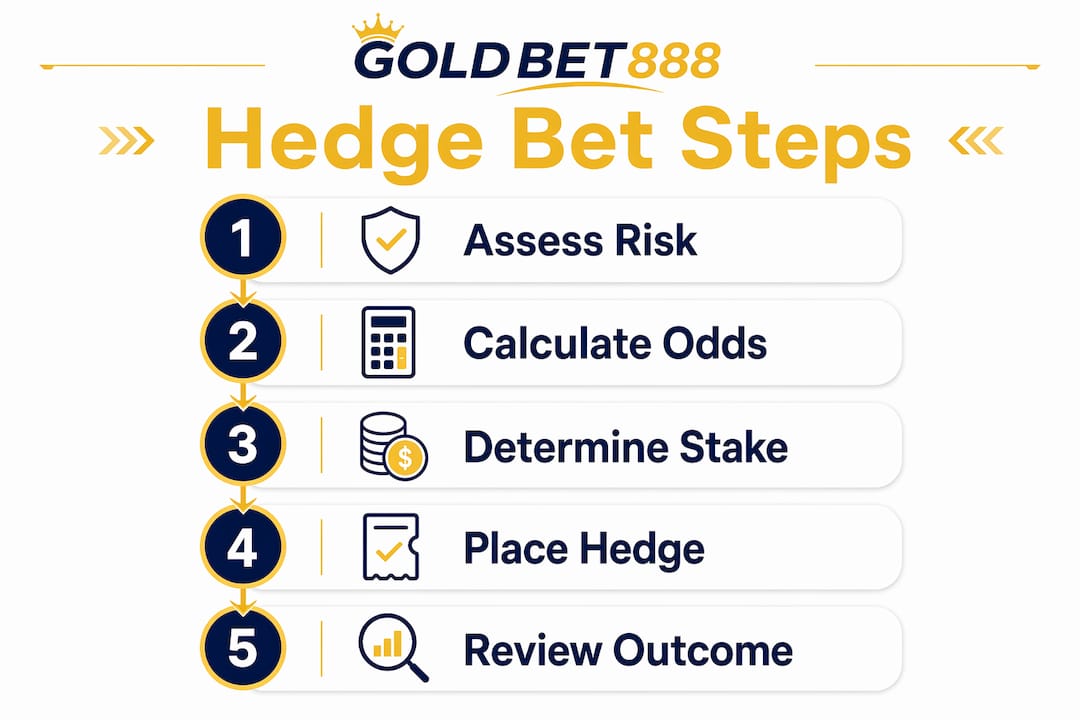
- Calculate your hedge stake using the appropriate formula before opening any live odds screen.
- Line-shop across books to find the best available hedge price. Even a 0.05 decimal difference on a $1,000 hedge stake changes your guaranteed floor by $50.
- Check the market’s maximum stake limit. If your hedge stake exceeds the book’s limit, split across multiple accounts.
- Confirm void and cancellation rules for both the original and hedge markets.
Execution steps
- Open the hedge market on your chosen book or exchange.
- Enter the pre-calculated stake. Do not adjust it based on how the game looks right now.
- For exchange hedges, set a limit order at your target price if the current price is slightly off.
- Confirm the bet slip shows the correct stake, odds, and potential return before submitting.
- Record the trade immediately (see template below).
Hedge record template
Keep this log in a spreadsheet. Every hedge, every outcome. You will need it for tax records and for reviewing whether your hedging decisions are improving or eroding your long-term results.
Numbered fail-safe sequence for live hedges:
- Pre-calculate stake offline.
- Verify market liquidity.
- Check book limit.
- Execute at pre-calculated size only.
- Record immediately.
- Do not place a second hedge on the same position.
Bankroll rules, taxes, and platform notes for U.S. bettors
Bankroll sizing for hedges
A practical rule: never fund a hedge with more than 15% of your total bankroll in a single transaction. If the hedge stake required to lock your floor exceeds that threshold, consider a smaller partial hedge or accept the variance. Keeping hedge funding within a defined bankroll band prevents a single large hedge from distorting your overall risk profile.
For high-stakes bettors running multiple open tickets, maintain a separate “hedge reserve” within your bankroll. Knowing exactly how much capital is available for hedging prevents the scenario where you need to hedge but lack the funds to execute at the right size.
Record-keeping for tax and audit purposes
Log every bet, original and hedge, with date, stake, odds, outcome, and net result. The IRS treats gambling winnings as taxable income, and your hedge bets and original bets are separate transactions. A losing hedge on a winning original ticket does not automatically net to zero for tax purposes without proper documentation.
Keep records that show:
- Gross winnings from each winning ticket.
- Gross losses from each losing hedge.
- Net position per event.
- Running annual totals.
This article is general information, not tax or legal advice. Consult a qualified tax professional for your specific situation, and verify current IRS rules on gambling income reporting.
Platform and regulatory constraints
U.S. sportsbooks vary significantly in their live-bet limits, and some jurisdictions restrict certain bet types. Key operational notes:
- Some books flag accounts that hedge frequently and reduce maximum stake limits.
- In-play markets in certain states close faster than others due to regulatory latency requirements.
- Exchanges with lay-betting functionality are not available in all U.S. states. Check your state’s licensed operators before building an exchange-based hedging strategy.
Quick operational mitigations:
- Maintain accounts at three or more licensed sportsbooks to split large hedge stakes.
- Scout liquidity on the hedge market at least 30 minutes before you expect to need it.
- Keep a cash buffer in each account so you are never waiting on a deposit when a hedge window opens.
Common mistakes and emotional traps to avoid
The single most destructive hedging behavior is emotional hedging: placing a hedge to relieve anxiety rather than because a pre-set rule was triggered. It feels like discipline. It is not. You are paying the book’s margin to buy comfort, and over hundreds of bets, that cost is substantial.
Common execution mistakes:
- Hedging a positive-EV position: If your model still shows the original bet has edge, hedging surrenders that edge for certainty. That is a choice, not a mistake, but only if you made it deliberately before the game started.
- Over-hedging: Placing a hedge larger than the lock-profit formula requires means you are now net short the original outcome. You have flipped your position, not hedged it.
- Hedging without a liquidity check: Executing a large hedge in a thin market moves the line against you mid-fill. Your actual hedge price is worse than the quoted price.
- Hedging too early on futures: Paying for uncertainty across multiple remaining rounds is expensive. The EV cost of an early futures hedge is almost always higher than waiting.
Counter-measures:
- Write your hedge rules on paper before every major event you have a ticket on.
- Apply a 10-minute cooling-off rule for any in-play hedge impulse. If the rule is still triggered after 10 minutes, execute. If it was emotion, the urge usually passes.
- Review your hedge log monthly. If you are hedging more than 30% of your tickets, examine whether those hedges were rule-triggered or emotion-triggered.
Pro Tip: Think of every hedge as an insurance premium with a real dollar cost. You would not buy car insurance mid-trip because you felt nervous. Decide the coverage level before you start driving.
Hedge calculator worksheet and decision templates
Spreadsheet template: three bet types
Single-game hedge
| Input | Value |
|---|---|
| Original Stake | Enter $ |
| Original Odds (decimal) | Enter |
| Potential Payout | = Stake × Odds |
| Hedge Odds (decimal) | Enter |
| Lock-Profit Hedge Stake | = Payout ÷ Hedge Odds |
| Guaranteed Floor | = Payout − Hedge Stake |
Parlay final-leg partial hedge
| Input | Value |
|---|---|
| Parlay Payout | Enter $ |
| Final Leg Odds (decimal) | Enter |
| Desired Floor | Enter $ |
| Partial Hedge Stake | = Floor ÷ (Odds − 1) |
| Upside if Parlay Hits | = Payout − Partial Hedge Stake |
Futures lock-profit hedge
| Input | Value |
|---|---|
| Futures Payout | Enter $ |
| Hedge Odds (decimal) | Enter |
| Exchange Commission (%) | Enter |
| Adjusted Hedge Odds | = Hedge Odds × (1 − Commission) |
| Lock-Profit Hedge Stake | = Payout ÷ Adjusted Hedge Odds |
| Guaranteed Floor | = Payout − Hedge Stake |
Three-check decision template
Before placing any hedge, complete this in writing:
- Pre-commit check: Is my pre-set trigger met? (Profit target, bankroll %, or life-changing payout rule.) Yes / No.
- EV check: Does my model show the original position still has positive expected value? If yes, partial hedge only. Yes / No.
- Liquidity check: Can the hedge market absorb my full stake at the quoted price? Yes / No.
Only proceed if check 1 is Yes. Checks 2 and 3 determine whether you hedge fully, partially, or wait.
Adapting for fractional odds: Convert fractional to decimal by dividing numerator by denominator and adding 1. (5/2 = 2.5 + 1 = 3.5 decimal.) Use decimal in all formulas.
Adapting for exchange commission: Multiply the exchange decimal odds by (1 − commission rate) before using in the hedge stake formula. A 2.30 lay price with 3% commission becomes 2.30 × 0.97 = 2.231 effective decimal.
Key Takeaways
Hedging high-stakes football bets protects bankroll and locks profit, but only when executed against pre-committed rules, with an EV check, and in liquid markets.
| Point | Details |
|---|---|
| Pre-commit your triggers | Set profit targets and bankroll thresholds before the event, not during it. |
| Use the lock-profit formula | Hedge Stake = Potential Payout ÷ Decimal Odds of Hedge Outcome for equal profit on both sides. |
| Partial hedges preserve upside | Use Desired Floor ÷ (Hedge Odds − 1) to lock a floor while keeping upside on the original ticket. |
| Liquidity and limits matter | Check market depth and book limits before sizing any hedge, especially for in-play and prop markets. |
| Goldbet888 for live football markets | Goldbet888 offers live football odds and World Cup 2026 markets suited to executing futures and in-play hedges. |
The mindset that separates disciplined hedgers from the rest
Most guides on hedging football bets treat it as a mechanical calculation problem. It is not. The math is the easy part. The hard part is the moment a score changes and your stomach tells you to act before your rules say to. That gap between the emotional impulse and the pre-committed rule is where long-term profitability is won or lost.
The sharpest bettors treat their open tickets as a portfolio, not a collection of individual bets. They maintain a payoff table that accounts for every open position, every potential hedge cost, and every void scenario. They know their guaranteed floor before they ever check a live price. When the market moves in their favor, they are executing a plan, not making a decision.
One practical edge: when exchange markets are available in your state, use them for hedges. The mid-market price on an exchange is almost always better than the opposing line at a sportsbook, and the commission is transparent. Over a full season of hedging, that pricing difference adds up to real money.
Goldbet888’s community of 5,000+ Telegram members shares live match insights and odds movement alerts, which is genuinely useful when you are tracking a futures ticket and need to know the moment a hedge price becomes attractive.
Useful sources and tools for executing hedges
Building a disciplined hedging practice means having the right resources at hand before you need them.
- Action Network hedge calculator: The fastest way to verify lock-profit and partial hedge stakes across different odds formats. Keep it open during live events.
- National Council on Problem Gambling (ncpgambling.org): The primary U.S. resource for responsible gambling support. High-stakes betting carries real financial risk; know the warning signs.
- Goldbet888 EV guide: Use this to run the EV check step in your hedge decision flow before committing to a full hedge.
- Goldbet888 odds value checklist: A practical reference for identifying whether the hedge price represents fair value or an expensive insurance premium.
- Goldbet888 live sports odds: Monitor live football markets and World Cup 2026 lines in real time to catch your hedge trigger price the moment it appears.
Keep the hedge calculator spreadsheet and the three-check decision template open in a second browser tab whenever you have a high-stakes ticket running. Execution speed matters in live markets, and having your pre-calculated stake ready removes one more decision from the moment.
Goldbet888 gives high-stakes bettors a faster path to live markets
High-stakes bettors who hedge football positions need one thing above everything else: fast access to live odds at competitive prices. Goldbet888 delivers that with reported withdrawal processing in three minutes and consistently sharp lines across NFL, soccer, and World Cup 2026 markets.

If you are running a futures ticket into the Super Bowl or a World Cup final and need to execute a hedge the moment your trigger price appears, Goldbet888’s live football betting markets give you the speed and depth to act without slippage. The platform’s 5,000+ Telegram community also flags real-time odds movement, which is a practical edge when you are watching for a specific hedge price. For bettors building a full hedging strategy around the 2026 World Cup, the World Cup 2026 betting hub covers futures, Asian Handicap, and over/under markets in one place. Check current odds and set up your account at Goldbet888 before your next high-stakes ticket goes live.