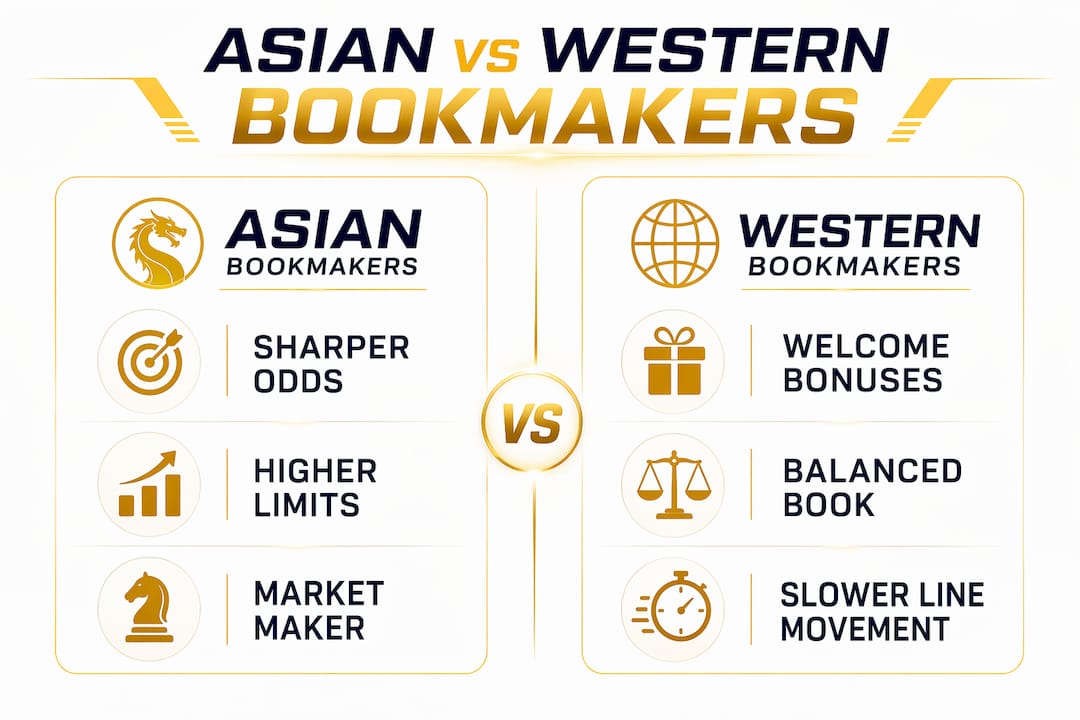
Asian bookmakers run as sharp, low-margin market-makers built for high-volume, price-driven betting. Western bookmakers are designed around recreational players, with higher margins, heavy promotions, and stronger consumer protections. That single difference in business philosophy ripples into every part of your betting experience.
The core differences at a glance:
- Odds margins: Asian sharp books typically run a low overround around 2–3% on major football markets, while European retail books commonly run a 5–8% overround on these markets
- Limits: Asian books routinely accept single-stake limits far exceeding what most Western retail accounts allow
- In-play pricing: Asian platforms update live odds in sub-second windows, faster than most Western platforms
- Promotions: Asian books rarely offer welcome bonuses or loyalty schemes; Western books lead with them
- Account treatment: Western books often restrict or close winning accounts; sharp Asian books tend to welcome sharp action
- Consumer protection: Licensed Western operators offer formal dispute resolution; many Asian books operate with minimal regulatory oversight
Margin in action: A UK bookmaker offering 91/100 on a coin-flip pays $19.10 on a $10 bet. An Asian book offering 19/20 pays $19.50. That $0.40 difference per bet compounds into hundreds of dollars across a serious betting volume.
Table of Contents
- How Asian bookmakers differ from Western ones at the philosophy level
- Exactly how the odds and margins stack up
- What betting products and market formats you’ll actually find
- How Asian books trade and why their lines move faster
- How account treatment, bonuses, and customer service differ
- Regulatory and legal implications for U.S. bettors
- How to decide between Asian-style and Western bookmakers
- Practical tips for adapting your strategy between book types
- Key Takeaways
- When an Asian-style book makes sense and when it doesn’t
- Useful sources and further reading
- Goldbet888 brings Asian-style value to football bettors
How Asian bookmakers differ from Western ones at the philosophy level
The term “Asian bookmaker” describes a specific business model, not just a geographic origin. Asian-style books treat betting as a high-liquidity financial market focused on accurate pricing, while Western operators position their platforms as entertainment hubs with promotions, side markets, and broad product ranges.
The model developed out of the massive, liquidity-rich betting cultures of Hong Kong, Macau, and Southeast Asia. The Hong Kong Jockey Club, one of the world’s largest betting operators, set an early standard for high-volume, low-margin wagering that shaped how the region’s private bookmakers competed. Agent networks, rather than open public registrations, became the dominant distribution model across Asia, creating a tiered structure that prioritized volume and price efficiency over customer acquisition costs.
What each model optimizes for:
- Asian sharp books: Price discovery, tight margins, high limits, accurate lines, volume throughput
- Western retail books: Customer lifetime value, promotional spend, broad market variety, user experience, regulatory compliance
The practical result: if you’re an analytical bettor who cares about long-run expected value, the Asian model is built for you. If you’re a casual bettor who wants free bets, streaming, and a polished app, the Western model is designed with you in mind. Neither is wrong. They’re just different products for different customers.
Sharp Asian books welcome professional bettors’ action because sharp money refines their lines and sustains liquidity. That’s the opposite of how most Western retail books operate, where a consistently winning account is a liability to be managed or closed.
Exactly how the odds and margins stack up
Overround is the bookmaker’s built-in margin. On a true 50/50 coin flip, fair odds would be 2.00 decimal (even money) on each side. A bookmaker charging a margin prices both sides below 2.00, so the implied probabilities sum to more than 100%. The excess above 100% is the overround.
The coin-flip example, calculated:
| Book type | Odds offered | Implied probability | Overround |
|---|---|---|---|
| Fair market | 2.00 / 2.00 | 50% + 50% = 100% | 0% |
| UK retail (91/100) | — | — | ~5% |
| Asian sharp (19/20) | — | — | ~2.5% |
| European retail | Varies | Often 105–108% | ~5–8% |
On that coin-flip bet, the Asian book returns $19.50 on a $10 stake versus $19.10 at the UK retail price. Over 1,000 bets at $10 each, that $0.40-per-bet difference adds up to $400 in additional payout, before any edge you might hold.
Asian handicap markets remove the draw outcome entirely, converting a three-way football market into a two-outcome bet. Fewer outcomes mean lower overround is structurally achievable, which is one reason Asian books can price so tightly on football. A standard European 1X2 market carries the draw as a third outcome, which inflates the total implied probability and the bookmaker’s margin.
Margin math: At a 5% overround versus 2.5%, a bettor placing 500 football bets at $50 each pays roughly $625 more in margin to the higher-margin book over that sample. That’s real money leaving your bankroll before variance even enters the picture.
For a deeper look at comparing bookmaker odds across stake sizes, the methodology matters as much as the headline number.
What betting products and market formats you’ll actually find
The product differences between Asian and Western books go well beyond odds format. They change how you structure your bets, how you calculate edge, and which strategies are even available to you.
Asian handicap and the quarter-handicap explained
The Asian handicap eliminates the draw by giving one team a head start. A standard Asian handicap of -1 means your team must win by more than one goal. But the quarter-handicap (0.25, 0.75) is where it gets interesting.
How a 0.75 handicap works, step by step:
- You back Team A at Asian handicap -0.75 (which splits into -0.5 and -1.0)
- Your stake is split equally between both lines
- If Team A wins by exactly one goal: the -0.5 portion wins, the -1.0 portion pushes (stake returned)
- Net result: you win half your stake at the offered odds
- If Team A wins by two or more: both portions win in full
This structure lets you take a position between two whole-number handicaps, which is genuinely useful when you think a team is likely to win narrowly. You’re not forced into an all-or-nothing line. For a full breakdown of Asian handicap mechanics, the quarter-handicap examples are worth working through before you place real money.
Other product differences you’ll notice
- In-play depth and speed: Asian platforms update live odds in sub-second windows, historically faster than most Western platforms. That speed matters if you’re trading in-play positions or reacting to match events
- Regional league coverage: Asian books go deep on Southeast Asian leagues, J-League, K-League, and Chinese Super League markets that Western books often ignore or price poorly
- Specialty markets: Corners, cards, and team-specific totals are often priced with more liquidity on Asian platforms for high-demand matches
- Esports: Several Asian-facing books carry esports markets with the same depth they apply to football, reflecting regional demand
- Over/Under focus: Goal totals are a core product, not an afterthought, with multiple line options per match
What does Asian over 0.75 mean? It splits your stake between Over 0.5 and Over 1.0. If the match ends 1-0 (one goal total), the Over 0.5 portion wins and the Over 1.0 portion pushes. You collect half your winnings. If two or more goals are scored, both portions win. If the match ends 0-0, both portions lose.
How Asian books trade and why their lines move faster
Asian sharp bookmakers operate as market-makers, deliberately taking positions to improve their own line accuracy rather than simply balancing liability against public betting patterns. That’s a fundamentally different trading model than what most Western retail books use.

Western retail books primarily manage risk by balancing their book. They want roughly equal money on both sides so they collect the margin regardless of outcome. When one side gets too heavy, they shade the odds to attract action on the other side. Sharp action from professional bettors is a problem for this model because it signals the line is wrong.
Asian books invert that logic. Sharp action is information. If a professional bettor hammers one side, the Asian book moves the line quickly to reflect that signal, improving their own pricing accuracy. The result is faster, more efficient line movement that cascades across global markets. When a major Asian book moves a line, Western books often follow within minutes.
Operational implications for you as a bettor:
- Timing is critical: The best prices on Asian books appear early, before sharp money moves the line. On Western books, lines sometimes drift in your favor as recreational money comes in late
- Execution speed matters: In-play windows on Asian platforms are narrow. A price you see may not be available by the time you click
- Model sensitivity: If you’re using a statistical model, Asian lines are harder to beat because they already incorporate sharp information
- Slippage risk: Large stakes on thin markets can move the line against you mid-bet. Size your bets relative to the market’s liquidity, not just your bankroll
Asian markets developed faster and deeper in-play infrastructure, which means the live betting experience is genuinely different. Prices refresh constantly, and the window to act on a perceived edge is measured in seconds, not minutes. Understanding how to time bets for line movement is a practical skill that pays off specifically in this environment.
How account treatment, bonuses, and customer service differ
This is where the two models diverge most sharply for everyday bettors, and where the wrong choice can cost you more than a few points of margin.
Bonus and promotion philosophy
Asian bookmakers prioritize price-driven competition and rarely offer welcome bonuses or loyalty schemes. Their value proposition is the odds themselves. Western books, by contrast, lead with free bets, deposit matches, and accumulator insurance. Those promotions look attractive, but they typically carry wagering requirements that reduce their real value significantly.
For a recreational bettor, a $50 free bet is tangible. For a high-volume bettor placing $500 per match, a 0.5% improvement in margin is worth far more over a season than any welcome offer.
Winning account treatment
Industry trackers classify bookmakers as “sharp” or “soft” based on margin, limits, and promotion strategy. Soft books prioritize broad market coverage and promotions but routinely restrict or close accounts that win consistently. Sharp books favor lowest margins with high limits and no promotions, and they do not restrict winners.
Western retail books often limit winning accounts to stakes of $5–$20 per bet, or close them outright. This is sometimes called “gubbing.” Sharp Asian books don’t operate this way. Winning action is useful to them.
Payments, currency, and support
- Currencies: Asian books often operate in Asian currencies (HKD, SGD, MYR) or accept USDT; Western books typically handle USD, EUR, and GBP natively
- Withdrawal speed: Varies widely; some Asian books process quickly through e-wallets, others route through agent networks that add delays
- Agent network access: Major Asian books historically operate through hierarchical agent networks rather than open public registrations. Western-facing bettors typically access those books via licensed brokers
- Customer support: Western books offer 24/7 live chat in English; Asian books may offer support primarily in Mandarin, Cantonese, or Bahasa, with English as a secondary option
Red flags to watch before depositing:
- No verifiable licensing information on the site
- Withdrawal terms buried in fine print or subject to agent discretion
- Agent-only registration with no direct customer contact channel
- Unusually aggressive KYC demands before any withdrawal is processed
- No published dispute resolution process
Regulatory and legal implications for U.S. bettors
This is the section most bettors skip and later regret. The regulatory gap between licensed Western operators and many Asian-style offshore books is significant, and it has real consequences for your money.
The U.S. sports betting market operates under state-by-state licensing following the Supreme Court’s 2018 ruling in Murphy v. National Collegiate Athletic Association, which struck down the federal prohibition on state-authorized sports betting. Licensed operators in states like New Jersey, Nevada, and Pennsylvania are subject to state gaming commission oversight, mandatory fund segregation, and formal dispute resolution processes. If a licensed U.S. book refuses a payout, you have a regulatory body to contact.
Asian bookmakers often operate with minimal regulatory oversight in many parts of the market. That provides odds advantages but reduces formal dispute resolution and consumer protections compared with regulated Western operators. If an offshore book refuses your withdrawal, your recourse is limited to whatever terms you agreed to, with no regulator to escalate to.
Consumer-protection consequences to understand:
- No state gaming commission oversight for offshore books
- Fund security depends entirely on the operator’s solvency and good faith
- AML and KYC requirements vary; some offshore books have minimal standards, which creates risk for both parties
- Dispute resolution is contractual, not regulatory, meaning the book’s terms govern everything
- Payment processor restrictions mean deposits and withdrawals may route through third parties, adding counterparty risk
Checklist for U.S. bettors assessing an offshore or Asian-style book:
- Does the book hold a verifiable license from a recognized jurisdiction (Malta, Isle of Man, Curaçao at minimum)?
- Is the corporate domicile publicly disclosed?
- Are withdrawal terms clearly stated, including timelines and any conditions?
- Is there a published dispute resolution process?
- Do payment methods offer any chargeback or fraud protection?
⚠️ This article is general information, not legal or financial advice. Confirm the current laws in your state with a qualified professional or your state gaming commission before using any offshore betting service.
The American Gaming Association (AGA) maintains resources on licensed U.S. operators and responsible gambling standards that are worth reviewing before you deposit anywhere offshore.
How to decide between Asian-style and Western bookmakers
Your choice should follow your betting profile, not marketing claims. Here’s a practical framework.
Decision checklist:
- Primary goal is long-run value: Asian-style books offer tighter margins and higher limits. If you’re placing $200+ per bet on football markets, the margin difference alone justifies the access complexity
- Primary goal is convenience and protection: Licensed Western books in your state offer regulatory recourse, native USD handling, and polished apps. The margin cost is real but the protection is genuine
- Stake size under $50 per bet: The margin difference between a 3% and 6% overround is small in absolute dollar terms at low stakes. A Western book’s welcome bonus may actually outweigh the margin disadvantage for a new bettor
- Stake size over $200 per bet: The margin difference becomes material quickly. Asian-style access via a licensed broker starts making financial sense
- Market focus on Asian leagues or Asian handicap: Asian books price these markets with far more depth and accuracy than most Western books
Questions to ask before depositing:
- What is the maximum single-stake limit on my primary market?
- What is the withdrawal timeline and are there any conditions?
- Is the book licensed, and in which jurisdiction?
- What happens to my account if I win consistently?
- Is customer support available in English, and through what channel?
When to use a licensed broker: Professional bettors use licensed sports-betting brokers to access Asian books when direct registration is blocked. Brokers provide a single wallet, currency conversion, and a regulated client interface while routing bets into master accounts at Asian books. This is the most practical route for a U.S.-based bettor who wants Asian prices without navigating agent networks directly.
For a structured look at value betting opportunities across different market types, understanding where your edge actually comes from helps clarify which book type serves your strategy.
Practical tips for adapting your strategy between book types
Moving between Asian and Western books isn’t just a platform switch. It requires real adjustments to how you size bets, time entries, and read line movement.
Key tactical adjustments:
- Line shop before every bet: Asian and Western books price the same match differently. The gap is often 0.05–0.10 in decimal odds, which is meaningful at volume. Check both before committing
- Adjust stake sizing for liquidity: On Asian books, large stakes in thinner markets move the line against you. Size down to avoid slippage, especially on lower-league matches or niche markets
- Use quarter-handicap positions strategically: When you’re uncertain between two whole-number lines, a quarter-handicap splits your exposure. It’s not a hedge; it’s a precision tool
- Time in-play entries differently: On Asian books, act within seconds of your trigger event. On Western books, you often have a wider window before the price adjusts
- Treat early lines as your best opportunity on Asian books: Sharp money moves Asian lines quickly. The opening price is often the best price you’ll see
Pro Tip: When entering a high-speed Asian in-play market, pre-calculate your target price before the match starts. Know exactly what odds trigger your bet and at what stake. Hesitation in a sub-second pricing window costs you the entry. Preparation replaces reaction.
A concrete example: You want to back Team A at Asian handicap -0.5 on a major football match. A Western book prices it at 1.88. An Asian sharp book opens at 1.93 and moves to 1.90 within 20 minutes as sharp money comes in. If you act at the open on the Asian book, you capture 1.93 versus 1.88, a 2.7% better price. On a $500 bet, that’s $25 more in potential return per bet. Across a season of 100 similar bets, the compounding effect on your bankroll is substantial.

For advanced football betting research methods that help you exploit these small margins consistently, building a repeatable process matters more than any single bet.
Key Takeaways
Asian bookmakers offer sharper odds, higher limits, and faster in-play pricing than Western books, but they come with less consumer protection and more complex access, making them best suited to analytical, high-volume bettors who can manage counterparty risk.
| Point | Details |
|---|---|
| Margin difference is measurable | Asian sharp books run roughly 2–3% overround; European retail commonly runs 5–8%, compounding into real money at volume. |
| Account treatment diverges sharply | Western books often restrict winning accounts; sharp Asian books welcome professional action as price discovery. |
| Access requires a broker for most U.S. bettors | Licensed brokers provide a single wallet and regulated interface to route bets into Asian master accounts. |
| Regulation gap is a real risk | Offshore Asian books offer no state gaming commission recourse; licensed U.S. operators do. Weigh that trade-off against the odds advantage. |
| Goldbet888 bridges both worlds | Goldbet888 offers Asian handicap markets and competitive football odds with a community of 5,000+ Telegram members for match insights and tips. |
When an Asian-style book makes sense and when it doesn’t
The conventional wisdom in betting circles treats Asian books as universally superior. That’s too simple, and it leads bettors to make choices that don’t fit their actual situation.
Asian books are the right choice for bettors who are placing meaningful stakes on football markets, have a statistical or analytical edge they need to express at volume, and can manage the account and counterparty risks that come with offshore or agent-network access. For those bettors, the margin difference is real, the limits are necessary, and the lack of promotions is irrelevant because the odds themselves are the value.
For recreational bettors, the calculus flips. A bettor placing $20 on weekend football for entertainment gets more from a licensed Western book’s free bet offers, live streaming, and polished app than from a 1.5% margin improvement they’ll barely notice. The regulatory protection also matters more when your betting knowledge is still developing and disputes are more likely.
The hybrid approach is what most serious bettors eventually land on: a licensed Western book for markets where the Asian equivalent is inaccessible or poorly priced, and Asian-style access via a broker for high-stakes football and handicap markets. Mixing accounts lets you line shop effectively and keeps your options open as your betting volume grows.
Reader profiles and which model fits:
- High-volume football bettor, $200+ per bet: Asian-style access via broker, prioritize margin and limits
- Casual bettor, $10–$50 per bet: Licensed Western book, prioritize protection and convenience
- In-play trader: Asian book for speed and liquidity, Western book as a backup for markets the Asian book prices poorly
- New bettor building a bankroll: Start with a licensed Western book, learn the markets, then evaluate Asian access when stakes justify the complexity
Useful sources and further reading
These are the primary sources behind this article, along with Goldbet888 resources for deeper exploration.
- European vs Asian Betting Markets: Two Completely Different Worlds — Core analysis of market philosophy, overround differences, and promotional strategies across regions. Essential reading for understanding why the two models diverged.
- Asian Bookies 2026: Key Info on the Best Asian Bookmakers — Source of the coin-flip odds example used in the featured snippet; covers practical access and odds format differences.
- How to Access Asian Bookmakers from Europe and Beyond — Explains agent networks, broker models, and stake limit ranges for bettors outside Asia.
- What American Sports Cappers Can Learn from Asian Gaming Markets — U.S.-focused perspective on in-play speed advantages and market-maker philosophy.
- Why Asian Betting Limits Appeal to Pro Gamblers — Covers the consumer-protection trade-off and why professional bettors accept the regulatory risk for better prices.
- Bookmaker Reviews: Top Asian Odds Sites — Sharp vs. soft classification framework; useful for evaluating any book you’re considering.
- Murphy v. National Collegiate Athletic Association — The Supreme Court ruling that opened state-by-state sports betting legalization in the U.S.; foundational for understanding the regulatory environment.
- GambleAware — Independent resource for responsible gambling guidance and support.
- Asian Handicap Betting Explained: A Beginner’s Guide — Goldbet888’s own guide to handicap mechanics, quarter-handicap examples, and practical application.
- Compare Bookmaker Odds for High-Stakes Bets — Goldbet888’s methodology for odds comparison across stake sizes and market types.
- Advanced Football Betting Research Methods — Goldbet888’s guide to model-building and research for bettors looking to exploit margin differences consistently.
Goldbet888 brings Asian-style value to football bettors

If this article convinced you that tighter margins and Asian handicap depth are worth pursuing, Goldbet888 is built for exactly that. The platform offers Asian handicap markets and competitive football odds on major matches, including full coverage of FIFA World Cup 2026, with withdrawals reported at three minutes. That’s the kind of speed that matters when you’re managing an active betting bankroll.
What sets Goldbet888 apart from a standard offshore book is the community layer: 5,000+ Telegram members sharing match previews, line movement alerts, and pre-match analysis. For bettors who want Asian-style pricing without navigating agent networks alone, that collective intelligence is a genuine edge. The platform is designed for football enthusiasts who take their betting seriously, not casual players chasing welcome bonuses.
Ready to bet on the World Cup 2026 with Asian handicap markets and live odds? Check Goldbet888’s current lines at goldbet888.io/sports and see the margin difference for yourself.